
 book a call with us
Thirdweb vs Kwala: Let’s compare both platforms in detail to see which is best for your Web3 project, from automation to scalability and workflows.
Read MoreAre you still writing insane lines of custom RPC listener code just to check if a user sent a token to your contract?
Building a decentralized application (dApp) in a multi-chain world is not easy; it’s a balancing act. Do you choose the high security and low latency of deep code or the speed and efficiency of no-code automation?
Two names stand out for you during your research: Tatum and Kwala. But you’re confused about which Web3 technology partner is right for your requirements. In this blog post, we compare the two platforms to help you answer this and arrive at a decision.
Tatum vs. Kwala: an overview
Tatum is a blockchain development platform that provides Application Programming Interface (APIs), Software Development Kits (SDKs), and Remote Procedure Call (RPC) services to simplify interactions with blockchain protocols.
Kwala is the first dedicated, decentralized workflow automation protocol for Web3. It goes beyond infrastructure abstraction to offer a native, logic-first layer for orchestrating complex, event-driven processes that span on-chain, cross-chain, and off-chain environments.
Here are the differences between the two platforms in a glance:
| Parameters | Tatum | Kwala |
| Core Function | Simplified API access and RPC gateway | Decentralized workflow automation protocol |
| Architecture | Primarily centralized API infrastructure | Fully decentralized, credit-based execution |
| Vendor Lock-In | Present (infrastructure dependency) | None (protocol-based execution) |
| Cost Model | Subscription/tiered usage (RCI/API calls) | Credit-based, pay-as-you-go execution |
| Workflow Automation | Requires custom code on top of APIs | Native, YAML-defined workflows (listen, trigger, execute) |
| Web2 Integration | API endpoints | Supports direct Web2 API calls within workflow |
Tatum: The simple connectivity layer
Tatum simplifies connectivity. It gives Web2 developers a clear path to build on Web3 without deep protocol knowledge.
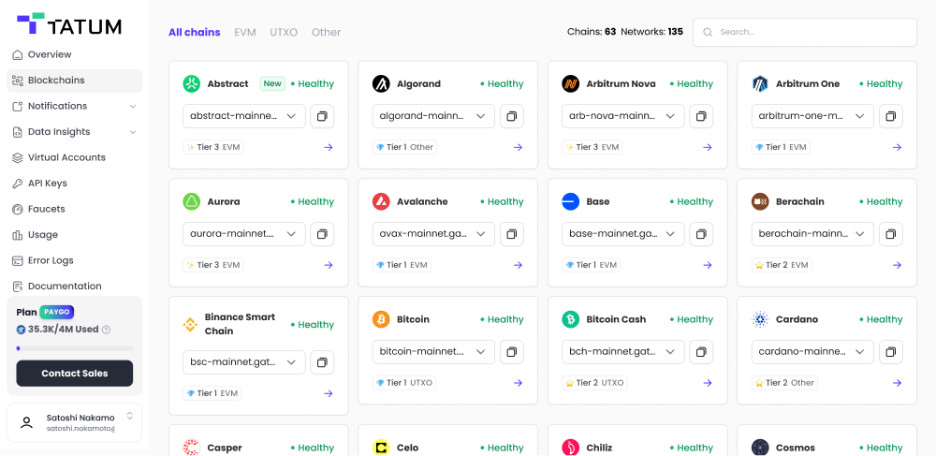
Top Features
- Multi-chain abstraction: Unified API for over 100 blockchain protocols.
- High-performance RPC: Fast, reliable RPC endpoints with failovers and geo-balancing.
- Virtual accounts: Tools for managing internal transactions and ledger states.
Pros
- Fastest way to prototype and ship basic dApps.
- Massive network support (100+ chains).
- Strong suite of basic blockchain functions (NFTs, Wallets).
Cons
- Lack of native workflow automation; requires custom-coded orchestration.
- Centralized reliance on their servers for critical API calls.
- Tiered pricing model can lead to over-provisioning costs.
Kwala: The agentic automated backend
Kwala is the first decentralized, sentient automation engine to address the limitations of centralized Web3 infrastructure by building the logic layer as a first-class, decentralized protocol. focuses on the automation of multi-step, event-driven business logic, not just transaction submission.
Top Features
- The only workflow automation protocol for Web3: Define complex logic in simple YAML; no custom backend services needed.
- Decentralized, credit-based system: True Web3 resilience with no vendor lock-in.
- Pay-as-you-go model: Only pay for successful workflow execution.
- Web3/Web2 bridge: Seamlessly sync on-chain events with off-chain API calls and vice versa.
Pros
- True decentralization and no vendor lock-in for mission-critical logic.
- Unbeatable cost-efficiency with pay-as-you-go execution.
- Native workflow orchestration, which is the future of event-driven Web3.
Cons
- As a decentralized system, Kwala relies on a consensus or verification process among nodes to ensure trustless execution.
Verdict: Reading the chain or responding to it?
Tatum is the API workhorse that helps you move data. For a straightforward dApp that mostly reads data and executes simple transactions, it’s a powerful tool and an infrastructure enabler.
Kwala is the proactive partner that runs your logic. For any dApp that requires conditional, multi-step, event-driven processes, from DAO governance to DeFi liquidations, Kwala is the invisible executor that turns complexity into flawless outcomes.
Which Web3 technology you will choose for workflow automation will depend on your exact requirements. However, if you’re looking for full control of outcomes without the hassles of coding, Kwala is your solution.
Decentralization is an architectural choice
The true promise of Web3 isn’t just decentralized data; it’s decentralized execution. API providers like Tatum operate as a static service layer.
They simplify connectivity and transactions, but you’ll still need to write and host significant custom code to achieve complex outcomes. They are a tool to access the chain, not a partner in running your business logic.
Kwala fundamentally changes this dynamic. It is the first protocol built to enable agent-driven automation of your workflows. Instead of passive APIs, Kwala utilizes sentient, proactive execution nodes that continuously monitor events and automatically trigger the next steps according to your declared logic.
Ready to explore a decentralized, no-code automation engine for your dApp? Book a demo to explore the Kwala platform.
FAQs
1. How does Tatum connect Web3 and Web2 workflows?
Tatum uses Webhooks to send real-time blockchain event notifications to a developer’s chosen off-chain (Web2) endpoint defined by the developer. This allows off-chain systems to react to on-chain activity, but the actual logic and automation still require custom backend handling.
2. What is Tatum’s pricing model?
Tatum uses a subscription-based model with tiered usage, offering a “Pay as You Go” plan where credit usage is tracked monthly. Kwala has a similar credit-based system.
However, Kwala ties credits directly to workflow execution, keeping costs more transparent for developers.
3. Which is a better backend platform: Tatum or Kwala?
Tatum is a good API provider for simplified connectivity. However, Kwala is better for teams needing decentralized, event-driven automation because it handles the full workflow orchestration without backend coding.