
 book a call with us
BNB keeps the on-chain work smooth, though the backend is where the complexity really starts to appear. The moment you need your dApp to react, to trigger a workflow, call an API, or send a transaction – everything slows down. You end up juggling scripts, maintaining servers, and babysitting cron jobs that keep breaking. What if your backend could listen to every BNB event, […]
Read MoreEvery Web3 developer knows the struggle. You start with an exciting idea, then spend days fighting RPC errors, testnet tokens, and endless on-chain configs. The vision is clear, but the setup? A nightmare.
But there’s a solution to this. Ethereum on-chain! It’s the foundation of the decentralized internet – powerful, secure, and backed by the largest blockchain community. But here’s the catch: building efficiently on Ethereum still takes time.
Kwala changes that. A no-code workflow automation platform built for developers who’d rather build products than infrastructure.
In this guide, we’ll explore how to build on Ethereum on-chain, the supported testnets and mainnets, and how Kwala helps you do it all faster and smarter.
Why choose Ethereum on-chain
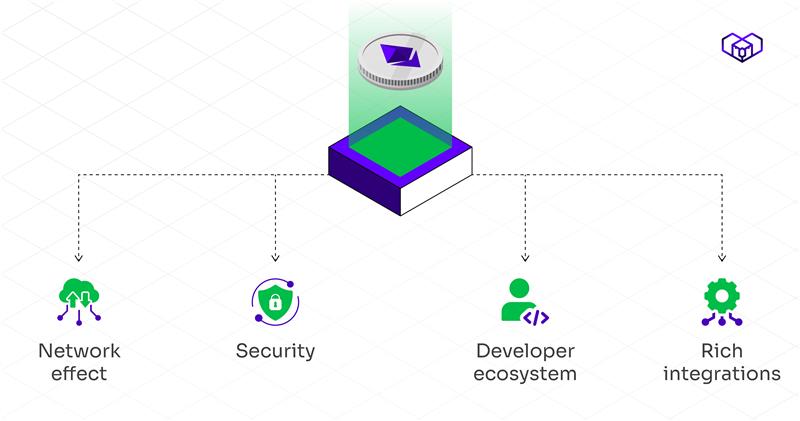
If you’re building in Web3, starting with Ethereum on-chain just makes sense. It’s the most trusted and widely adopted blockchain, powering everything from DeFi apps to NFT ecosystems.
With its proven stability and an unmatched developer community, Ethereum provides your project with a solid on-chain foundation to grow on.
Here’s why developers choose Ethereum:
- Strong network effect: Millions of active wallets and global adoption make Ethereum the go-to chain for decentralized innovation.
- Battle-tested infrastructure: Years of audits, upgrades, and real-world use make it one of the most secure smart contract platforms.
- Massive developer ecosystem: Endless open-source tools, libraries, and frameworks reduce setup time.
- Rich ecosystem: From DAOs to DeFi, Ethereum offers integrations and liquidity that newer chains still lack.
Altogether, these advantages make Ethereum a dependable foundation for teams building long-term in Web3.
Why Kwala makes this easier
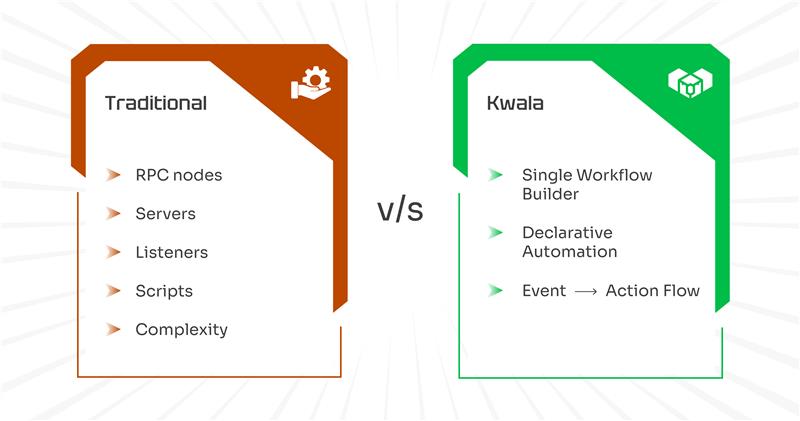
While building on the Ethereum on-chain has its own advantages, you can make the entire process far easier with Kwala. It removes the backend burden, automates every on-chain trigger, and enables your workflow to run without additional infrastructure.
Here’s why Kwala makes Ethereum development dramatically simpler:
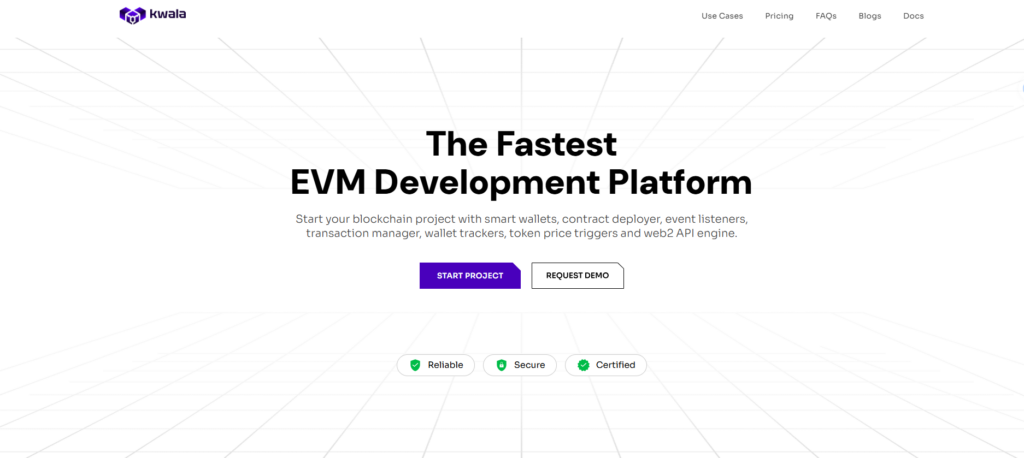
- No-code workflow automation: Build backend logic visually, no servers or webhooks needed.
- Multi-chain orchestration: Run actions across Ethereum, Polygon, and Arbitrum without extra setup.
- Declarative workflows: You decide what happens, Kwala handles how it happens.
- Faster time-to-market: Spend less time fixing infra, more time building.
- Seamless scalability: Automate Web3 interactions and blockchains across testnets and mainnets.
For early decentralized teams, it’s the fastest way to go from idea to deployment.
Supported chains on Kwala
Kwala doesn’t limit you to Ethereum alone. Its multi-chain support lets your on-chain project grow across any blockchain without extra backend work.
Because everything is decentralized, no code, and powered by Web3 workflow automation, you can build and manage logic across networks from a single place.
Below are the chains Kwala supports for both testnet and mainnet:
- Ethereum (Mainnet & Sepolia Testnet): The core of the decentralized ecosystem. Use Sepolia to test transactions safely before going live on the main network.
- Polygon (Mainnet & Amoy Testnet): An EVM-compatible chain known for lower gas fees and faster transactions. Ideal for scaling your on-chain apps.
- Arbitrum (Mainnet & Sepolia Testnet): A Layer 2 scaling network that brings Ethereum’s security with near-instant transaction speed and reduced costs.
- Multi-chain orchestration with Kwala: Beyond these, Kwala supports multi-chain logic through YAML workflows, meaning you can automate actions across different chains in a single setup.
From testing on Sepolia to deploying on Polygon or Arbitrum, Kwala ensures your Web3 project runs smoothly at every stage, without the hassle of backend development.
How to build: Step-by-step workflow
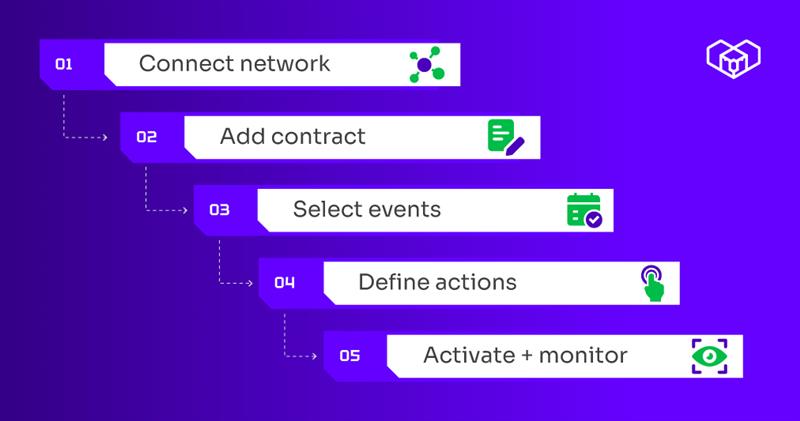
Now it’s time to start building. We’ll walk you through each step of the on-chain development process and show exactly how Kwala fits in to simplify, automate, and connect everything behind the scenes.
Here’s how to get started:
Step 1: Connect to metamask wallet
Open kwala website and connect your metamask wallet.
Approve the connection request in your MetaMask wallet to link it with the KWALA network.
Step 2: Configure trigger for Kwala workflow using Workflow buildler
Select “Event” as Workflow Trigger and complete Trigger Configuration by providing Smart Contract address, Chain ID and Trigger Event details.
Kwala auto detects the ABI for verified contracts and fetches event details.
Optionally, you can provide source code for the Smart contract and configure Trigger Event details.
Step 3: Define your actions
Attach the actions that should run after each trigger: send an API request, update data, notify users, or launch cross-chain flows on Polygon, Arbitrum, Base, or BNB.
All done through a no-code, decentralized automation layer.
Step 4: Activate and monitor
Turn on your workflow and watch Kwala execute everything instantly. Track logs, action status, retries, and event flow from one clean dashboard.
From setup to execution, you never write a backend, run a server, or manage a listener again. Kwala handles every moving piece behind your Ethereum contract, giving you fast, stable, and scalable Web3 workflow automation.
Scale Ethereum on-chain ideas with no-code workflows
Ethereum on-chain remains the heart of the decentralized world, but building on it can feel like a maze of RPCs, servers, and backend chaos. Kwala makes it simple with no-code workflow automation, turning complex blockchain builds into smooth, plug-and-play processes across Ethereum, Polygon, and Arbitrum.
Just remember: always test on Sepolia before mainnet deployment, keep your YAML workflows clean, and log every on-chain event for smoother debugging.
With that, you’re all set to build faster, scale confidently, and launch smarter.
Ready to skip the backend grind? Sign up on Kwala and start building today.
FAQs on Ethereum on-chain
What chain is Ethereum on?
Ethereum runs on its own blockchain, a decentralized network that powers on-chain smart contracts and transactions.
What are ETH on-chain coins?
ETH on-chain coins refer to native tokens that exist and move directly on the Ethereum blockchain through decentralized transactions.
Why is Ethereum falling?
The Ethereum price can dip due to market volatility, shifting investor sentiment, or liquidity changes across the wider Web3 and blockchain ecosystem. Macroeconomic trends, network activity, or major updates can also influence short-term price movement.
What does claiming on-chain mean?
Claiming on-chain means completing a verified transaction directly on a blockchain to receive tokens, rewards, or assets in your wallet. It ensures the action is decentralized, transparent, and permanently recorded through a secure transaction.