
 book a call with us
You’ve just won a hackathon, your dApp works fine, the wallet connects, transactions go through, maybe there’s even a slick NFT minting flow. The demo is flawless too. Fast forward a few weeks: you’re up late, debugging why events are being missed at 3 AM, your RPC node has gone down again, and you’re drowning in server maintenance tickets instead of shipping features. Sound familiar? The gap between a production […]
Read MoreBuilding on Polygon often feels smooth at first: its fast, low-cost Layer 2 environment is designed for scalable dApps. However, even with Polygon’s speed, developers hit friction when centralized infrastructure can’t keep up with critical, real-time events.
The result: slow momentum for time-sensitive tasks.
What you need instead is a decentralized, low-code automation protocol like Kwala. This platform instantly reacts to events on Polygon, automating logic that links on-chain triggers to off-chain actions.
In this blog, we discuss why traditional backends cause friction when building on Polygon and how Kwala’s decentralized, automated model helps solve it through smooth workflow orchestration.
To understand this, let’s first examine what makes traditional backends limiting.
Why traditional backends slow you down on Polygon
Imagine you’re in a hackathon on the testnet or launching a mission-critical decentralized finance (DeFi) product on the Polygon mainnet. If you’re using a traditional backend, you’ll need to depend on manual coding and centralized polling for every workflow. The painstaking process will include:
- Setting up RPC nodes or indexing services.
- Writing custom listeners to poll the contract for events.
- Building serverless functions to handle off-chain logic.
- Managing infrastructure to ensure uptime.
Kwala eliminates all of it. Let’s take a scenario: a user deposits $10k+ into the Polygon vault (the on-chain event). Instead of writing custom code, Kwala lets you simply define the flow by:
- Automatically triggering a multi-step workflow
- Performing a security check and syncing the user ID to your off-chain database
- Instantly reacting by sending a Slack notification to the risk team via a Web2 API call.
Kwala gives your Polygon application the competitive advantage of automation by eliminating the need for manual, complex infrastructure setup.
Traditional vs. low-code automation: which is better for building on Polygon?
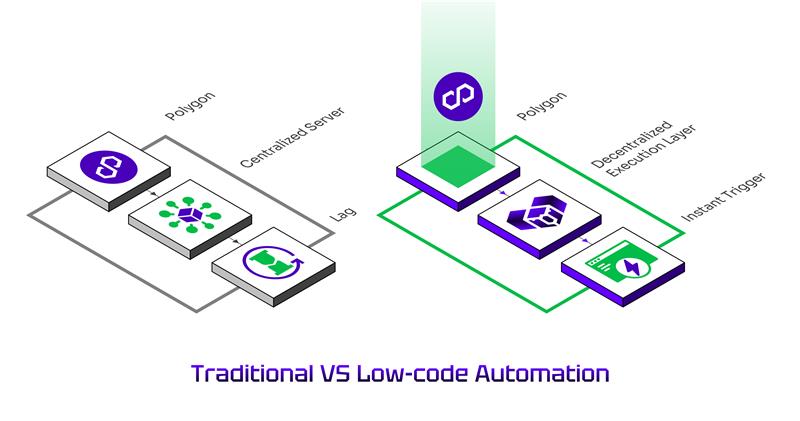
The benefits of using Polygon get diluted when your infrastructure model is outdated. Older backends require painstaking manual coding; Kwala eliminates the effort by building and automating your necessary workflows.
Here are some differences between traditional backends and low-code automated ones:
| Feature | Traditional Backend (Centralized/Custom Code) | Kwala (Decentralized Low-code Automation) |
| Setup and deployment | Manual setup of RPC nodes, indexing, and custom servers. Months of development time. Vendor lock-in is standard. | Defines logic in a visual flow builder. Deployment is instant and decentralized. No vendor lock-in. |
| Pricing model | High, fixed-cost infrastructure fees. You pay for idle server time and maintenance. Unpredictable scaling costs. | Pay-as-you-go credit system. You only pay for the execution actions Kwala takes. Budget is agile and cost-efficient. |
| Web2 API integration | Complex, secure wrapper code must be written for every API call. High security risk and maintenance overhead. | Seamless, secure integration with Web2 API calls right within the automated workflow. |
| Developer focus | Focused on writing and maintaining infrastructure code. | Focused entirely on product logic and user experience. |
Integration guide: build on Polygon in 4 simple steps
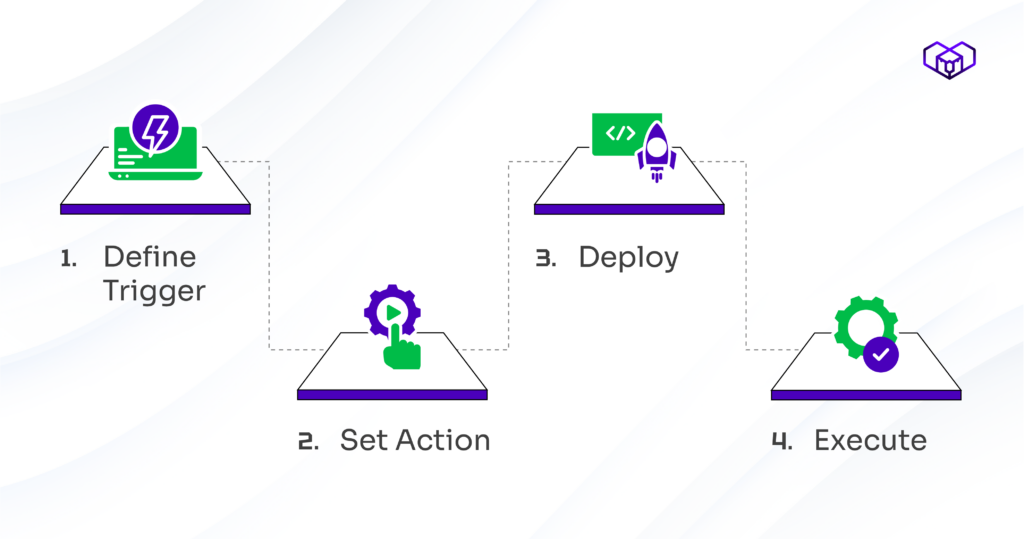
Kwala orchestrates complex, internal maintenance and self-correction tasks for your dApps running on Polygon. This allows your smart contracts to become self-sufficient, reacting not just to user activity, but to time, price changes, or specific internal states.
Step 1: Define the time-based trigger
You define a time-based trigger, telling the engine to listen for a specific condition (e.g., every 24 hours, or when the token price drops below X). You can also automate token price-based notifications for traders or investors using similar logic in Kwala.
Step 2: Set the on-chain action (Internal Function Call)
In the actions section, you configure an internal on-chain action. Kwala enables you to define an action that directly calls a function within your smart contract [e.g., rebalancePool() or claimFees()]. The event data (often just the timestamp or the current state) is packaged for the function call.
Step 3: Activate and deploy
With the end-to-end logic defined, you deploy and activate the workflow. This registers the script on Kwala’s decentralized execution layer, making it an invisible executor that manages your contracts autonomously.
Step 4: Execute and repeat
Kwala immediately begins to listen (for the set time interval) and react (by making the function call). When the condition is met on Polygon, the logic executes instantly. Your wallet is charged only with execution credits when the logic triggers and executes, i.e., pure pay-as-you-go efficiency for contract maintenance.
Take the leap to automated outcomes with Kwala
The problem is simple: your Web3 ambitions are constrained by a Web2 backend model. Building on fast, scalable networks like Polygon should mean agility, but traditional infrastructure introduces manual coding overhead, high fixed costs, and crippling vendor lock-in.
Kwala is the decentralized backend for Web3, the only protocol providing true workflow automation. Kwala’s solution is a pay-as-you-go, credit-based system that runs as an invisible executor, always listening and immediately reacting to your on-chain events. It supports native Web3 logic, connects to Web2 APIs, and works smoothly across all major blockchain networks.
(Image: Kwala website screenshot)
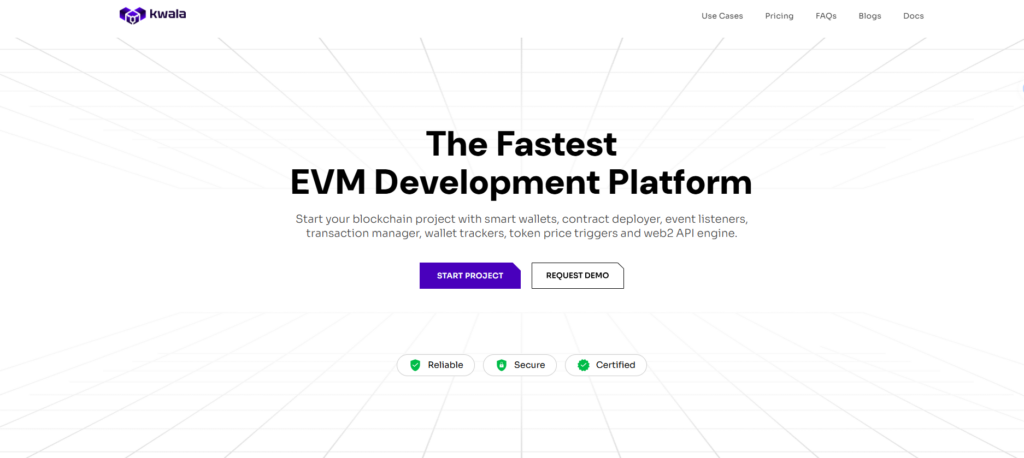
Shift from managing infrastructure to defining outcomes. For teams moving past traditional backends, Kwala’s protocol functions as a practical, effective alternative!
FAQs
1. What can be built with Kwala’s Workflow Automation?
Kwala enables you to build automated, event-driven backends for Polygon dApps, powering everything from DeFi liquidation bots to NFT reward distribution and DAO governance.
2. How can I connect my Polygon wallet to Kwala?
You can connect your Metamask wallet to Kwala network and Approve the connection request in Metamask, allowing Kwala to monitor on-chain activity and execute actions on the Polygon network via signature requests.
3. What are some examples of automated apps built on Polygon with low-code automation?
Developers can use Kwala’s low-code workflows to create DeFi yield harvesters that automatically call claimFees() when a contract state is met, or NFT airdrop systems that trigger off-chain rewards based on on-chain mint events.