
 book a call with us
Your liquidation protection logic executes on-chain. The collateral ratio drops, the contract triggers, and the position closes within the same block. But your monitoring dashboard still shows the old state because your polling script runs every 30 seconds, and you just missed the window. DeFi developers face this gap constantly. The blockchain operates in real-time, […]
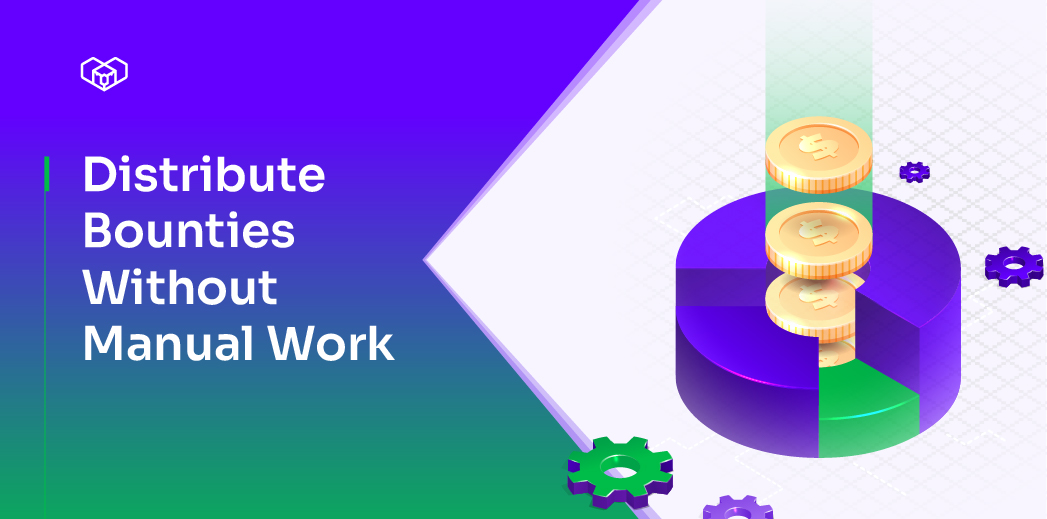
Read MoreWhen your app depends on fast user actions, manual bounty payouts can feel painfully slow. Teams often find themselves tracking every event, checking every wallet, and approving every reward – work that becomes chaotic the moment users interact frequently.
These delays don’t just add operational load; they interrupt the real-time experience that players and community members expect. One small pause in payout timing is enough to break the momentum of a game, a quest, or any reward-driven flow.
That’s why automating bounty rewards has become essential. With Kwala listening to on-chain events in real time, payouts execute instantly: no servers, cron jobs, or backend scripts.
This blog walks through how to automate bounty rewards to payers, why it matters, and where Kwala fits naturally into the workflow.
Why automated bounty rewards matter
Bounty systems work best when they’re instant. Delays create doubt, slow down gameplay loops, and force developers to build manual verification layers.
However, the moment you automate the chain of steps – detecting the event, identifying the payer, executing the payout, and notifying the user – you eliminate the operational overhead entirely.
Automation also solves three recurring challenges developers face:
- They no longer need to write backend logic for reward distribution.
- They don’t have to constantly monitor event logs or maintain servers.
- They avoid errors from mismatched triggers, wallet addresses, or timing lapses.
This reliability is a major reason teams search for solutions that support automated bounty distribution and crypto bounty reward automation while staying chain-agnostic and cost-efficient.
How bounty payout automation works in 6 steps
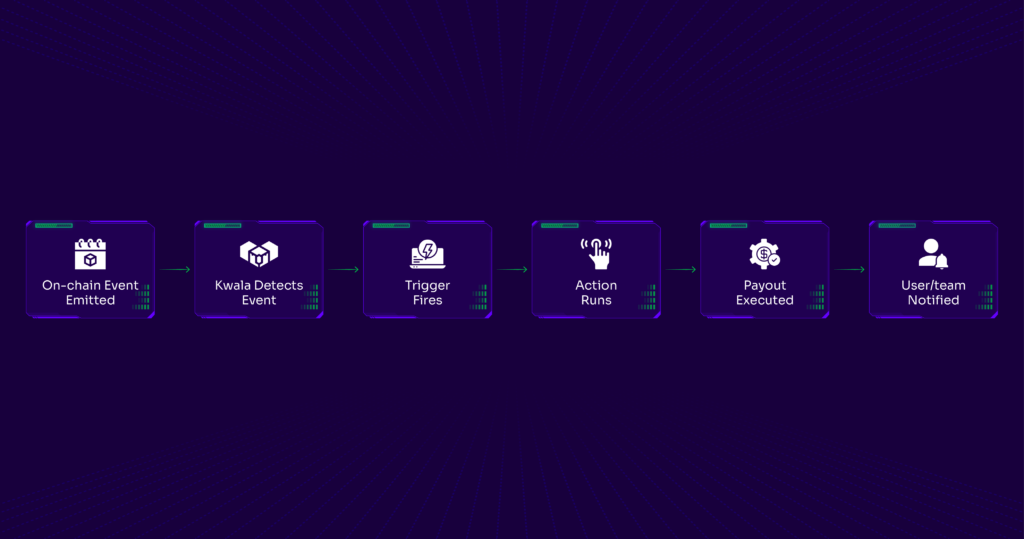
At the core of any automated bounty system is a simple flow: an on-chain action occurs, it emits an event, and that event becomes the trigger for the reward.
Here’s how an automated bounty payout typically works:
1. A user performs an action in the dApp
Whenever a user or participant completes an action that should generate a bounty, the smart contract records the event. This triggers a smart contract function (performSlide) that:
- Stores the player’s wallet address
- Emits an event (slidePerform) containing that address
This event becomes the source of truth for blockchain bounty payouts.
2. Kwala begins monitoring the smart contract
Once the smart contract is published, Kwala continuously listens for the event. Its monitoring engine tracks on-chain activity without requiring any additional servers- something that would be tedious to set up manually.
The moment the event is emitted, Kwala:
- Captures the wallet address
- Reads event parameters
- Initiates the next step in the workflow
This is where bounty reward automation truly begins.
3. The workflow trigger fires
Inside the workflow builder, you define what should happen when that event fires. This includes:
- Selecting the event as the trigger (e.g., slidePerform)
- Setting execution preferences (e.g., run on every event)
- Adding expiry timelines
- The smart contract details (contract ID + chain ID + ABI) are added
Once deployed and activated, Kwala is now listening live for every qualifying action.
4. Kwala calls the payout function
Your first action typically calls a smart contract function that distributes the bounty: whether it’s a token reward, points, credits, or any other incentive. Kwala passes the parameters from the event directly into the contract function, allowing payouts to remain accurate and fully automated.
This step eliminates the need for manual scripts and directly powers automate bounty rewards workflows.
5. A notification is dispatched
The second action can send:
- A webhook
- A Telegram or Discord message
- An email
- A system log
- A dashboard update
This gives your team or your users real-time visibility into successful payouts.
6. The entire pipeline runs without backend infrastructure
Once activated, the entire chain runs in real time:
- User action
- Event emission
- Kwala detects the event
- Payout smart contract is executed
- Notification is sent
Since Kwala uses a no-backend, YAML-driven system, this logic can be deployed in minutes.
How Kwala simplifies bounty payout workflows
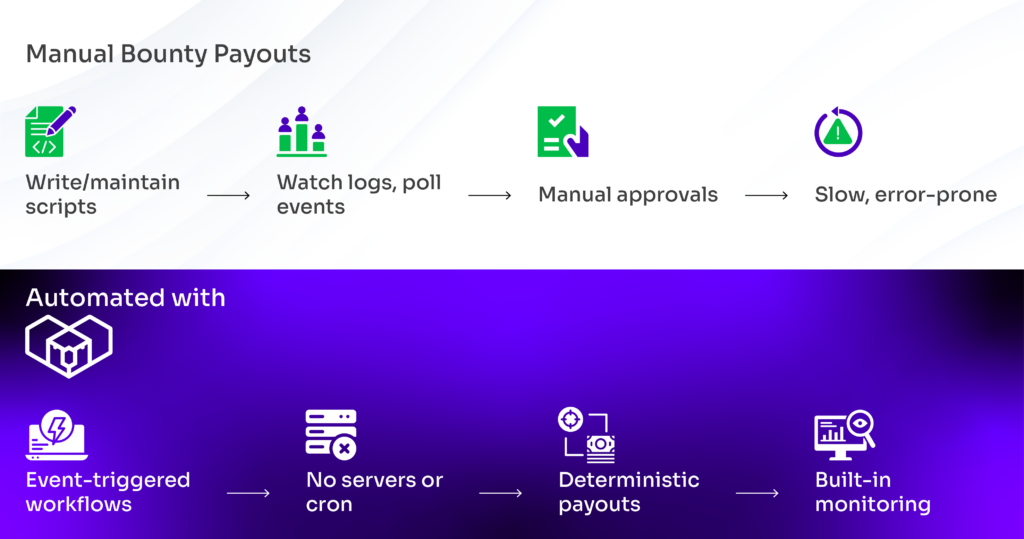
What makes Kwala valuable in bounty automation is not just the execution; it’s the monitoring-first architecture.
Kwala continuously streams event logs from supported chains, normalizes them, and maps them to workflow triggers without requiring developers to:
- Build or maintain a listener node
- Poll for events
- Manage backend infra
- Write retry logic or cron jobs
This capability allows developers to build bounty reward automation pipelines that feel effortless.
| Manual bounty reward systems | Automated rewards with Kwala |
| Requires backend scripts, servers, manual checks | No servers, no backend logic required |
| Delays reward distribution | Rewards execute instantly based on events |
| Higher chances of human error | Deterministic, event-based automation |
| Requires monitoring tools | Built-in on-chain monitoring |
| Complex to maintain | YAML-driven workflows, minutes to deploy |
Kwala handles smart contract calls, API integrations, and cross-system orchestration. It abstracts execution complexity into a unified automation environment, without extra code.
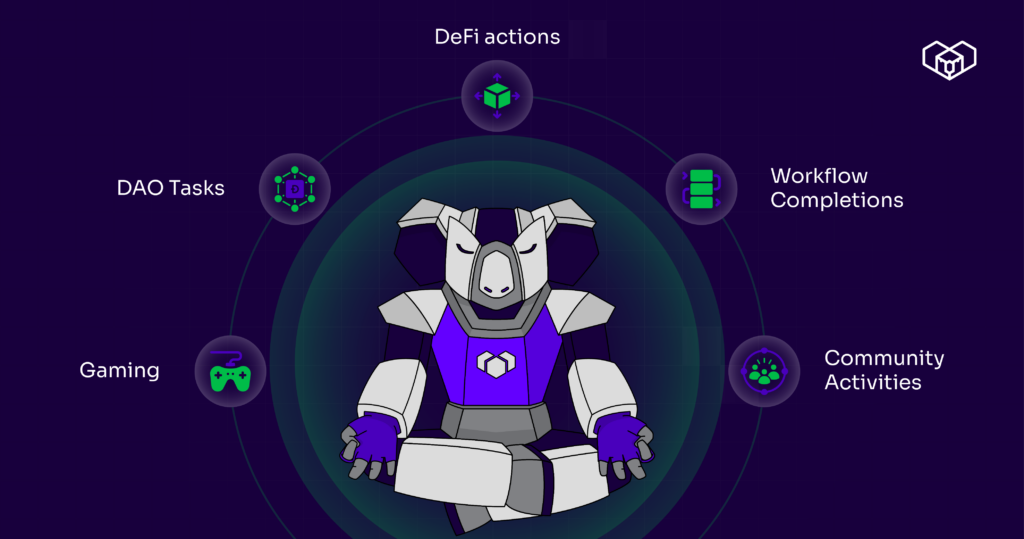
Automated bounty payouts follow the same event-driven pattern, making them useful for:
- Community participation rewards
- DAO task payouts
- DeFi engagement incentives
- Quest and activity-based reward systems
- Tournament participation or leaderboard incentives
- Gaming and interactive app incentives
Solutions like Automate DeFi bounty rewards, Token reward automation for bounty, and DAO bounty reward automation all follow the same pattern.
5 key advantages for Web3 teams
For many teams, bounty payout workflow automation becomes the first automation layer they adopt because it removes the highest amount of manual frustration with the least setup.
Advantages include:
- Deploy workflows in minutes instead of writing backend code.
- Run event-driven automation across chains.
- Avoid complexity of centralized API limits.
- Keep your logic deterministic and tamper-resistant.
- Scale rewards workflows without scaling engineering teams.
A smarter way to run bounty payouts
Automating bounty rewards to payers is one of the clearest examples of how event-driven architecture transforms Web3 development.
A simple event emitted from a smart contract becomes the anchor for payouts, notifications, and user experience flows. When triggers, actions, and event monitoring work together, rewards feel instant, systems stay reliable, and teams build faster.
With Kwala turning on-chain events into programmable workflows, developers can bring production-ready reward systems to life in minutes.
FAQs on automating bounty rewards to payers
1. Can I automate rewards across different chains?
Yes, as long as your smart contract emits events, Kwala can detect them and trigger workflows on supported chains. This lets you automate payouts across ecosystems without managing multi-chain infrastructure.
2. Do I need backend knowledge to automate bounty rewards?
No, workflows are created using simple YAML, so you don’t need servers, listeners, or backend logic. Kwala handles the execution layer while you focus only on the automation logic.
3. What if my payout logic needs additional parameters?
Kwala can pull parameters directly from emitted on-chain events and pass them into your actions. This makes it easy to customize payout logic without modifying your contract or adding extra code.