
 book a call with us
Is your backend infrastructure slowing your decentralized app (dApp) down? Relying on slow, expensive polling scripts or centralized servers means you’re always a step behind. In decentralized finance (DeFi), even a split-second delay can be costly – it could mean missing a transaction or, worse, facing liquidation from an online wallet. However, when your dApp monitors your smart contracts at the block […]
Read MoreStruggling to write recurring codes for Web3 subscription payments?
With the Web3 payment solutions market expected to grow at a CAGR of 28.5% between 2024 and 2032, subscription payments are a non-negotiable feature. Asking users to renew every month manually is a slow path to attrition.
However, your decentralized finance (DeFi) protocol lacks the autonomous, recurring ‘push’ mechanism to trigger token payments reliably. This means you have to rely on manual coding or centralized backends.
But manual coding drains time, introduces edge-case vulnerabilities, and makes systems harder to maintain. Developers end up patching logic every cycle, fixing failed triggers, and monitoring events- all of which slows down feature delivery and increases room for errors.
You can close this revenue gap by switching from a passive infrastructure to a Web3 automation platform like Kwala. This multi-chain workflow automation platform will recognize the recurring payment date, initiate the pre-approved token transfer, and orchestrate the entire process fast and reliably.
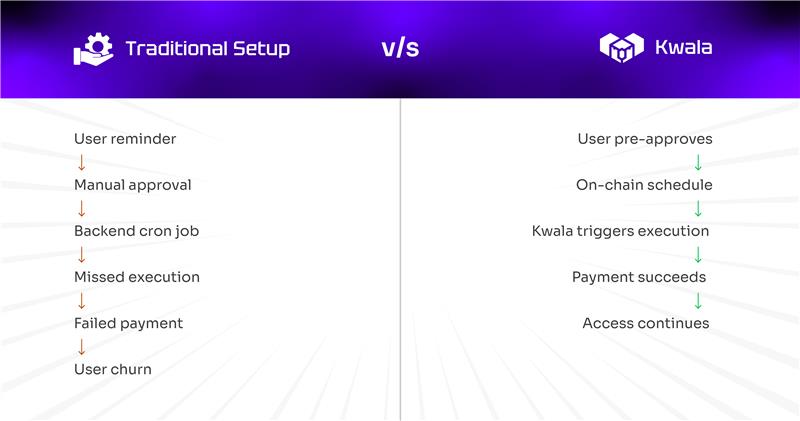
In this blog, you’ll see how workflow engines for blockchain development enable fast and simple recurring payments for Web3.
What are subscription payments, and how do they work?
The future of decentralized commerce is recurring revenue. Web3 demands a rapid shift from unreliable one-off sales to sustainable business models. Subscriptions are the engine of Web2’s most successful companies, offering the predictability required for scaling.
A Web3 subscription payment is a system where a user pre-authorizes a smart contract to periodically initiate a token transfer for continued access to a decentralized service. Subscription payments create automated, predictable revenue streams without dependence on centralized billing providers.
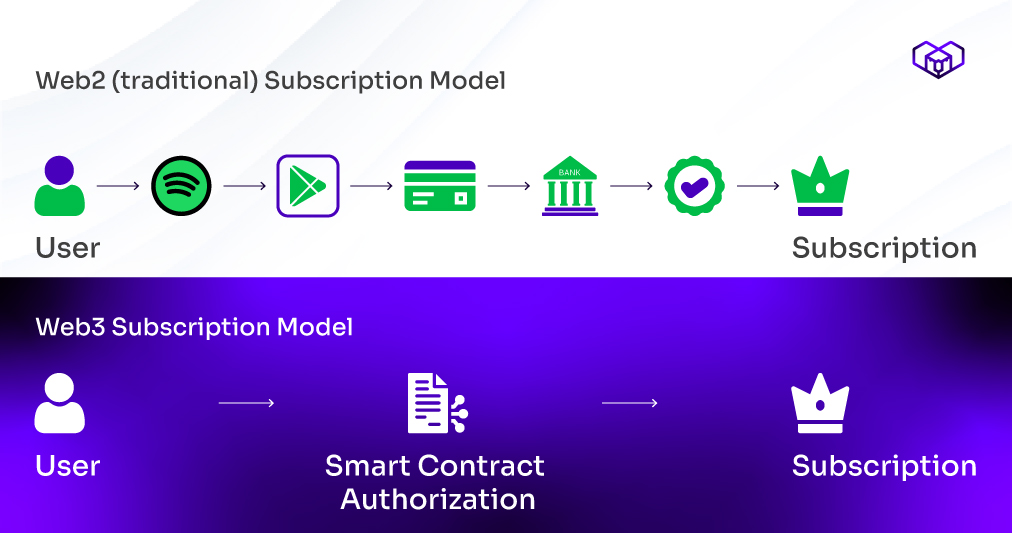
Web3 recurring payments depend on two distinct steps:
1. Authorization: The user grants a designated smart contract approval to spend a specific amount of their tokens on their behalf through a standard approve() function call.
2. Execution: A decentralized execution layer autonomously initiates the transferFrom() action on the exact date and time specified (e.g., the 30th day, every month).
Why automate subscription payments?
Integrating recurring payments into your dApp is where most traditional backends fall short. Why? Because you need an event-driven backend for blockchain apps that doesn’t sleep, lag, or demand manual oversight, i.e., a wallet that just knows when to pay. A centralized server or a standard smart contract workflow automation won’t be able to proactively trigger this without volumes of manual code.
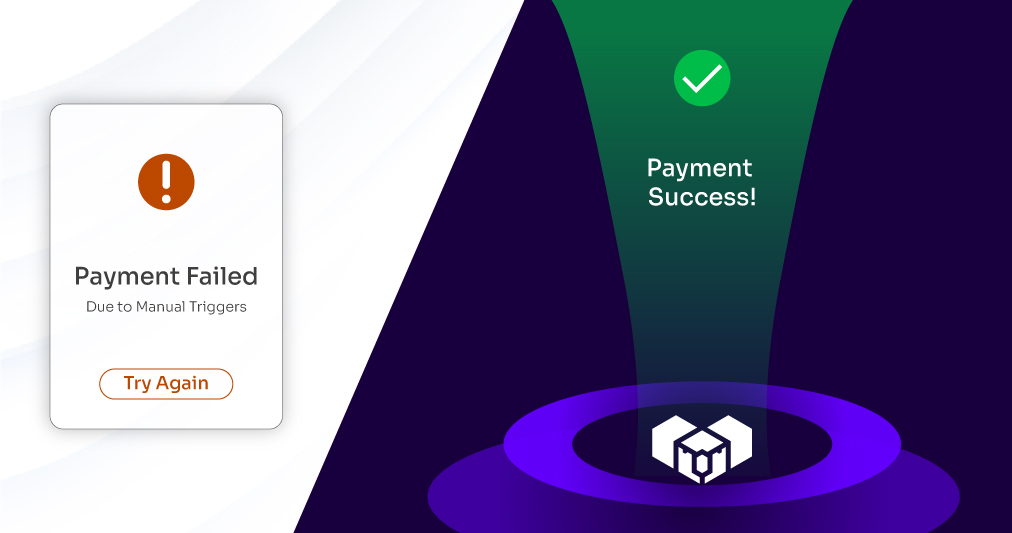
A dashboard showing “FAILED PAYMENT” due to manual triggers vs. “SUCCESS” from automated execution.)
The friction leads to failure points that are seen everywhere. The makeshift attempts to handle subscriptions break down fast because they lack a dedicated, strong workflow engine for blockchain development.
Kwala breaks this bottleneck. It is the intelligent executor: the decentralized event listener backend that constantly syncs the chain state and executes the critical action precisely on schedule.
We turn around the four major issues with traditional backends into simple solutions:
- Vendor lock-in and centralization – open and unified.
- Unpredictable costs pay-as-you-go model.
- Single-chain limits- multi-chain workflow automation.
- Code overhead – workflow orchestration.
Automating subscription payments with Kwala: a step-by-step guide
This flow, managed entirely by Kwala, ensures that funds are settled, services are notified, and the user receives automatic confirmation.
Here’s how to set it up:
Step 1: The event trigger
The booking is confirmed, but the journey hasn’t started. Kwala listens for the specific BookingConfirmed event emitted by your dApp’s smart contract on the Ethereum or Polygon network.
Step 2: On-chain settlement and split
The first action is critical: funds must be distributed immediately to all parties: the platform, the vendor (airline/hotel), and any referral partners.
Kwala executes a call to the multisig contract, triggering a pre-defined function to sync and split the payment instantly. This on-chain split payment automation is trustless and verifiable.
Step 3: Off-chain fulfillment with Web2 API
The execution doesn’t stop at the blockchain. Kwala then uses its native API capabilities to connect with your existing Web2 services in parallel.
Kwala triggers two simultaneous API calls: one to SendGrid to fire off the detailed itinerary email, and another to Salesforce to update the customer’s record with the new booking ID and revenue data.
Step 4: Final confirmation and audit
The entire workflow, from listening to execution, is cryptographically secure and auditable. Kwala acts as the invisible executor, coordinating Web3 payments and Web2 fulfillment in one reliable flow.
Recurring payments are the new reality with Kwala
Are you going to wait for the right platform to build your dream dApp? Kwala is not just a platform; it is the real-time blockchain workflow backend your dApp economy requires.
It is the dApp orchestration tool that eliminates manual burdens and centralization risks, replacing them with predictable, automated revenue streams. Kwala empowers you to build ambitious, multi-chain services with confidence, knowing the invisible executor is constantly at work.
From complex logic to simple subscription triggers, Kwala ensures that when you build, you build to scale.
Explore multi-chain workflow automation for your dApp today!
FAQs
How does Kwala manage the gas fees for automated, recurring subscription payments?
Kwala uses a decentralized, credit-based execution model. Instead of paying unpredictable gas fees for every single execution, you pre-load credits, and Kwala deducts them only when the payment workflow successfully executes. This ensures a predictable, pay-as-you-go model for your recurring revenue streams.
If Kwala executes my payments, does that mean I’m locked into a centralized vendor?
Absolutely not. Kwala is built as a decentralized execution layer, making it the only workflow automation protocol for Web3 designed to prevent vendor lock-in. Your smart contracts and assets remain non-custodial and secure, orchestrated by our network of invisible executors.
Can I use Kwala to trigger off-chain actions, like sending an email after a subscription payment?
Yes. Kwala is a powerful dApp orchestration tool that seamlessly supports both on-chain and off-chain logic. You can easily define subsequent actions in your workflow YAML to trigger Web2 API calls, ensuring your entire business process syncs instantly across all required services.