
 book a call with us
When your app depends on fast user actions, manual bounty payouts can feel painfully slow. Teams often find themselves tracking every event, checking every wallet, and approving every reward – work that becomes chaotic the moment users interact frequently. These delays don’t just add operational load; they interrupt the real-time experience that players and community members expect. One […]
Read MoreWeb3 applications don’t fail because of weak smart contracts. They slow down when everything around those contracts (event tracking, automation, and cross-chain coordination) becomes too complex to manage. This is especially true for DeFi protocols and DAOs, where backend logic must react instantly to on-chain activity while remaining transparent and decentralized.
Kwala addresses this gap by positioning itself as a low-code Web3 backend platform that turns blockchain events into automated workflows. Instead of building servers or stitching together multiple tools, developers define logic once and let Kwala handle monitoring, execution, and orchestration across chains.
At its core, Kwala exists to simplify how Web3 backends are built: without abstracting away the control that DeFi and DAO teams depend on. This blog breaks down how Kwala simplifies Web3 backend complexity for DeFi and DAO teams using low-code, event-driven workflows.
Why DeFi and DAOs need a different backend approach
DeFi and DAO systems operate on constant on-chain signals: liquidity thresholds, proposal votes, repayments, staking activity, or governance outcomes. Each of these emits events that must trigger actions reliably and in real time.
Traditionally, this required custom indexers, backend services, and infrastructure that teams must maintain long after deployment. Over time, backend complexity has grown faster than protocol logic itself.
Kwala reframes this problem by functioning as a blockchain workflow engine that continuously monitors on-chain events and reacts the moment predefined conditions are met. For builders, this means less time spent maintaining infrastructure and more focus on protocol design and governance logic.
Event monitoring as the foundation
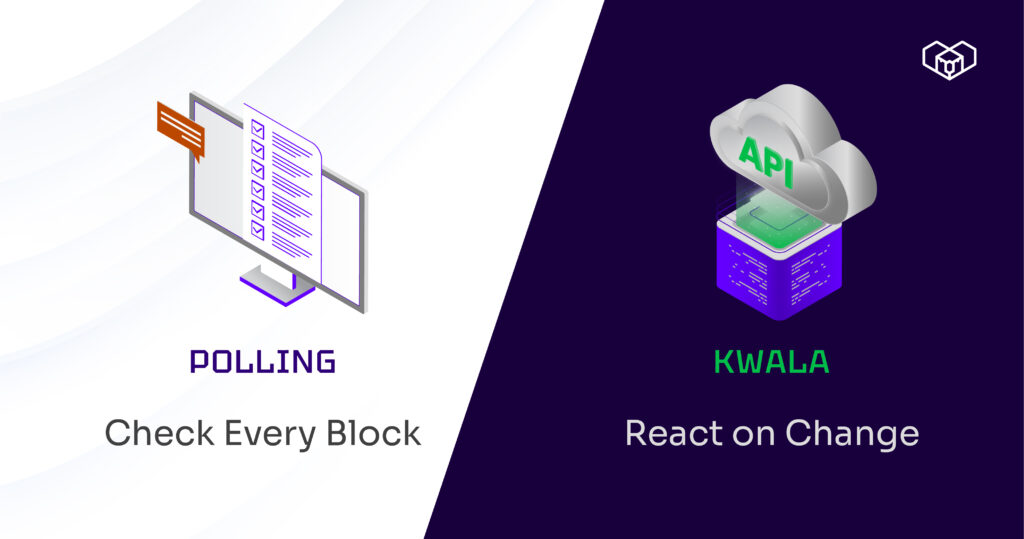
Everything in Kwala starts with monitoring. As a Web3 API provider, Kwala streams and processes blockchain data directly, allowing workflows to listen for specific contract events, block conditions, or address-level activity.
When an event occurs, Kwala executes the associated workflow immediately. There is no polling, cron-based delays, and separate listener setup. This monitoring-first architecture is particularly valuable for DeFi use cases where timing and determinism matter: such as liquidations, reward distributions, or compliance-related actions.
By abstracting event ingestion while keeping logic explicit, Kwala becomes a reliable Web3 infrastructure for developers building systems that must respond to blockchain state changes in real time.
Low-code workflows instead of backend sprawl
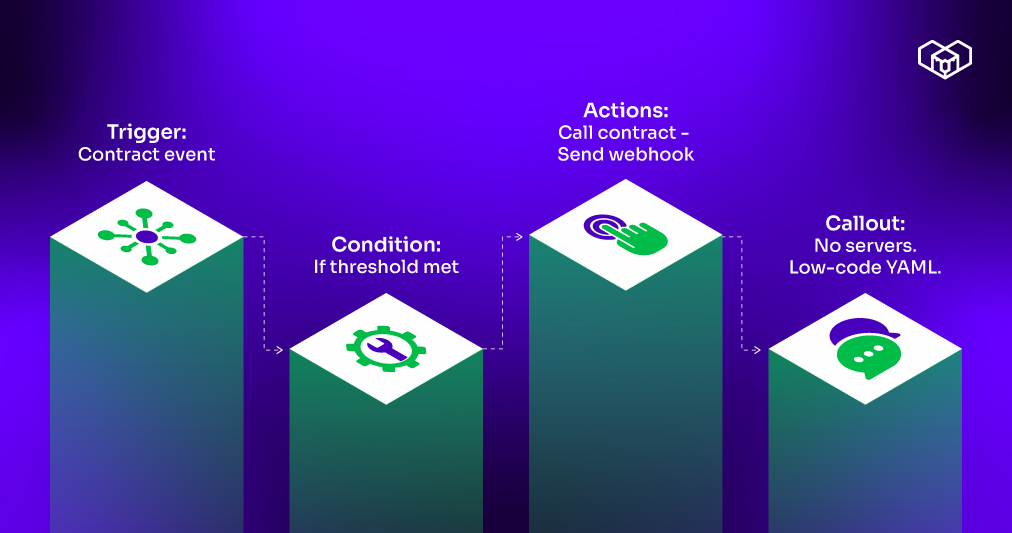
Rather than forcing developers into rigid abstractions, Kwala adopts a low-code approach using KWALA YAML workflows. These workflows define backend logic declaratively, making them easy to understand, audit, and evolve.
Each workflow specifies:
- Which on-chain event should be monitored
- What actions should follow
- How those actions should execute
This structure gives teams the flexibility of a KWALA programmable Web3 backend without the overhead of writing and maintaining traditional backend code. For DAOs managing governance flows or DeFi teams automating protocol operations, this balance of simplicity and control is critical.
Multi-chain logic without multi-backend systems
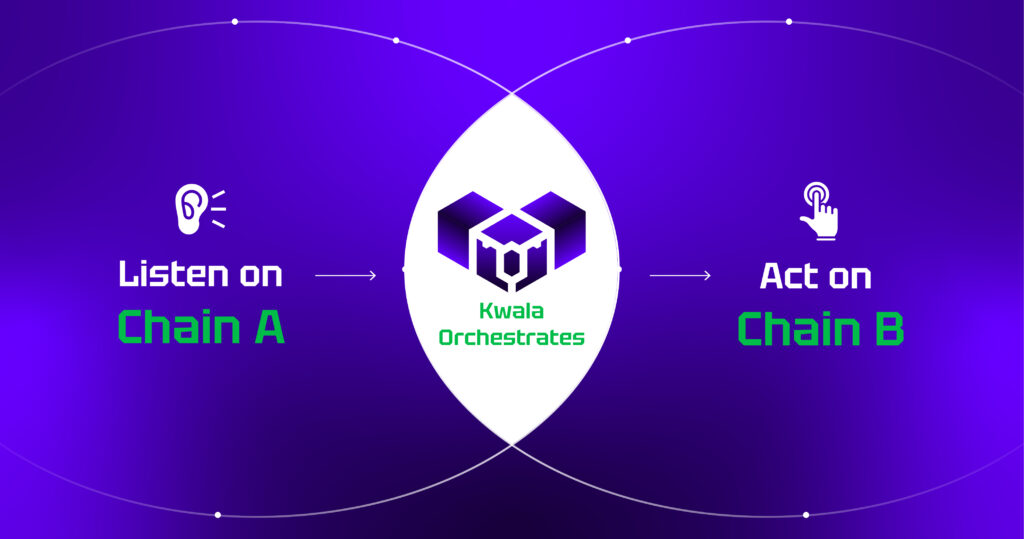
As liquidity and users spread across ecosystems, most serious Web3 products operate on more than one chain. However, multi-chain support often means duplicating backend infrastructure for each network.
KWALA multi-chain workflow engine avoids this by allowing a single workflow to listen on one chain and execute actions on another. Developers define logic once, while Kwala handles orchestration across supported Layer 1s and Layer 2s.
This capability is especially relevant for DAOs coordinating activity across governance and execution layers, or DeFi protocols balancing cost efficiency and settlement security across chains.
Serverless, without losing control
Kwala removes the need to provision or manage servers entirely. As a KWALA serverless Web3 backend, workflows are executed by a decentralized network that ensures reliable and conflict-free execution.
Each deployed workflow is claimed by a single node at runtime, preventing duplicate execution and race conditions. This execution model aligns well with financial and governance use cases where consistency and predictability are non-negotiable.
The result is a backend layer that behaves like backend as a service for Web3, while remaining aligned with decentralized principles.
Designed for builders at different levels
Kwala’s low-code design makes it accessible without being restrictive. For teams that want minimal setup, it allows workflows to be created through structured configuration rather than programming.
At the same time, developers who need deeper customization can import and reuse workflows, making Kwala a practical low-code blockchain backend for evolving DeFi and DAO systems.
This flexibility allows Kwala to support everything from early-stage governance experiments to production-scale financial protocols.
A backend layer that matches Web3’s pace
By combining continuous monitoring, declarative workflows, and multi-chain execution, Kwala positions itself as a KWALA Web3 backend built for modern decentralized applications.
Instead of reacting to blockchain data after the fact, Kwala enables systems that respond as events occur: without forcing teams to manage infrastructure or compromise on decentralization.
For DeFi protocols, DAOs, and emerging Web3 applications alike, Kwala represents a shift toward backend logic that is simpler to build, easier to maintain, and better aligned with how blockchains actually operate.
FAQs on low-code Web3 platform
How does Kwala handle upgrades when a smart contract’s logic changes?
Kwala workflows reference contract addresses and events, so teams can deploy updated contracts and point new workflows to them without rewriting backend infrastructure or migrating servers.
Is Kwala suitable for non-financial DAO operations?
Yes, DAOs use Kwala to automate governance notifications, contributor onboarding, proposal status tracking, and coordination between on-chain actions and off-chain tools.
Is low-code suitable for production-grade Web3 applications?
Yes, when built as an execution layer rather than a visual wrapper, low-code platforms can support production workloads with deterministic behavior and scalable automation.