
 book a call with us
If you’re handling stablecoin transactions, you already know USDC moves fast. And if you’re not watching closely, you’ll miss something important, which can cost you opportunities, revenue, or even security. USDC’s growth alone tells you how high the stakes are right now. Over the last year, USDC in circulation rose by more than 78%, faster than any other major global stablecoin. The faster […]
Read MoreWeb3 feels powerful, but the messy backend work slows every developer down. You juggle scripts, RPC listeners, cron jobs, and quick fixes just to keep your dApp stable. Web3 workflow automation removes this clutter and gives you simple, predictable logic you can rely on.
Tools like Kwala push this even further by offering no-code flows designed specifically for decentralized app automation.
We’ll walk through how web3 workflow automation works, what beginners should understand, and how platforms such as Kwala make automation easier from day one.
What a “workflow” means in web3
A workflow in Web3 is a simple chain of actions that run automatically when something happens on-chain. It’s the core idea behind Web3 workflow automation, where one event triggers the next step without manual effort. Think of it as “IF X happens, THEN do Y,” but built directly into your smart contract logic.
If a wallet receives a token, you can mint a badge NFT. If a DAO proposal passes, you can auto-execute treasury transfers. This assembly-line style flow is what makes decentralized app automation smoother and sets the base for any Web3 automation protocol.
Why web2 automation tools don’t fit web3
You might be wondering why Web2 automation tools can’t simply handle this. The issue is deeper than it looks. Web2 automation simply can’t keep up with how Web3 workflow automation works.
Here’s where Web2 falls short:
- Can’t read blockchain logs, state changes, or smart contract events.
- Runs on centralized servers, while Web3 needs trustless execution.
- Fails to react to token transfers, oracle updates, or contract triggers.
- Forces developers to build heavy backend listeners and monitoring systems.
These limits make a native Web3 automation protocol the only real fit.
What is a web3 protocol dApp workflow automation?
Now we know Web3 needs real workflow logic to keep apps running, but something has to coordinate all those moving parts. A Web3 workflow automation protocol handles this job by watching what happens on-chain and firing the right actions at the right moment.
It doesn’t rely on scripts, random servers, or manual checks. It runs everything through decentralized logic that stays steady even when the ecosystem gets noisy. You can think of it like a smart switchboard that notices an event and instantly sends it to the next step in your dApp.
This keeps the messy backend work out of the way and lets developers focus fully on the product instead of maintaining plumbing.
How Web3 automation works
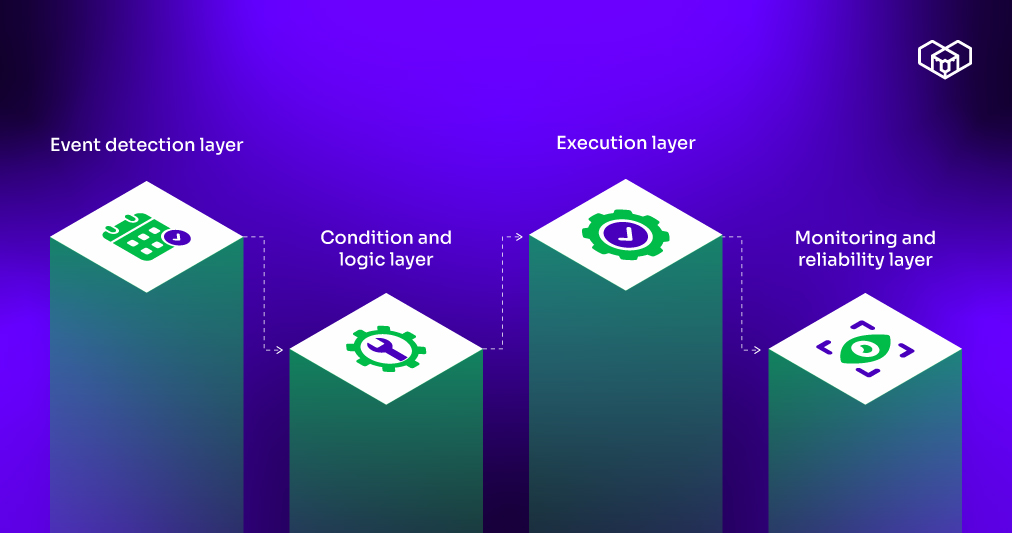
A Web3 automation protocol comprises several key components that enable it to run smoothly. These layers work together to power reliable Web3 workflow automation. They are:
Event detection layer
The protocol listens for on-chain events, logs, state changes, or transactions across multiple networks. It stays alert to every signal your dApp depends on, forming the starting point of blockchain workflow automation.
Condition and logic layer
Rules are checked here: wallet addresses, token amounts, time intervals, or contract states. Branching paths (if/else) shape how the workflow moves forward, giving your workflow engine for Web3 its decision-making power.
Execution layer
This is the layer where actions get carried out, from sending transactions to calling smart contracts or interacting with APIs. The run stays stateless and trustless, which keeps decentralized app automation predictable and clean.
Monitoring and reliability layer
Failures are tracked, missed actions are replayed, and alerts are sent when something needs attention. The system stays steady during network noise, much like a railway control room coordinating signals and routes with precision.
Key features you usually find in these protocols
A robust Web3 automation protocol is equipped with features that streamline automation for developers and teams. These capabilities eliminate backend clutter and transform complex logic into straightforward, reliable workflows.
Here are the features you’ll usually find:
- Real-time blockchain triggers: React to contract events, wallet activity, or state changes instantly.
- Multi-step logic and orchestration: Connect actions in clean sequences without writing glue code.
- Cross-chain workflows: Run logic on one chain based on events from another.
- Smart contract automation: Keep interactions running without redeploying your system.
- Off-chain integrations: Connect to APIs, CRMs, databases, or messaging tools.
- No-code builders: Build workflows visually through drag-and-drop steps.
- Stateless execution: Stop jobs from getting stuck or duplicated.
- Secure, decentralized infrastructure: Reduce risk by avoiding single-server dependency.
All of this translates into fewer moving parts to babysit and a faster path to shipping updates with confidence.
How Kwala makes web3 workflow automation easy
Using tools to automate Web3 workflows makes life easier for developers, and Kwala is one such tool.
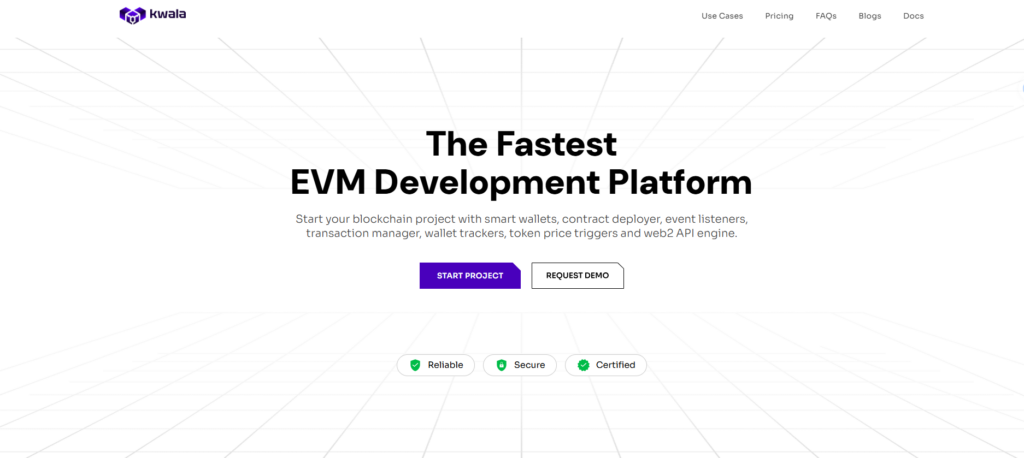
Here’s how it helps:
- Real trigger event-based monitoring: Lets you specify the smart contract, chain ID, ABI, and exact event you want to watch, making Kwala perfect for things like tracking mints, transfers, or state changes.
- Real-time reactions to on-chain activities: Sends alerts or runs actions the moment a contract emits an event, powering clean blockchain workflow automation.
- No backend code required: Removes scripts, listeners, and servers, keeping your Web3 automation protocol setup simple.
- Auto wallet configuration: Connects to MetaMask and auto-sets chain ID 1905 so users never switch networks manually.
- Visual no-code builder: Let’s teams drag steps to create complete workflows without glue code.
- Decentralized execution: Runs reliably on a distributed backend with no single point of failure.
- Cross-chain orchestration: Allows logic to jump between Ethereum, Polygon, Base, and Arbitrum without writing bridge logic.
- Off-chain integrations: Connects workflows to Slack, Telegram, CRMs, APIs, or analytics tools with ease.
Kwala keeps Web3 automation clean, fast, and beginner-friendly while giving advanced teams a lighter path to shipping.
The future of automation in web3
The future of Web3 leans heavily on Web3 workflow automation, with protocols becoming core infrastructure for every decentralized app. They cut through backend complexity, improve reliability, and reduce the engineering load that slows teams down. As ecosystems grow, automation shifts from optional to essential.
Tools like Kwala make this easier by offering a clean, intuitive Web3 automation protocol for building workflows without backend code. The next wave of dApps will run smoother, faster, and more predictably.
Try Kwala to automate your blockchain workflows in minutes
FAQs on workflow engine for web3 decentralized app automation
What is the purpose of workflow automation?
Workflow automation removes repetitive manual steps and lets tasks run automatically. It speeds up execution, cuts down errors, and makes Web3 workflow automation more reliable for both developers and end users.
How does Web3 enhance user control?
Web3 gives users full ownership of their assets, identity, and data. A Web3 automation protocol builds on this by keeping all actions transparent, permissioned, and verifiable on-chain.
What are the three types of workflows?
- Sequential workflows
- State machine workflows
- Rules-driven workflows