
 book a call with us
Someone just swapped tokens on your DeFi protocol. The transaction is confirmed, and the tokens moved from one wallet to another – everything worked as expected. But there is probably something you didn’t see. The smart contract broadcasted specific data about what happened – the wallet addresses involved, the token amounts, and the exact timestamp. This broadcasted data is […]
Read MoreYou are probably here because you are tired of setting up servers, monitoring logs, and dealing with DevOps just to keep a dApp running. Understandably so. The promise of Web3 gets buried under endless backend chores.
But don’t worry, Kwala can help you break that cycle. With it, you skip the heavy lifting and run production dApps without touching or managing a backend as a service for Web3. It works like a full-stack Web3 backend platform, but without the backend part.
In this blog, you will see how that becomes possible.
Why dApps without a no-devops Web3 backend matter
Did you know most Web3 teams spend more time fixing servers than building actual features?
Shocking but true. You can see the problem clearly once you examine the effort required to maintain a Web3 backend. Also, why a no-devops web3 backend is so important.
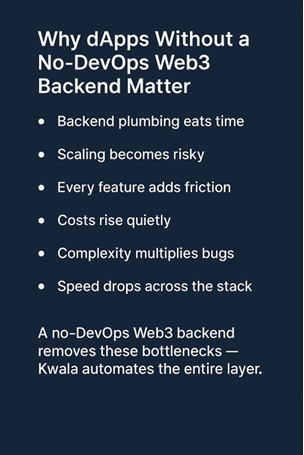
Here are the reasons:
- Backend plumbing eats time: Developers lose hours wiring cron jobs, retries, and queues just to make simple actions run reliably.
- Scaling becomes risky: A small traffic spike can crash your Web3 backend, forcing constant monitoring and firefighting.
- Every feature adds friction: Even tiny updates need new endpoints, new checks, and new backend logic that slow delivery.
- Costs rise quietly: A backend as a service for Web3 still requires maintenance, tuning, and developer oversight.
- Complexity multiplies bugs: A heavier backend creates more surface area for failures, hurting reliability and user trust.
- Speed drops across the stack: It also turns your “simple dApp” into a full engineering project overnight.
When you eliminate the backend layer, you eliminate the need for an ops team. That is why teams choose a full-stack Web3 backend platform like Kwala to run dApps without infrastructure weighing them down.
Kwala explained: Your no-devops web3 backend
If you have ever paused your feature work just to fix a listener, restart a server, or chase down a broken cron job, Kwala will feel like a breath of fresh air.
It provides the experience of a no-devops Web3 backend, as it completely eliminates the operations layer that you would normally maintain. Instead of servers, scripts, and cron jobs, you get simple automated workflows
Here’s what Kwala brings to the table:
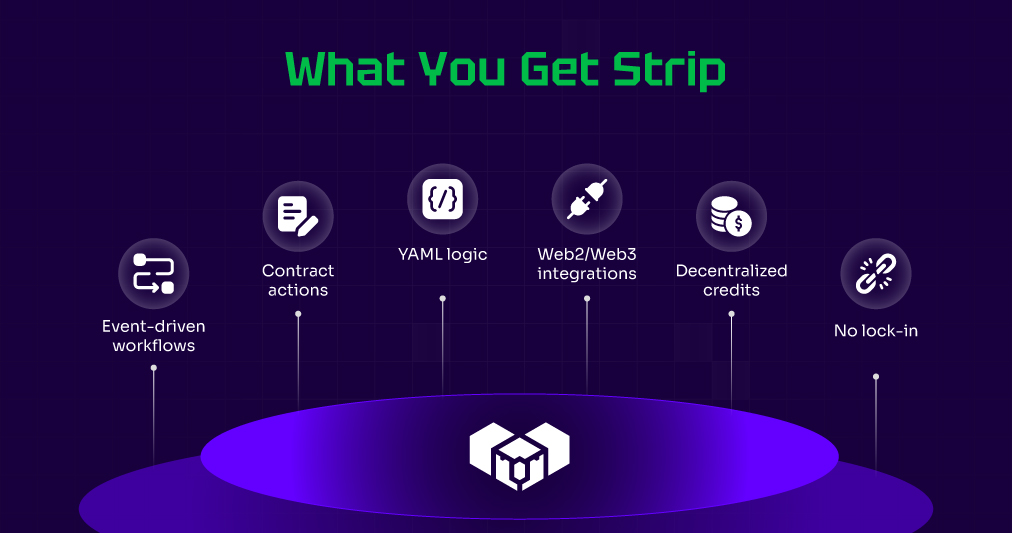
- Event-driven workflows that run your dApp logic with zero servers involved.
- Automated smart contract calls powered by triggers you define.
- YAML-based logic that replaces backend coding entirely.
- Built in Web2 and Web3 integrations for APIs, notifications, and legacy tools.
- A decentralized, credit-based system that removes high upfront costs.
- No vendor lock-in, so you always control how your dApp behaves.
- A pay-as-you-go model that stays budget-friendly while you scale.
- The only workflow automation protocol for Web3, designed for production apps.
Kwala cuts out DevOps from your day-to-day so you can focus on building features, not maintaining infrastructure.
How Kwala lets you launch and run dApps without an ops team
So, how does Kwala actually lets you automate dApps without a DevOps team? The answer is simpler than you’d expect. Kwala turns every repetitive backend task into an automated workflow.
Below is how it handles the work you’d normally assign to ops:
Event listeners that act as your backend logic
Kwala listens to on-chain events exactly the way a DevOps-heavy backend would. Every time a smart contract emits an event, the workflow engine reacts instantly. No servers, no cron jobs, no retries to manage. This is how Kwala operates as a no-devops Web3 backend.
Pro tip: Certificate issuance occurs automatically the moment the registration event is triggered.
YAML workflows instead of backend code
You define the trigger, the action, and the parameters in a simple YAML file. Kwala generates and runs the entire execution layer from it. That’s why it feels like a full-stack Web3 backend platform even though you never write backend code.
Dynamic parameters using regex or index mapping
Kwala passes event data into your workflows automatically. Here’s how it works:
- Extracts parameters directly from emitted events, even when there are multiple arguments.
- Maps each parameter to the correct function input or API field automatically.
- Supports both regex-based extraction and simpler index-based mapping for cleaner workflows.
- Removes the need for custom data transformation code in your backend.
Pro tip: Index-based mapping makes multi-argument events far easier to handle, especially when building fast-moving dApps.
Seamless integration with Web2 APIs
Telegram notifications, external servers, and Web2 endpoints were triggered without a backend proxy. Kwala sends success/failure logs, transaction info, and dynamic messages directly to APIs. Now there is no need to build middleware or maintain endpoints.
Automatic scaling and verified execution
Kwala handles scaling, performance, and reliability behind the scenes without any DevOps support. It does this by:
- Auto-scaling workflow execution based on volume, with no servers to tune or monitor.
- Verifying logic before deployment to prevent runtime issues.
- Managing retries and error handling so flows stay stable under load.
- Removing the need for monitoring dashboards, infra patches, or ops escalation.
Decentralized, credit-based execution (no hidden ops costs)
Your dApp runs entirely through a decentralized, credit-based system, where you pay only when workflows are executed. This alone replaces the financial burden of hiring and maintaining an ops team.
Kwala absorbs everything that traditionally required backend engineers, infra specialists, or DevOps support. It provides a clean, stable, event-driven automation layer, allowing your team to focus on shipping the actual dApp, rather than maintaining the underlying infrastructure.
Kwala’s role in the next generation of backend as a service for Web3
The idea of a backend as a service for Web3 used to mean spinning up servers, wiring listeners, writing glue code, and managing outages.
Kwala takes a different route. It gives you the full backend layer through automation, not infrastructure, so your dApp can run smoothly without constant engineering effort. It feels practical, predictable, and built for teams that want to move fast without carrying technical baggage.
Start exploring Kwala and see how simple running a dApp can be
FAQs on no-devops Web3 backend
What happens if there is no DevOps?
Without DevOps, teams struggle to keep servers, listeners, and backend workflows stable. A full-stack Web3 backend platform like Kwala removes this gap by automating the backend layer so dApps run reliably without manual ops work.
Does DevOps come under backend?
Yes, DevOps usually supports the backend by managing servers, deployments, monitoring, and workflow reliability. In Web3, a no-devops Web3 backend can replace this layer entirely through automated workflows.
Why is Web3 not the future?
Web3 isn’t failing; it’s evolving. The challenge lies in the complexity of infrastructure and developer tooling. Tools like full-stack Web3 backend platforms make it easier to build real, practical applications that move the space forward.
Which is better, DevOps or blockchain?
They serve different roles. DevOps manages infrastructure, while blockchain provides transparent and decentralized execution.