
 book a call with us
Thirdweb vs Kwala: Let’s compare both platforms in detail to see which is best for your Web3 project, from automation to scalability and workflows.
Read MoreWeb3 was built on the promise of decentralization, yet many developers still find themselves tied to centralized tooling.
Platforms like Moralis and Thirdweb make onboarding and deployment easier. But that convenience comes with trade-offs: they control the infrastructure, dictate data flows, and set the guardrails around what developers can or cannot build. They have pushed space forward, but they still rely on centralized control layers that limit flexibility and autonomy. This centralization goes against the very philosophy Web3 set out to champion.
The challenges don’t stop at tooling. Web3 UX is still far from seamless. Even registering for a self-custodial wallet like MetaMask can feel overwhelming for a first-time user, let alone navigating transactions, on-chain data, or network settings.
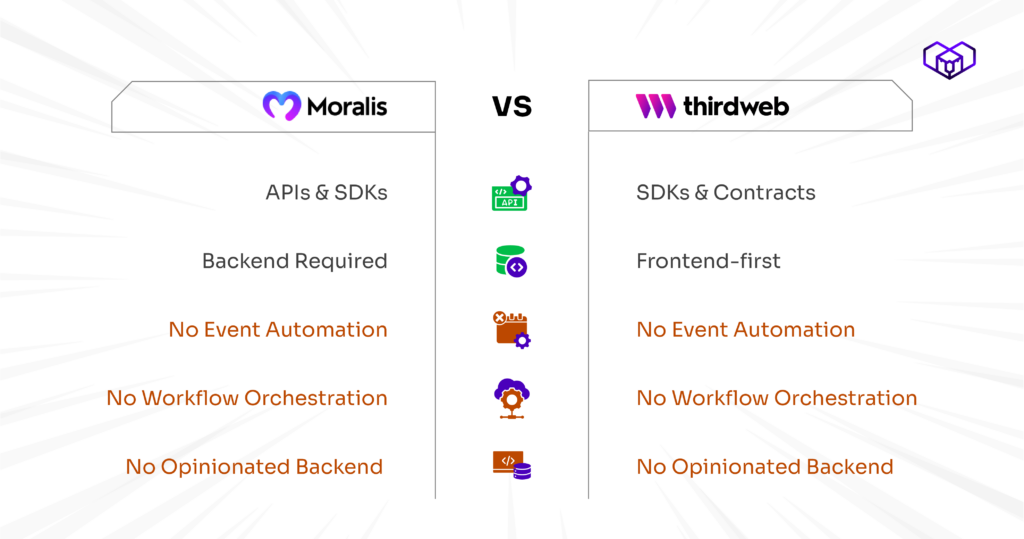
How do Moralis and Thirdweb excel in Web3 development?
Moralis and Thirdweb target different layers and developer needs.
Moralis: Backend & Data Infrastructure
Moralis is strong on the backend side of Web3 development.
It offers:
- Real-time event streams
- Multi-chain data indexing
- Authentication APIs
- SDKs for fetching on-chain data
- Tools for managing blockchain sync and backend logic
It’s built primarily as a data and infrastructure layer that helps developers manage the server-side complexity of Web3 apps.
Thirdweb: Full-Stack App Development
Thirdweb, meanwhile, focuses on simplifying the end-to-end app development workflow.
It provides:
- Smart contract deployment tools and templates
- Wallet integration modules
- Authentication solutions
- No-code and low-code builders
- SDKs designed for launching dApps, Web3 games, and NFT projects quickly
It positions itself as a full-stack framework that helps developers go from smart contract to production-ready UI with fewer steps.
Moralis vs Thirdweb: A detailed comparison
| Features | Moralis | Thirdweb |
| Platform overview | A Web3 backend platform offering scalable APIs, cross-chain support, and real-time blockchain data. | A Web3 development toolkit offering smart contracts, wallet infrastructure, and developer tools for creating on-chain applications and decentralized games. |
| Best for | Developers needing robust backend infrastructure, reliable data streaming, and Web3 API integrations. | Builders focused on user-facing dApps, NFT marketplaces, and Web3 games. |
| Key strengths | Real-time blockchain data sync, cross-chain SDKs, enterprise-grade scalability, and API-first architecture. | AI-powered contract deployment, universal authentication, streamlined token/NFT tools, and multi-chain operability. |
| APIs and tools | Provides APIs for NFTs, tokens, streams, authentication, and blockchain events. | Offers unified API for wallets, contracts, tokens, DeFi strategies, and AI control. |
| Supported blockchains | Ethereum, Polygon, BNB Chain, Solana, Avalanche, and more. | Supports multiple EVM and non-EVM chains with cross-chain deploy and data query capabilities. |
| Authentication | Web3 and traditional login (wallet, email, or password integration). | 13+ OAuth providers (Google, Apple, Discord, Coinbase, etc.), including JWT and SIWE support. |
| Storage solutions | Integrated with IPFS for decentralized file storage. | Offers decentralized, high-performance data storage. |
| Analytics | Real-time event monitoring and usage analytics. | Built-in performance monitoring via Thirdweb Insight and Indexer. |
| Scalability | Cloud-based auto-scaling infrastructure; serverless functions for backend extension. | Horizontally scalable architecture integrated across its complete toolkit. |
| Pricing | Tiered plans: Free for beginner developers, Starter ($59/month), Pro ($249/month), and Business ($749/month). | Tier-based pricing: Starter ($5/month), Growth ($99/month), Scale ($499/month), Pro ($1,499/month). |
If you’re also exploring backend-first solutions, check out this detailed comparison between Moralis and Kwala to see how automation changes dApp scalability and speed.
Where Moralis and Thirdweb fall short (and how to fix it)
Moralis and Thirdweb simplify dApp development, but the trade-off is dependency. Their centralized pipelines decide how your data moves, how your events fire, and how far your workflows can stretch. The result? More manual scripts, more duct-taped systems, and less autonomy.
Moralis limitations
- Centralized infrastructure creates dependency and limits control.
- Limited customization for event handling and data processing.
- Advanced workflows (automation, multi-chain logic) need extra tooling.
- Some use cases like real-time cross-chain triggers, aren’t fully achievable.
- Platform-specific APIs can lead to lock-in.
Thirdweb limitations
- Requires deeper smart contracts and blockchain knowledge.
- Templates and SDKs can create vendor lock-in.
- No native support for complex backend automation or orchestration.
- Some use-cases (multi-chain syncs, conditional triggers) need custom scripts.
- Flexibility is restricted by framework-defined structures.
How to resolve these limitations
Moralis and Thirdweb surely get you partway. However, challenges such as control, backend orchestration, workflow automation, and cross-chain syncing still persist.
Kwala changes this equation.
Instead of routing your logic through a centralized platform, Kwala lets you automate directly from on-chain events across any chain: without predefined boxes or limitations.
It’s the first workflow automation protocol for Web3. Since this platform is built on the principle of decentralization, it puts the power back in your hands.
Here’s how it helps:
- Decentralized and credit-based system: Kwala eliminates vendor lock-in by running on a decentralized network with a pay-as-you-go credit model. So, you only pay for what you use, unlike fixed subscription tiers.
- True workflow automation: The no-code platform listens to blockchain events and Web2 API calls. It automatically initiates complex Web3 workflows without manual coding.
- Cross-chain native execution: It is one of the core benefits of Web3 workflow automation protocols, acting as an invisible executor across multiple blockchains. The tool orchestrates seamless multi-chain actions instantly to reduce infrastructure overhead and cross-chain risks.
- Unified Web3-Web2 integration: Kwala connects Web3 smart contracts with traditional Web2 APIs. It enables you to build hybrid dApps with real-time data syncing and event-driven triggers.
Move faster, orchestrate better with Kwala
Kwala doesn’t wait for instructions; it listens, reacts, and executes. This platform is a backend enabler but also your invisible automation engine for Web3. With its no-code, decentralized platform running your workflows, you don’t need endless scripts, manual triggers, or patchy integrations.
You can launch, automate, and scale seamlessly, all while keeping full control in your hands.
If you’re curious, you can visit Kwala’s website to learn more; you can even claim free credits while you’re there!
FAQs on Moralis vs Thirdweb
Can Kwala replace both Moralis and Thirdweb?
Yes. Kwala can take over the backend automation layer for projects that rely on multi-chain execution, real-time event triggers, and workflow logic that normally requires Moralis or Thirdweb functions. It does not replace their frontend SDKs, but it replaces the backend infrastructure they provide.
Does Kwala support traditional Web2 APIs?
Yes. Kwala can listen to Web2 events from tools like Stripe, Notion, or any REST API and connect those triggers to automated on-chain actions. This lets teams unify Web2 and Web3 workflows without writing or hosting servers.
Is Kwala secure for production-grade apps?
Yes, Kwala uses on-chain verifiable execution, user-signed actions, and immutable logs for secure automation. This makes it suitable for production environments where correctness and auditability matter.