
 book a call with us
Options: Think about how most Web3 apps still work. A contract emits an event. Somewhere, a backend checks for it. If the timing is right, something finally happens. If not, things break quietly. Gaps like these explain why event-driven web3 architecture is gaining attention. With blockchain event triggers, systems respond immediately. On-chain event automation removes the […]
Read MoreScaling a Web3 game is rarely about graphics or gameplay mechanics. The real friction begins once players arrive. Every dice roll, point update, NFT upgrade, or reward claim creates on-chain activity that must be monitored, processed, and acted upon in real time.
For most teams, this quickly turns into a backend problem: servers, listeners, retries, and infrastructure that grows faster than the game itself.
This is where serverless blockchain infrastructure becomes critical. Instead of scaling backend complexity alongside player growth, Web3 games need automation that reacts directly to on-chain events.
Kwala approaches game scaling through low-code workflows that act as the backend itself, removing the need for custom servers or event listeners while preserving real-time gameplay.
Why Web3 games struggle to scale
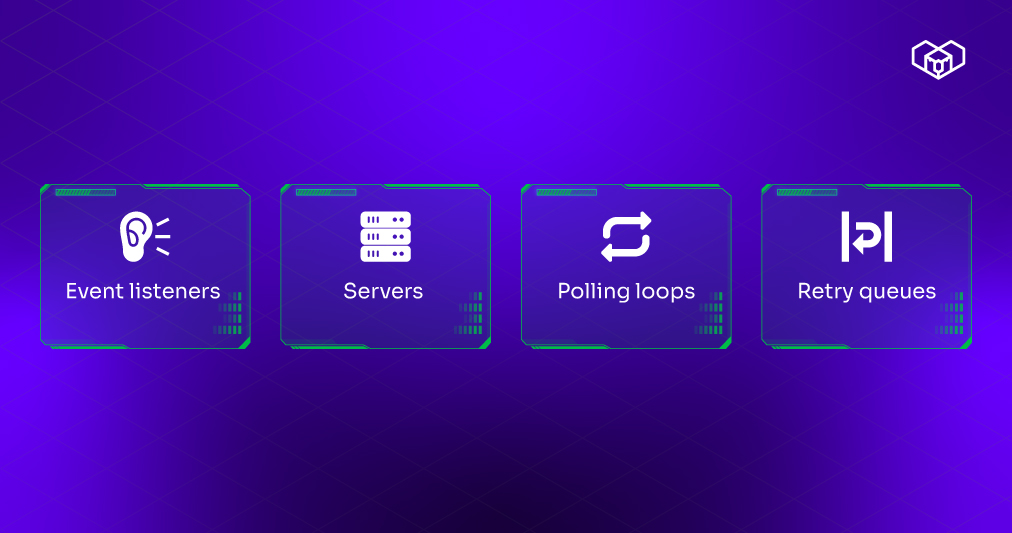
At an early stage, many Web3 games function with minimal backend logic. As engagement increases, the architecture starts to crack. Games must continuously listen to smart contract events, synchronize state across systems, and trigger follow-up actions such as NFT upgrades or reward distribution.
Traditional setups require teams to build and maintain infrastructure that constantly polls the blockchain, manages failures, and handles concurrency. This approach does not scale gracefully. As player activity grows, so does backend cost, operational risk, and development overhead. Even simple mechanics like progression systems become difficult to manage reliably.
A serverless blockchain infrastructure model shifts this burden away from game developers by eliminating the need to manage backend services altogether.
Kwala’s monitoring-first approach to game scaling
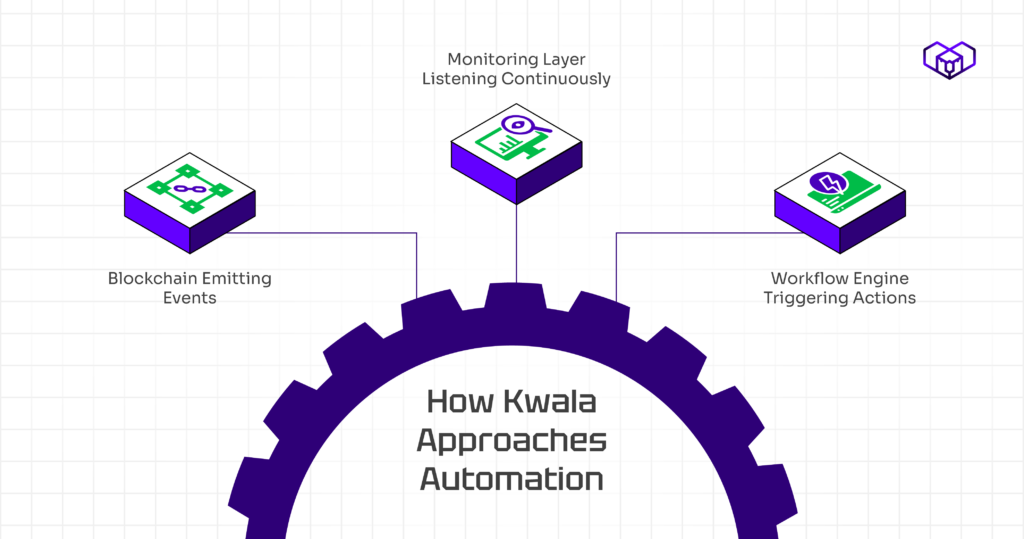
Kwala is built around continuous on-chain monitoring. Instead of developers hosting listeners or writing polling logic, workflows are configured to react directly to blockchain events. Each workflow defines what to monitor, what conditions matter, and what actions should follow.
This monitoring-first architecture allows game logic to execute deterministically and at scale. When an event is emitted on-chain, Kwala’s decentralized execution network ensures that the workflow runs exactly once, preventing duplicates and race conditions. For Web3 games, this means gameplay logic remains consistent even as player volume increases.
At its core, this model enables serverless blockchain infrastructure where workflows replace traditional backend components.
Steps to scale a Web3 game using automation
This approach shows how game logic can scale by automating responses to on-chain activity rather than backend infrastructure.
Step 1: Create a new workflow
Without Kwala, developers need to build and host backend services just to listen to smart contract events. With Kwala, the backend is created through a workflow.
To begin with, a New Workflow is created from the dashboard. Developers can choose between a visual workflow builder or a YAML-based editor. Both options serve the same purpose: defining how on-chain events should trigger backend logic.
Step 2: Define when the workflow should run
Next, the workflow’s execution time is set. This includes specifying when the workflow should trigger: for example, after a particular on-chain event occurs.
An expiry time is also added, allowing the workflow to stop monitoring after a defined period. This is useful for time-bound game mechanics or limited events.
Step 3: Configure the on-chain event trigger
The workflow is then connected to a smart contract. This involves specifying:
- The contract address
- The blockchain where it is deployed
- The exact event the workflow should listen for
Once configured, Kwala continuously monitors this contract for the defined event, removing the need for custom listeners or polling logic.
Step 4: Add optional notifications
At this stage, notification preferences can be configured. Developers can choose to receive updates when workflows succeed or fail. This provides visibility into backend execution without manual monitoring.
Step 5: Define the action to perform
After setting up the trigger, the next step is defining what action should happen when the event occurs.
This typically involves calling a function on another smart contract. The workflow specifies:
- The target contract
- The function to be executed
- The blockchain where the action should run
Any required parameters are passed directly from the event data. Retry logic can also be enabled to ensure the action completes successfully.
Step 6: Choose how actions execute
Kwala allows actions to run either sequentially or in parallel.
This choice depends on the game’s logic: parallel execution supports high-frequency gameplay events, while sequential execution preserves order when needed.
Step 7: Activate and deploy the workflow
Activate the workflow by switching it on. Before going live, the workflow can be compiled to validate its configuration. This step ensures the trigger and action logic are correctly defined.
Once validated, the workflow gets deployed. From this point onward, Kwala hosts the listeners and executes the backend logic automatically.
Step 8: Connect the game and observe automation in action
With the workflow active, the game can be connected to a wallet and used normally. As players interact with the game, on-chain events are emitted, actions execute automatically, and state updates happen in real time.
All backend operations – event monitoring, execution, retries, and coordination – are handled by Kwala without manual intervention.
Case study: dynamic NFT evolution in gameplay
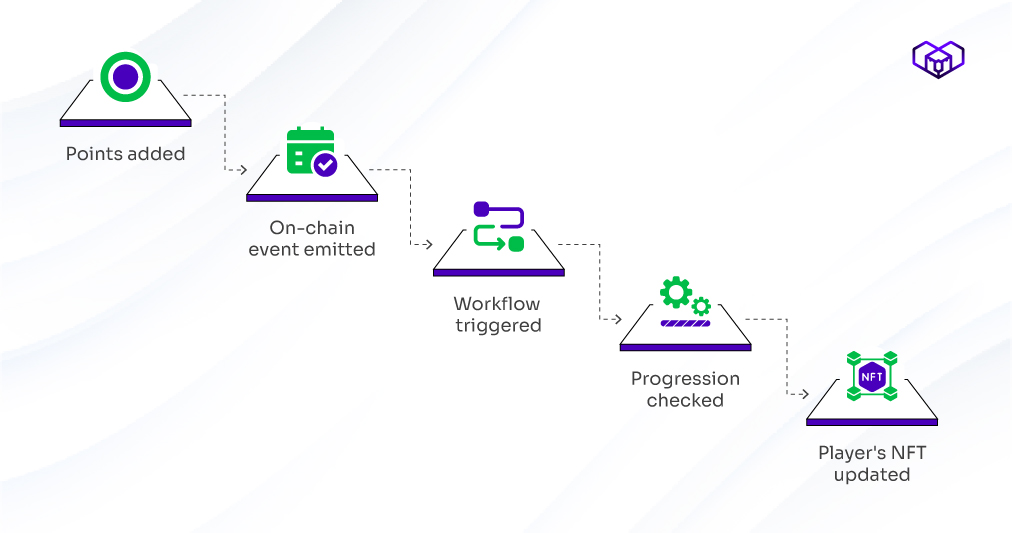
A clear example of this approach is a dynamic NFT-based game where players earn points through repeated actions like dice rolls. Each time points are added, an on-chain event is emitted. That event triggers a workflow which checks progression thresholds and upgrades the player’s NFT accordingly.
A character might begin at one stage and evolve as the player remains engaged. All of this occurs without backend servers, polling logic, or manual intervention. The game feels responsive to players, while the backend remains invisible and scalable.
Why low-code workflows matter for game studios
Low-code automation fundamentally changes how game teams operate. Instead of dedicating engineering effort to infrastructure management, teams can focus on refining mechanics, balancing gameplay, and experimenting with new ideas.
Workflows make backend logic easier to reason about, modify, and safer to scale. Smaller teams gain the ability to build production-ready systems without maintaining large backend stacks.
As games evolve, workflows can be extended without rebuilding infrastructure from scratch.
How Kwala helps scaling gameplay without complexity
Web3 games do not fail because of a lack of ideas. They fail when backend complexity outpaces development velocity. By turning on-chain events into automated workflows, Kwala enables games to scale smoothly without introducing infrastructure risk.
With monitoring at the core and low-code workflows as the execution layer, serverless blockchain infrastructure allows Web3 games to grow in users, mechanics, and ambition: without growing backend burden alongside them.
FAQs serverless blockchain infrastructure
1. How does Kwala prevent duplicate executions during high player activity?
Kwala uses a claimed execution model where only one node processes a workflow instance at a time. This ensures that each on-chain event triggers backend logic exactly once, even during traffic spikes.
2. Can the same workflow support multiple game mechanics or modes?
A single workflow can be reused across different gameplay mechanics as long as the triggering events and actions align. This makes it easier to expand features without creating separate backend systems for each mode.
3. What types of game workflows can be automated using Kwala?
Common workflows include player onboarding, reward distribution, asset minting, tournament triggers, cooldown enforcement, and in-game notifications based on on-chain activity.