
 book a call with us
Realising a critical wallet update hours after it happens can be costly. If you’re an admin managing gas or relayer wallets, staying funded is survival. But keeping an eye on multiple wallets around the clock is impossible. Manual tracking takes time, custom scripts often break, and even the best developers can’t react faster than an automated alert. It leads to missed […]
Read MoreWeb3 development has reached a point where teams aren’t slowed down by ideas; they’re slowed down by the backend.
Every dApp needs event listeners, retries, smart contract connections, multi-network logic, indexing, cron jobs, notifications, and API bridges. However, the time spent building these backend pieces keeps multiplying, stretching development cycles even before the actual product is ready.
For years, Web3 teams have had only one path to production: write and maintain backend code.
Kwala offers a new alternative. As a codeless automation platform, it helps developers describe backend behavior in YAML and instantly deploy it as a reliable, production-ready workflow: no backend engineering, servers, or complexity.
Why codeless backend building is becoming the default need
Today, enterprises are rapidly shifting toward tools that reduce repetitive engineering work.
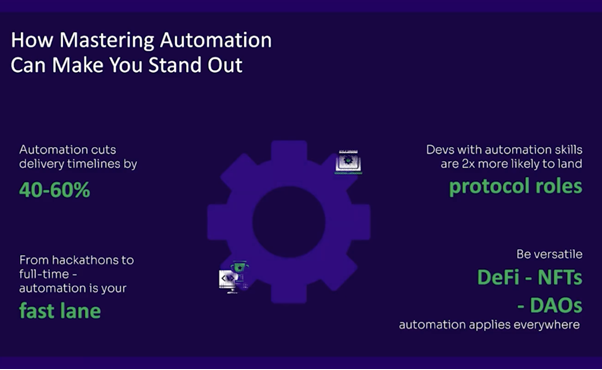
More than 70% of companies exploring blockchain automation now recognize that most backend tasks are predictable, repeatable, and time-consuming: perfect candidates for automation. As the transcript notes, developers spend nearly 80% of their time handling integrations and infrastructure challenges instead of building application logic.
Backend friction isn’t just frustrating; it becomes the biggest obstacle between an idea and a production launch.
Teams want to:
- go live fast,
- integrate smart contracts without custom scripts,
- monitor events without setting up indexers,
- move across chains without rewriting logic,
- and automate actions without touching backend code.
A traditional backend cannot offer this speed. A codeless automation platform can.
How Kwala removes backend code from Web3 development
Kwala redefines Web3 backend development by replacing code-heavy infrastructure with simple, declarative logic.
A workflow in Kwala is made up of four elements:
| Name | Trigger | Actions | Execution preference |
| A clear label for the workflow logic | The event or condition that initiates it | The steps executed after the trigger | Choose sequential or parallel execution |
Developers simply edit a clean YAML template: no backend scripts, servers, schedulers, or APIs to wire manually. Kwala compiles the YAML, validates it, deploys it, and handles all execution under the hood.
This is why Kwala is often described as backendless: there’s no server, no cron job, no indexer, and no infrastructure for teams to manage. Every function that would normally require backend code is built through configuration instead.
The only requirement is defining the workflow. Everything else is handled by the platform.
Automation without engineering: the heart of Kwala
One of the standout qualities of Kwala is that every workflow is powered by real-time triggers. These triggers can come from on-chain events, scheduled times, or external APIs – and all of this works without backend code. As soon as a contract emits an event, Kwala immediately reacts and runs the logic the team defined.
Developers don’t write scripts to stream logs, build indexers, normalize data, or parse dynamic values. Kwala does it automatically.
At the same time, the platform naturally supports multi-chain execution and contract interactions. This means a workflow can listen on one chain and execute on another: again, without any backend scripting. These aren’t features teams must engineer; they are built-in conveniences that make codeless building realistic for production environments.
The result is simple: backend logic behaves like a coordinated automation layer, not an engineering project.
How Kwala speeds up production-ready development
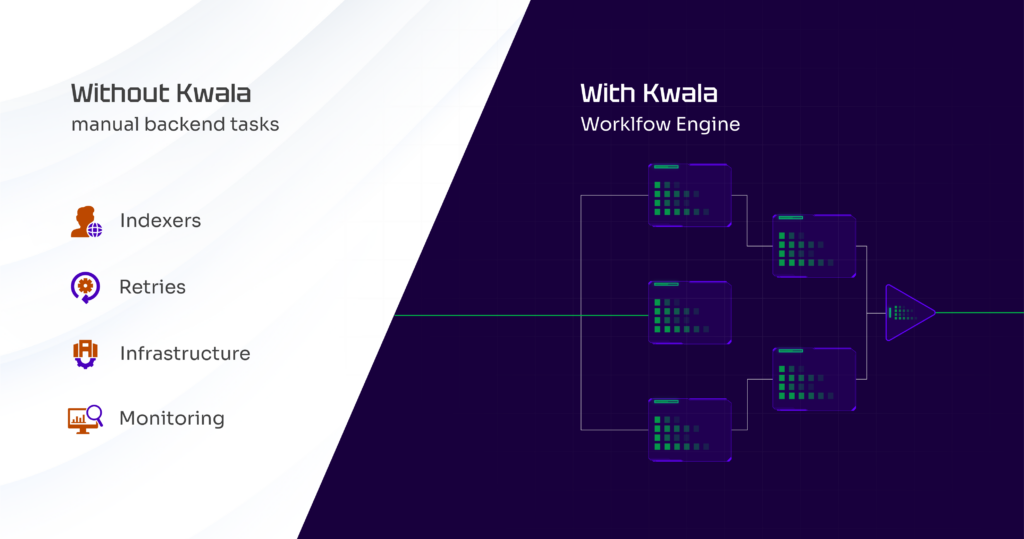
With Kwala, backend automation moves from “weeks of engineering” to “minutes of configuration.” Teams gain several advantages that directly accelerate their launch timelines:
No backend code required
Developers describe what should happen, and Kwala executes it. There’s no code for retries, no code for event listeners, no code for smart contract calls.
No infrastructure or servers
Kwala is serverless, backendless, and codeless by design. Infrastructure management disappears from the workflow.
Production deployment in days, not months
The transcripts highlight how workflows go from idea to deployment in a couple of days, even for complex on-chain interactions.
Built-in reliability without audits
Kwala validates scripts, ensures correct compilation, and deploys them with verified execution: reducing the need for manual security checks.
Dynamic value handling
Whether extracting parameters from events or passing dynamic data into smart contract calls, Kwala handles it through declarative inputs rather than backend code.
Smooth integration with existing systems
APIs, notification endpoints, and webhooks plug directly into workflows, allowing dApps to communicate with off-chain systems without custom orchestration code.
This combination of speed, reliability, and simplicity is what moves teams toward codeless backend building.
A real use case: production logic with zero backend engineering
Consider a student certification system: a registration event triggers a certificate issuance, followed by dynamic notifications. Kwala automates this entire flow without backend code.
- A registration event triggers a workflow.
- That workflow calls a certificate-issuance function on another contract.
- A second workflow listens for the issuance event and sends dynamic notifications.
The entire backend – event extraction, cross-contract communication, dynamic parameters, notifications, and execution flow – is built without writing a single backend script.
This illustrates how even multi-step, multi-contract logic that normally requires backend engineering can instead be configured as automation.
Why codeless backend development is the future
As teams outgrow traditional backend architectures, they’re moving toward platforms that eliminate infrastructure and reduce backend code to its simplest form: workflow logic.
Kwala delivers this through:
- an execution engine that listens, reacts, and automates
- built-in support for multiple chains
- a monitoring layer that doesn’t need maintenance
- workflow orchestration without servers or coding
- a system where developers write logic, not backend components
With Kwala, backend complexity disappears, and workflows scale with your application, not with your engineering burden.
Codeless is no longer a shortcut. It’s the fastest path to production. Kwala simply turns it into a workflow.
FAQs on Web3 backend platform
Does using a no-code platform limit future customization?
No, Kwala workflows are designed to evolve: developers can modify triggers, actions, and logic as application requirements grow, without rebuilding backend systems.
Do I need to manage RPC nodes or indexing services myself?
No, Kwala abstracts away node management and event indexing. Developers don’t have to maintain RPC endpoints, run listeners, or store event histories. This is handled automatically as part of the execution engine, allowing teams to focus purely on workflow logic instead of infrastructure.
How does Kwala handle failures or retries during workflow execution?
Kwala’s execution layer includes built-in reliability features. If an action fails due to temporary network issues, node delays, or third-party API errors, retries and recovery logic are handled at the platform level, not in user-written code. This gives workflows production-level stability without manually coding fail-safes.