
 book a call with us
Every Web3 developer reaches a point where the backend starts feeling heavier than the actual product. You’re juggling listeners, syncing data across chains, patching RPC issues, and trying to keep scripts alive during traffic spikes. That’s when the realization dawns that you don’t need any more scattered tools; what you need is a Web3 infrastructure for developers that doesn’t fall apart under load. Kwala steps in exactly […]
Read MoreYou’ve just won a hackathon, your dApp works fine, the wallet connects, transactions go through, maybe there’s even a slick NFT minting flow. The demo is flawless too.
Fast forward a few weeks: you’re up late, debugging why events are being missed at 3 AM, your RPC node has gone down again, and you’re drowning in server maintenance tickets instead of shipping features.
Sound familiar?
The gap between a production web3 apps prototype and a mainnet-ready application isn’t just about polish. It’s about infrastructure reliability, transaction guarantees, and operational overhead that can quickly drain your budget. While Hackathons are great for proving ideas, Mainnet is far less forgiving.
In this blog, we’ll break down the real blockchain production challenges teams face, and explore how stateless automation can eliminate backend inconsistencies.
Hackathon vs. Mainnet: What’s the difference?
Hackathons and Mainnet are fundamentally different paths. One helps you validate an idea; the other is where your Web3 application goes live.
Here is a brief overview of both:
| Aspect | Hackathon | Mainnet |
| Purpose | An event where developers build prototypes to solve specific problems within a time constraint. | An independent blockchain network where real cryptocurrency transactions using native tokens take place |
| Focus | Speed and creativity | Stability, security, and reliability |
| Product Stage | MVP with just enough functionality to show value | Finished, production-ready application |
| Features | Wallet connection, basic transactions, simple token logic | Full transaction flows, native tokens, and live dApps |
| Network Type | Testnet or local environment | Independent, live blockchain network |
| Risk | None (test tokens, low risk) | Real cryptocurrency and real user funds |
| Users | Judges, teammates, early testers | Public users and real customers |
| Consequences | Bugs are learning opportunities | Bugs can lead to privacy leaks, drain wallets, or slow transactions. |
The difference between the two isn’t subtle. One serves as a proof of concept; the other involves real users with real money at stake. This is why web3 deployment best practices require a fundamental shift in mindset.
Six Common Production Challenges for Web3 MVPs
Most teams run into the same problem once they move beyond the demo- the Web3 backend problem.
Despite building on decentralized protocols, many dApps still rely on centralized servers. Why? This is because of the communication gap between blockchains and Web2 systems, which forces teams to introduce off-chain infrastructure.
This creates a single point of failure in an otherwise decentralized system. Here are some blockchain production challenges that teams face as they scale beyond an MVP:
1. Scaling for real-world transaction volume
Most leading blockchains struggle when transaction volumes spike. Ethereum’s limited TPS creates issues that frustrate users with failed transactions and unpredictable wait times.
2. User experience still feels too complex
Although Web3 has been gaining visibility over the years, it still feels complicated to the average user. Wallets, private keys, and unfamiliar terminologies create a steep learning curve that many aren’t willing to climb.
3. Cross-chain fragmentation and interoperability
Web3 ecosystems operate in silos, forcing users to swing between multiple wallets for simple cross-chain transactions. Furthermore, Web3 doesn’t have proper standardized protocols, which limits what production Web3 apps can actually accomplish.
4. Communication gaps between Web3 systems and users
Although most Web3 apps rely on centralized servers, communication between systems is far from smooth. Add in the dense terminology, DAOs, MEV, and account abstraction that make new users feel lost before they start.
5. Reliability and “missed” events
If your event listener goes offline for sixty seconds, those transactions are gone forever. This makes blockchain unreliable oftentimes. Imagine missing transactions because blockchain can’t send notifications. Weird, right?
6. Complex transaction management
Scaling dApps requires handling gas estimation and transaction replacement. Also, various chains have different finality rules, requiring you to have custom logic for each network.
While these challenges make web3 difficult to navigate, Kwala, on the other hand, is paving a way unknown to many.
Production best practices for web3 teams with Kwala
The transition from prototype to production doesn’t always have to be a hassle. Kwala changes the game by giving you a decentralized backend that listens, executes, and scales without the operational turbulence.
Here’s how teams are deploying production of web3 apps faster:
Focus on on-chain events
- Use Kwala’s event trigger to track on-chain activity, mints, transfers, and governance votes across all supported chains.
- Kwala simplifies web3 monitoring and automation. Configure contract address, chain ID, and ABI once, and the protocol handles 24/7 monitoring.
- You don’t have to worry about network switching. Kwala automatically configures MetaMask to its network (chain ID 190405)
Build workflows visually
- You can connect blockchain events to Web2 APIs without writing backend code.
- Trigger Telegram alerts when NFTs are minted, update databases on token transfers, or execute multi-step transactions across chains
- Define your logic once and Kwala executes it reliably across its decentralized node network.
Pay only for what you use
- Kwala follows a credit-based system so you’re not locked into monthly fees for infrastructure you’re not using.
- Workflows scale automatically during peak activity, without provisioning servers or managing capacity.
- You can ship features in days, not months, because the backend disappears.
Launching in a weekend, not a month
Moving from a hackathon win to a Mainnet launch shouldn’t make you have sleepless nights. You built the MVP, your demo worked perfectly, and you proved your idea.
Yet for many Web3 teams, production issues don’t come from bad ideas or weak code; they come from the invisible backend work no one warns you about.
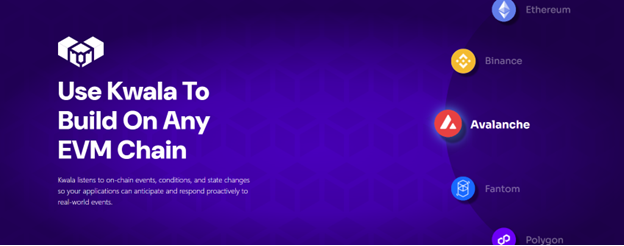
But blockchain production challenges, missed events, scaling limits, and fragile infrastructure are solvable.
By shifting focus from managing servers to reacting to on-chain events, you can spend less time debugging and more time building what actually matters. Switch to Kwala’s workflow automation today, so you can move faster without adding operational overhead.
FAQs on production web3 apps
What’s the biggest difference between a hackathon MVP and a production-ready Web3 app?
Hackathon MVPs often focus on fast coding skills and building functional prototypes While production web3 apps are made to handle the real load.
Why do most Web3 dApps still rely on centralized servers despite being built on decentralized protocols?
Web3 apps still rely on centralised servers because it’s more convenient. Centralized servers are faster, less expensive, and offer familiar user experiences.
How can I scale my dApp across multiple blockchains without managing separate infrastructure for each chain?
While there are some solutions, like multi-chain deployment or chain abstraction solutions. We recommend using Kwala; it listens, reacts, and best of all, builds your backend seamlessly.