
 book a call with us
Every Web3 developer reaches a point where the backend starts feeling heavier than the actual product. You’re juggling listeners, syncing data across chains, patching RPC issues, and trying to keep scripts alive during traffic spikes. That’s when the realization dawns that you don’t need any more scattered tools; what you need is a Web3 infrastructure for developers that doesn’t fall apart under load. Kwala steps in exactly […]
Read MoreSomeone just swapped tokens on your DeFi protocol. The transaction is confirmed, and the tokens moved from one wallet to another – everything worked as expected.
But there is probably something you didn’t see. The smart contract broadcasted specific data about what happened – the wallet addresses involved, the token amounts, and the exact timestamp.
This broadcasted data is called a blockchain event. Most people building Web3 apps don’t realize these events are what make automation actually possible. Without them, your protocol would need someone manually checking every transaction to trigger the next step.
Ever wonder how liquidation bots know exactly when to act? Or how NFT marketplaces update listings the instant a sale completes? Smart contract events make all of that happen automatically.
Let’s break down what these events are and why they matter if you’re building anything in Web3.
Why smart contracts broadcast events in the first place
Smart contracts live on the blockchain. The blockchain is a closed system. It doesn’t automatically talk to external databases, send emails, or update your frontend interface.
So how does anything off-chain know what’s happening on-chain? That’s where blockchain events come in. When a function executes successfully, the contract can emit an event – basically a permanent log entry that announces what just occurred.
These on-chain triggers serve three specific purposes that traditional databases handle differently:
- Creating permanent records: Every event gets stored in transaction logs. This creates an unchangeable history of what happened and when it happened on your protocol.
- Enabling external detection: Outside systems can monitor for specific events. The moment your defined pattern fires, automated workflows can react instantly without polling the chain constantly.
- Reducing operational costs: Reading event data costs far less gas than querying contract state directly. This makes continuous monitoring economically viable for protocols at any scale.
A token transfer event consists of the sender’s address, the recipient’s address, and the transfer amount. An NFT mint includes the token ID and the wallet that minted it. This structured format is what makes Web3 automation predictable and reliable.
The three-part system that makes event-driven automation work
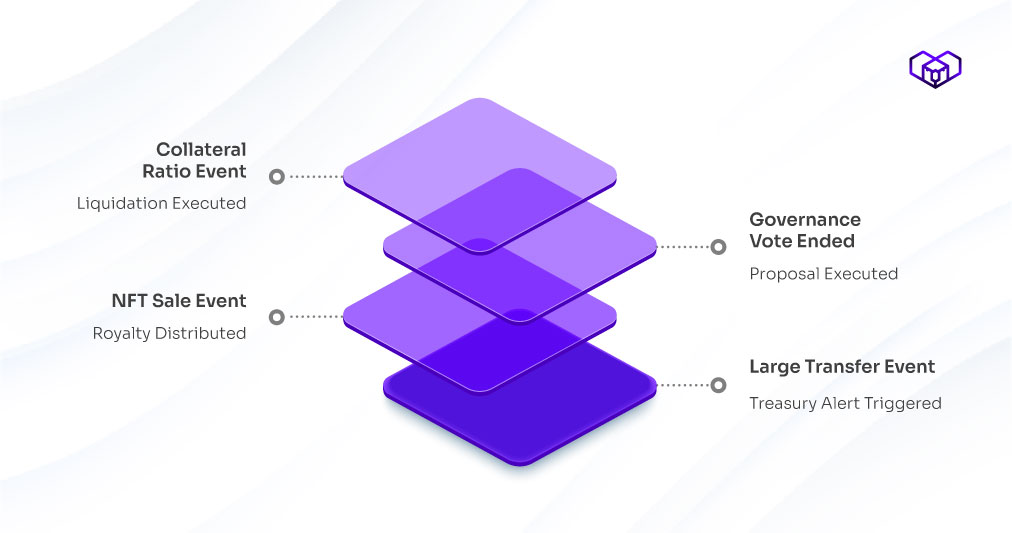
Traditional software checks databases every few seconds asking “did anything change?” Event-driven blockchain systems work completely differently. They sit quietly until something specific happens, then react immediately.
- Developers write smart contract code that emits events when important actions complete. Every swap, transfer, mint, or vote creates an event with relevant data attached.
- Monitoring infrastructure watches the blockchain for your specific event patterns. When the defined event fires, the system captures the data within the same block confirmation.
- Predefined logic executes automatically based on what the event contains. This might mean sending notifications, updating databases, executing additional transactions, or coordinating complex multi-step workflows.
Understanding how monitoring systems track live blockchain activity clarifies why blockchain triggers enable automation impossible with traditional polling approaches.
Real workflows powered by smart contract triggers
Web3 event automation isn’t theoretical. Here’s what production protocols actually automate using events:
Lending platforms and liquidations
Collateral ratio events fire when positions become undercollateralized.
Liquidation bots detect these on-chain triggers instantly and execute protective actions before bad debt accumulates. Oracle price update events trigger portfolio rebalancing across multiple positions simultaneously.
NFT marketplaces and royalties
Mint events trigger metadata uploads and the creation of marketplace listings. Sale events update inventory, notify buyers, and distribute royalty payments to creators automatically. This happens without anyone clicking buttons or running manual scripts.
DAO governance execution
Proposal events notify community members the instant new governance actions are submitted.
Quorum events trigger the next voting phase automatically. Conclusion events initiate approved changes on-chain without administrative intervention.
Treasury coordination
Transfer events above certain thresholds trigger immediate alerts to operations teams. Vesting events release tokens and update ownership records. Multi-sig approval events coordinate sequential transactions across multiple chains and wallets.
These patterns depend entirely on smart contract triggers being detected the moment they occur and triggering responses without human involvement.
Building event-driven workflows without backend infrastructure
You might think monitoring blockchain events requires running servers with custom polling scripts. That’s how most teams started five years ago. But that approach creates infrastructure overhead that doesn’t scale well.
You define which events matter to your protocol. You specify what should happen when they fire. The platform handles detection and execution across all supported chains.
Defining what to monitor: You specify contract addresses and event signatures you care about. Maybe you’re tracking Transfer events on a specific ERC-20 token. The system registers these patterns and begins monitoring immediately.
Configuring automated responses: What happens when your defined event fires? Update a database? Execute another on-chain transaction? These actions become part of your Web3 workflows definition without writing backend code.
Coordinating across multiple chains: Some workflows detect events on Ethereum and trigger actions on Polygon or Arbitrum.
Teams building production DeFi automation understand that reliable event listeners Web3 infrastructure determines whether protocols can operate efficiently at scale.
Events make decentralized automation possible
Blockchain events explained in one sentence: they’re public signals that let external systems know exactly when specific on-chain actions complete.
Smart contracts emit them. Monitoring systems detect them. Automated workflows react to them. This on-chain triggers model is how DeFi protocols, NFT platforms, and DAOs operate reliably without centralized control or manual intervention.
Want to see Web3 automation in action? Explore Kwala’s event-driven workflows to understand how blockchain triggers power production protocols.
FAQs on blockchain events
Can I monitor events from smart contracts I didn’t deploy myself?
Yes. All events emitted by any contract are publicly visible on the blockchain. You can monitor Uniswap swaps, Aave liquidations, or OpenSea sales without special permissions or contract ownership.
How fast can automated systems detect and react to blockchain events?
Detection happens within the same block confirmation window – usually 2-12 seconds depending on network speed. Automated responses execute immediately after detection based on your workflow configuration and complexity.
Do I need to run my own blockchain node to monitor events effectively?
No. Modern event monitoring platforms connect to networks through their own infrastructure. You define which events to track and what actions to trigger. The platform handles technical requirements for reliable detection.