
 book a call with us
You’ve just won a hackathon, your dApp works fine, the wallet connects, transactions go through, maybe there’s even a slick NFT minting flow. The demo is flawless too. Fast forward a few weeks: you’re up late, debugging why events are being missed at 3 AM, your RPC node has gone down again, and you’re drowning in server maintenance tickets instead of shipping features. Sound familiar? The gap between a production […]
Read MoreMost DeFi protocols operate across multiple blockchains by the time they reach maturity. Assets move between Ethereum and Arbitrum. Governance happens on one chain while execution occurs on another. Treasury operations span five networks simultaneously.
The technical challenge isn’t moving assets between chains. Bridges exist for that. The problem is coordinating workflows across those chains without deploying separate monitoring infrastructure for each network.
A treasury rebalancing operation might start with detecting low liquidity on Polygon. Then it triggers a bridge transaction from Ethereum. Finally, it executes the liquidity provision once assets arrive. Traditional approaches require three separate scripts, each monitoring a different chain, each maintaining its own state.
Kwala’s chain agnostic Web3 platform eliminates this complexity. Let’s understand in this blog how developers define cross-chain workflows once and deploy them to a unified execution layer. The infrastructure handles multi-chain coordination automatically.
The infrastructure problem with multi-chain operations
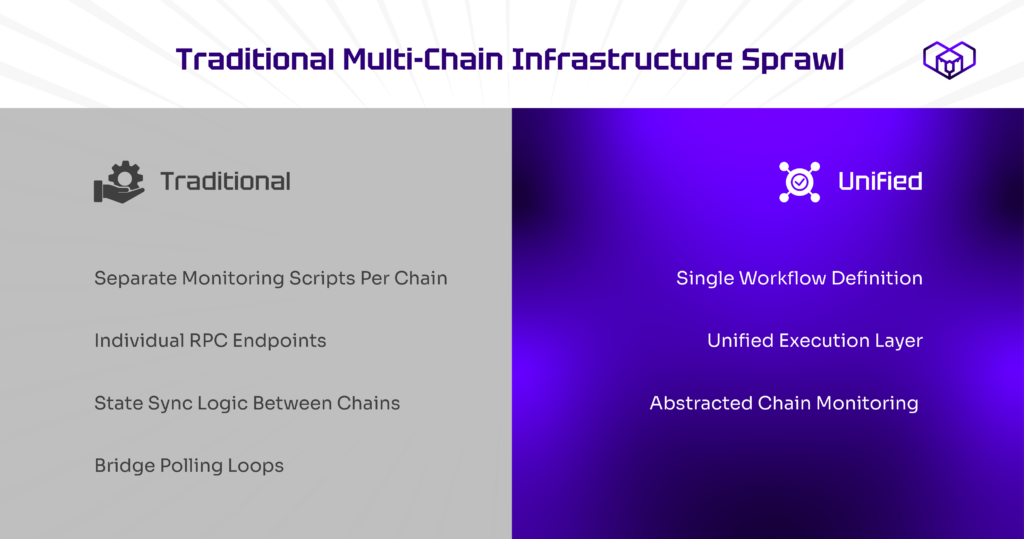
Building protocols that span multiple blockchains creates exponential infrastructure overhead. Each additional chain requires its own RPC endpoint, event monitoring system, and state management logic.
Ethereum requires one monitoring script. Adding Polygon means duplicating that infrastructure. Arbitrum, Optimism, and Base mean five separate systems. Each needs maintenance, debugging, and uptime guarantees.
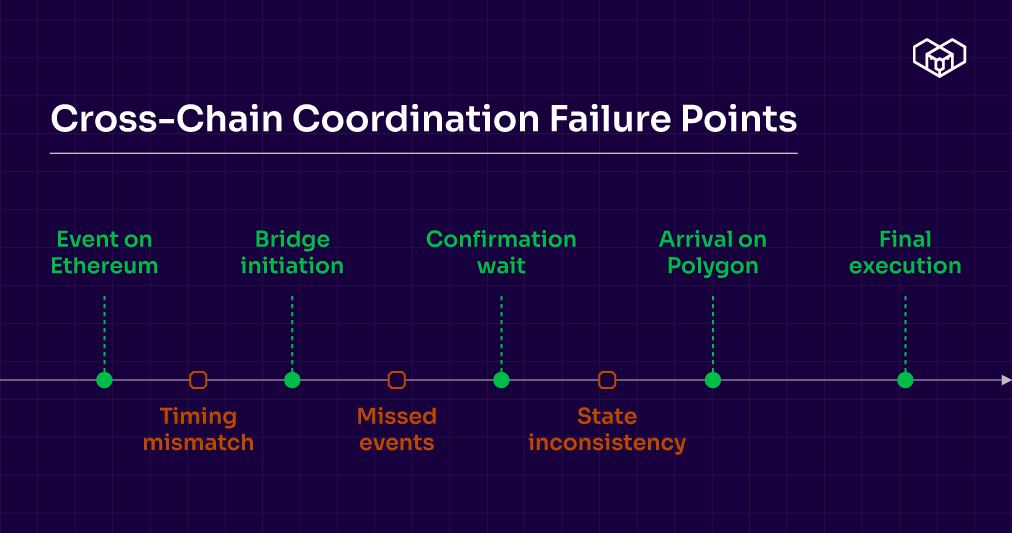
The coordination layer introduces additional complexity. Moving assets from Ethereum to Polygon involves monitoring the bridge contract on Ethereum. Then it requires waiting for confirmation. Finally, it means detecting the arrival event on Polygon before executing the next step.
Custom scripts handle this through polling multiple chains simultaneously. They maintain state across networks. They reconcile timing differences when blocks confirm at different rates. This architecture scales poorly and breaks frequently.
How chain-agnostic workflows eliminate coordination overhead
Multi-chain workflow automation treats different blockchains as execution contexts within a single workflow definition. Developers specify which actions happen on which chains without managing separate infrastructure per network.
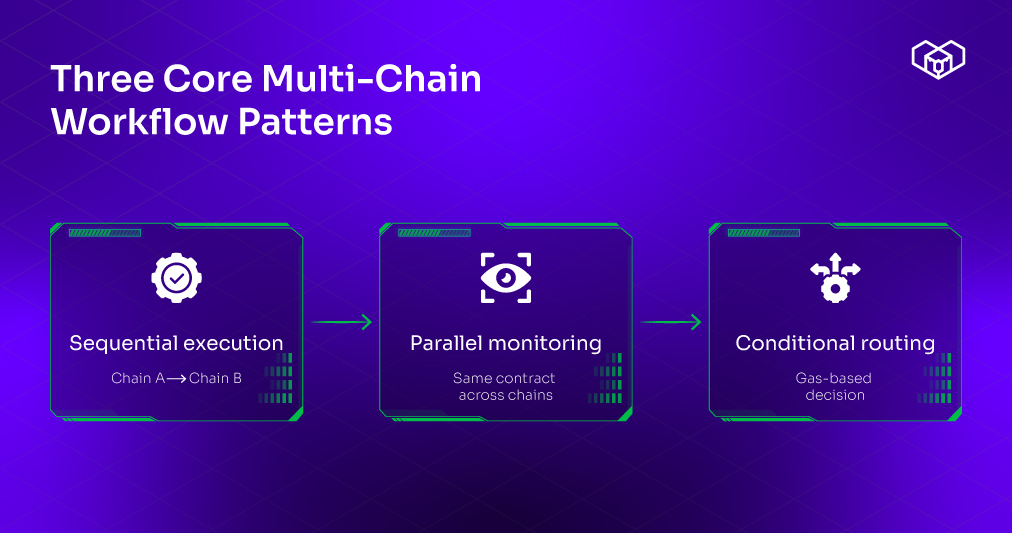
The workflow model handles three critical coordination patterns:
Sequential cross-chain execution
- Monitor event on Chain A
- Trigger bridge transaction
- Detect arrival on Chain B
- Execute follow-up action
Parallel multi-chain monitoring
- Watch the same contract across five chains simultaneously
- Trigger chain-specific responses based on which network fires the event
- Aggregate results for unified reporting
Conditional chain selection
- Evaluate gas costs across networks in real-time
- Route transactions to the most cost-effective chain
- Execute identical logic regardless of chosen network
Understanding how to monitor blockchain events across multiple chains becomes straightforward when the infrastructure abstracts network-specific complexity.
Building cross-chain workflows without infrastructure multiplication
Kwala’s execution layer supports Web3 multi-chain workflows through a unified interface. You define the workflow logic once. The system handles network-specific monitoring and execution automatically.
Bridge coordination workflows
Monitor treasury balance on Ethereum. When it drops below the threshold, calculate the required transfer amount.
Initiate a bridge transaction to Polygon. Detect completion on the destination chain. Execute liquidity provision. In fact, Kwala supports monitoring events from one smart contract per workflow, rather than across multiple chains.
Multi-chain governance execution
A DAO votes on Ethereum but manages protocol parameters across Arbitrum, Optimism, and Polygon.
When voting concludes, the workflow executes parameter updates on all three networks sequentially. It logs results from each chain. It aggregates confirmation data for the governance dashboard.
Protocols leveraging DeFi automation across multiple networks reduce deployment time significantly when infrastructure handles cross-chain coordination.
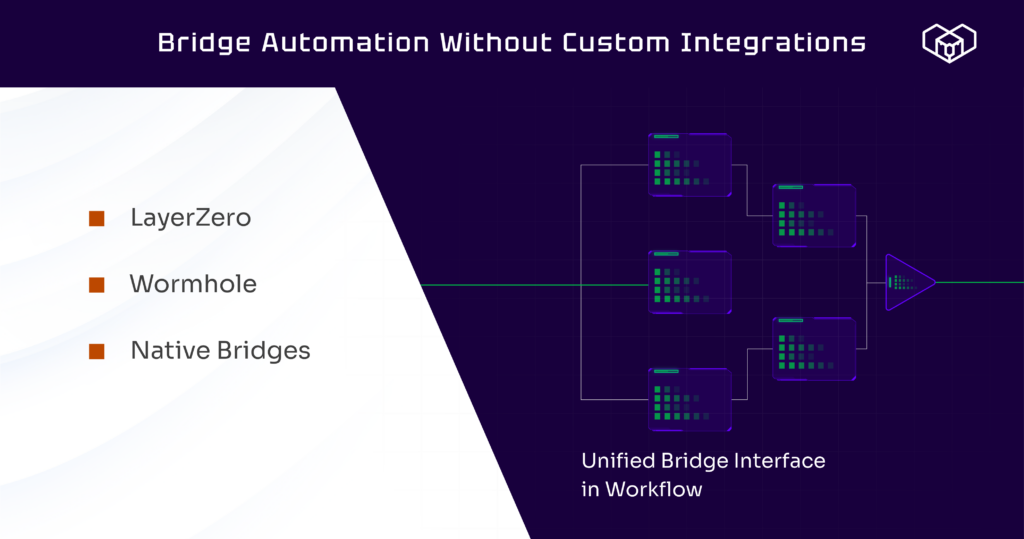
Traditional cross-chain bridge automation requires understanding each bridge’s specific API. Developers write custom integration code for LayerZero, Wormhole, and native bridges separately. Testing requires actual cross-chain transactions with real assets.
The workflow approach simplifies this dramatically:
- Native bridge support: Kwala integrates common bridge protocols at the platform level. Developers reference bridges by name in workflow definitions.
- Standardized event patterns: Bridge events follow consistent patterns regardless of the underlying protocol. Workflows monitor bridge completions using standardized triggers. This reduces custom code and testing overhead when adding new chains.
- Built-in retry mechanisms: Bridge transactions occasionally fail or timeout. Workflows include configurable retry logic with exponential backoff. Failed bridge attempts are logged transparently for debugging without manual intervention.
Example: A yield farming protocol moves assets between Ethereum, Arbitrum, and Polygon based on APY differentials. The workflow monitors yield rates across chains. It calculates optimal allocation. It initiates bridge transactions to rebalance positions. The entire operation executes automatically without chain-specific infrastructure.
Developers can configure blockchain bridges fast by defining bridge parameters in YAML rather than writing integration code for each protocol.
Chain-agnostic as operational advantage with Kwala
Multi-chain operations shouldn’t require deploying and maintaining separate infrastructure for each network. The chain agnostic Web3 platform model treats blockchain networks as execution targets within unified workflows.
Kwala provides the multi-chain workflow automation foundation protocols need. Define logic once. Execute across any supported chain. Coordinate cross-chain operations without infrastructure multiplication.
Teams building scalable DeFi infrastructure across chains recognize that coordination overhead determines whether multi-chain strategies remain operationally viable at scale. Explore Kwala’s multi-chain capabilities for cross-chain automation.
FAQs
Which blockchain networks does Kwala support for multi-chain workflows?
Kwala supports major EVM-compatible chains including Ethereum, Polygon, Arbitrum, Optimism, and Base. The platform continuously adds support for additional networks based on ecosystem demand and protocol requirements.
Can workflows handle bridge failures or timeouts automatically?
Yes. Workflows include configurable retry logic for bridge operations. When transactions fail or timeout, the system retries according to defined parameters. All attempts are logged transparently for operational visibility.
How does Kwala handle gas fee optimization across multiple chains?
Workflows can evaluate gas prices across supported networks in real-time. Moreover, Kwala users can pay transaction fees using Kwala credits rather than native gas tokens.