
 book a call with us
Every Web3 developer knows this pattern: you launch a contract, test it, feel good about it… and then the backend work begins. Suddenly you’re maintaining RPC listeners, cron jobs, relayers, indexers, retry queues; all before you even build your actual product logic. Multiply this across chains, and backend complexity becomes the reason simple ideas take weeks to ship. All the backend […]
Read MoreWeb3 development gets messy fast. Manual listeners, scattered triggers, and fragile backend scripts turn simple ideas into heavy engineering work. Most teams end up maintaining more infrastructure than actual product logic.
Kwala changes that. It gives developers a Web3 automation platform built for speed, reliability, and scale. With multi-chain workflow automation, a strong blockchain workflow engine, and smooth smart contract workflow automation, you finally get a workflow engine for blockchain development that cuts out the grunt work.
In this guide, we’ll explore how Kwala moves teams from manual operations to automated, real-time workflows across every chain.
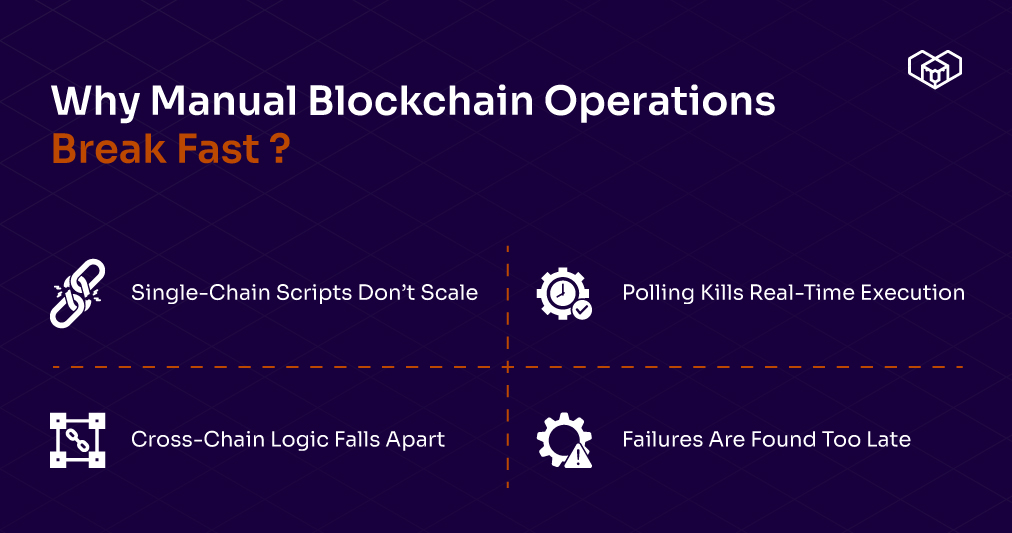
Why manual blockchain operations break fast
A manual blockchain workflow might look simple on paper: watch wallets, poll smart contracts, copy transaction data, and trigger scripts by hand.
It works in small setups but also breaks just as fast as chains, events, and integrations multiply.
Here’s why that happens, and why developers eventually need real multi-chain workflow automation instead of improvised fixes:
Manual scripts cannot support multi-chain workflow automation
Manual scripts are usually written to solve narrow problems in early blockchain systems, when only one chain and a few contracts are involved. They start breaking as soon as teams expand across networks, because logic gets duplicated and dependencies grow uncontrollably.
Without a central blockchain workflow engine, teams lose visibility into how actions connect and fail. Maintenance effort rises faster than development speed. This is where multi-chain workflow automation becomes essential.
Event polling breaks real-time blockchain execution
Polling is a common fallback when systems cannot react directly to on-chain events. As transaction volume increases, this creates delayed responses and inconsistent application states, and important events are missed or processed late.
Users experience lag without knowing why. A real-time blockchain workflow backend ensures actions execute the moment events occur.
Cross-chain orchestration fails without centralized control
Cross-chain coordination requires synchronized execution across networks, which is not possible with a manual workflow. This is because:
- Chains settle at different speeds and failure modes
- Manual handling breaks cross-chain smart contract orchestration
- Rollbacks and retries are handled inconsistently
- Logic fragments across scripts and services
A multi-chain workflow orchestration platform standardizes execution paths.
Debugging manual workflows becomes reactive
When workflows are manually stitched together, failures surface only after users are affected. Logs are scattered across scripts, chains, and services, making root cause analysis slow.
Teams lack visibility into smart contract workflow automation steps. Fixes often introduce new errors. However, with a workflow engine for blockchain development, tracing and control can be centralized.
Event-driven backends degrade into cron-based systems
Manual systems gradually replace event-driven execution with scheduled jobs. This shift breaks alignment with real on-chain state changes. Timing inaccuracies compound as systems grow. An event-driven backend for blockchain apps restores precision and reliability.
Introducing Kwala – A unified automation layer for web3
Kwala reshapes how Web3 workflows are built. It removes backend maintenance and replaces it with predictable, automated execution across chains.
Kwala serves as a single layer that combines everything developers need:
- A decentralized automation network
- A YAML-based workflow engine for blockchain development
- A universal Web2 ↔ Web3 connectivity layer
- No vendor lock-in
- Pay-as-you-go model
- The only workflow automation protocol built for Web3
- Built for multi-chain workflow automation
- Supports smooth smart contract workflow automation across ecosystems
Instead of writing scripts, teams define triggers, conditions, and actions. Kwala handles the orchestration automatically.
How Kwala automates web3 workflows end-to-end
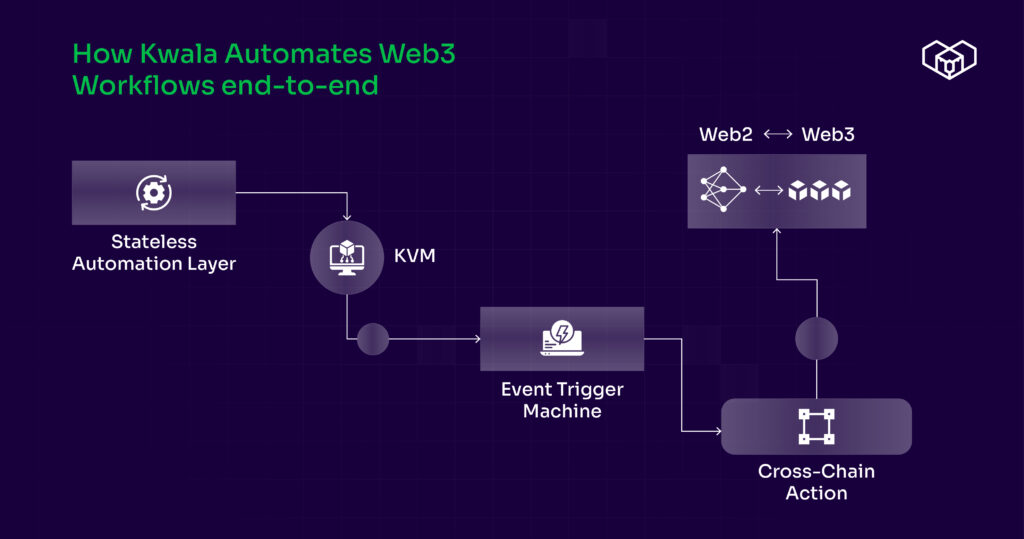
Kwala removes the heavy lifting that slows down Web3 development. Developers get a Web3 automation platform that reacts to events in real time, executes smart contract logic across chains, and connects Web2 systems without custom code.
Here’s how they go from manual operations to full multi-chain workflow automation with ease:
Step 1: Log in through the Kwala dashboard
Go to the Kwala dashboard and click Connect Wallet. MetaMask connects instantly, and Kwala auto-configures chain ID 1905. No manual switching needed, unlike other blockchain tools.
Step 2: Open the visual workflow builder
Click Create Workflow. You’ll enter Kwala’s no-code canvas, designed for clean smart contract workflow automation without extra infrastructure.
Step 3: Start the workflow with an event trigger
Select Event Trigger as your first block. This is how Kwala tracks real on-chain activity like mints, transfers, or contract updates.
Event Trigger provides fields for contract address, ABI, chain, and event, which are essential for real-world Web3 event trigger service use cases, such as monitoring mints, transfers, or contract updates.
Step 4: Attach actions to power on-chain and off-chain workflows
Choose your next step:
- Smart contract call
- Telegram alert
- Slack notification
- API request
- CRM update
This is where cross-chain smart contract orchestration meets real-world systems, giving you full blockchain workflow orchestration platform capabilities without backend code.
Step 5: Activate the workflow and automate end-to-end
Switch the workflow ON. Kwala now listens to your on-chain events continuously and reacts instantly across networks. This gives your dApp a stable multi-chain workflow automation from day one.
Step 6: Verify your workflow
Trigger a test mint or run a sample action.
Kwala’s logs show every detail through the real-time blockchain workflow backend, so you can confirm everything fires correctly.
Why Kwala leads the future of multi-chain workflow automation
Web3 teams need systems that cut through complexity, not add more to it. Kwala brings that shift. It gives developers a multi-chain workflow automation inside a clean blockchain workflow engine that reacts in real time and stays consistent across chains.
With a strong Web3 automation platform, teams focus on building products instead of maintaining infrastructure. Kwala becomes the workflow engine for blockchain development that developers can trust at scale.
Use Kwala to automate Web3 workflows and rely on a decentralized backend
FAQs on Web3 automation platform
Is Web3 a coding language?
No, Web3 isn’t a coding language. It’s a development ecosystem built around decentralized protocols. Developers use it with tools like a workflow engine for blockchain development or a Web3 automation platform to manage logic and automation.
Should I learn Web3 or AI?
Both fields matter, but it depends on your interests. Web3 fits builders who enjoy smart contracts and multi-chain workflow automation, while AI suits those who prefer data-driven systems. Many developers now blend both skills.
What are the 4 types of blockchain?
The four types are public, private, consortium, and hybrid blockchains. Each model serves different use cases and governance styles.
What is a Web3 example?
A Web3 example is a dApp that runs smart contracts and syncs data across chains. It may use smart contract workflow automation or cross-chain smart contract orchestration to handle actions smoothly. This creates a connected experience for users and systems.