
 book a call with us
Most DeFi protocols operate across multiple blockchains by the time they reach maturity. Assets move between Ethereum and Arbitrum. Governance happens on one chain while execution occurs on another. Treasury operations span five networks simultaneously. The technical challenge isn’t moving assets between chains. Bridges exist for that. The problem is coordinating workflows across those chains without deploying separate monitoring infrastructure […]
Read MoreIs the gap between a token’s price movement and the moment you hear about it costing you opportunities?
As of 2024, the crypto user base has already crossed 833 million, and it’s expected to hit nearly 992 million by 2028. With a market growing this fast, every second becomes more competitive. And even a few seconds of delay can lead to missed entries, poor exits, treasury inefficiencies, or unnecessary risk. And when volatility spikes, that delay becomes even more expensive.
That’s why real-time token price alerts aren’t just nice-to-haves. They connect what’s happening on-chain and what reaches you on Telegram. When your monitoring and communication are in sync, you can react instantly.
This blog walks you through how to set up token price notifications without writing a single line of backend code. With Kwala’s no-code automation, you get instant alerts when blockchain hits your target price. Let’s break it down.
Setting up token-based price notifications in Telegram with Kwala
Before you set token price alert on blockchain, let’s get clear on what we’re trying to do.
Imagine a scenario where you want to keep a close eye on Solana. You only want to buy when the price drops to $200, but you can’t sit around refreshing charts all day. And price-tracking apps often ping you late or not at all. That’s the problem we’ll solve with Kwala token price alerts.
Here’s a simple step by step workflow that sends you repeated Telegram notifications the moment Solana hits your target price:
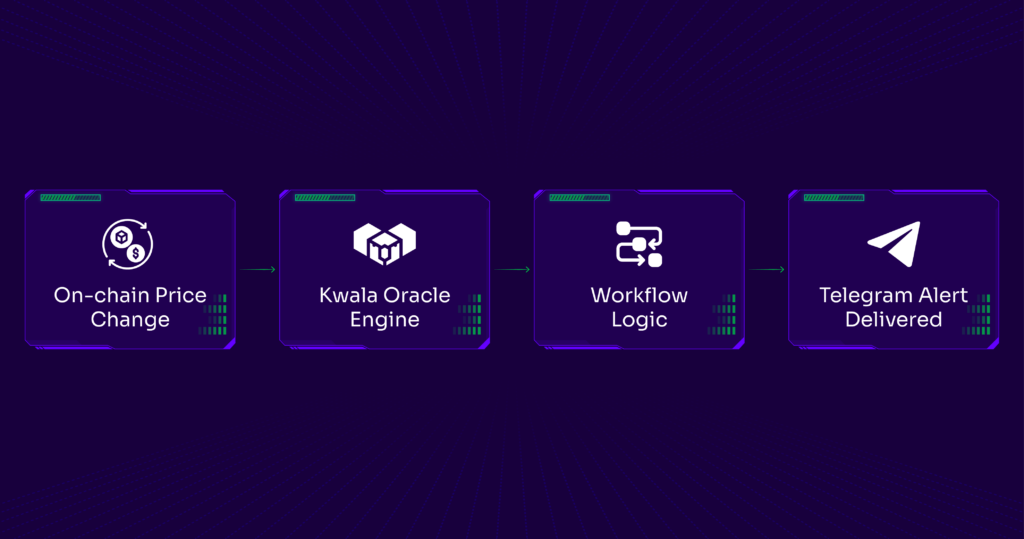
Step 1: Create a Telegram bot for crypto token price monitoring
To start sending instant token price alerts, you first need a Telegram bot. Just open Telegram and search for BotFather (Telegram’s official bot-creation tool). Start a chat, type /newbot, and follow the simple prompts to name your bot.
Once it’s created, BotFather will give you an API token. Keep this token handy. You’ll plug it into Kwala later for the token price drop alert on Telegram.
Step 2: Create a token price alert workflow
Head to the Kwala Web3 automation platform and go to the console.
Click “Create Workflow” and name it “sol_priceDrop1.” This workflow will monitor Solana’s price and send you automated token price notifications whenever it reaches your target value.
Step 3: Configuring the execution settings for token price monitoring automation
Now it’s time to define when your workflow should trigger a cryptocurrency price notification.
- Set Execution Type to Oracle Price.
- Under Repeat Every, select Oracle Price again.
- Choose the timing preferences according to your time zone.
- Set workflow expiry to 1 hour for price-based crypto alerts.
- Enter your Target Price of $195 and select the Solana token. (Let’s say SOL is currently trading at $196.73, and you want an alert when it drops to $195.)
- For Recurring Details, put $195 again
- Finally, paste your Telegram notification POST URL (from your bot setup).
Step 4: Adding the actions and deploying the workflow
Now you’ll tell Kwala what to do when the price hits your threshold.
- Add an action name like “telegram_notifier1”
- In Action Type, select POST (API CALL)
- Paste your Telegram API endpoint URL
- Add the message you want to receive in token price trigger notifications.
- Set Execution Mode to Sequential
- Review the automatically generated YAML file to make sure every detail is correct.
- Once everything looks good, hit Save, Compile, and then Deploy. Now, you’ll start receiving Kwala token price notifications.
Eliminate price-tracking stress with Kwala blockchain workflows
The biggest pain in Web3 price monitoring isn’t just the volatility but the backend chaos that comes with it. Token prices change every second, and reacting on time should be simple. But in reality, it isn’t.
However, fetching prices, checking thresholds, and sending alerts still rely on backend scripts, manual polling, and infrastructure. And this entire setup often breaks right when you need it the most.
For you, this means countless hours wiring RPC calls, maintaining cron jobs, and patching scripts. All of that effort just for a simple alert that should take seconds. This is exactly where the old backend approach slows you down.
What you really need is something that monitors the chain for you, nonstop. Something that triggers an alert the instant your price conditions hit, and does it all without code.
That’s what Kwala network automation can do for you. It removes backend complexity and lets you build real-time price alert workflows in minutes.
Here’s what you can get:
- Faster execution: Set up instant alert workflows without building or maintaining backend infrastructure.
- Zero complexity: Replace complex scripts and server setups with simple, no-code logic blocks.
- Instant scalability: Monitor multiple tokens, thresholds, and conditions without extra engineering effort.
- Continuous reliability: Let Kwala listen 24/7 so you never miss critical price movements.
Price volatility shouldn’t create blind spots. With tools like Kwala, you’ll always stay one step ahead.
FAQs on token price notifications
Can I monitor multiple tokens and alert rules at once?
Yes, with no-code solutions like Kwala, you can set up workflows for several tokens, prices, and conditions simultaneously. This scalability ensures you’ll get instant alerts for any number of assets without extra engineering or maintenance.
What types of events or data can trigger an alert besides price changes?
You can create triggers or alerts for trading volume surges, new token listings, major wallet activity, or even changes in your wallet balance. This makes it easier to catch market-moving events as they happen.
Do I need any technical knowledge to set up these workflows?
No, platforms like Kwala let you create, configure, and deploy alert workflows without coding. You can start monitoring tokens and getting notifications with just a few clicks through a simple dashboard interface.