
 book a call with us
User onboarding in Web3 is supposed to be simple. Connect a wallet, interact with a protocol, and you’re in. Yet in practice, many dApps still rely on backend-heavy flows: user records, authentication logic, API keys, and off-chain services stitched together just to identify who a user is. The result is friction for users and complexity for developers. Source True Web3 onboarding doesn’t start with […]
Read MoreIs your backend infrastructure slowing your decentralized app (dApp) down? Relying on slow, expensive polling scripts or centralized servers means you’re always a step behind. In decentralized finance (DeFi), even a split-second delay can be costly – it could mean missing a transaction or, worse, facing liquidation from an online wallet.
However, when your dApp monitors your smart contracts at the block level through integrations like Telegram, it leads to better preparedness. With a no-code, decentralized workflow automation partner, you can trigger high-priority, personalized Telegram alerts at critical moments, ensuring instant responses when they matter most.
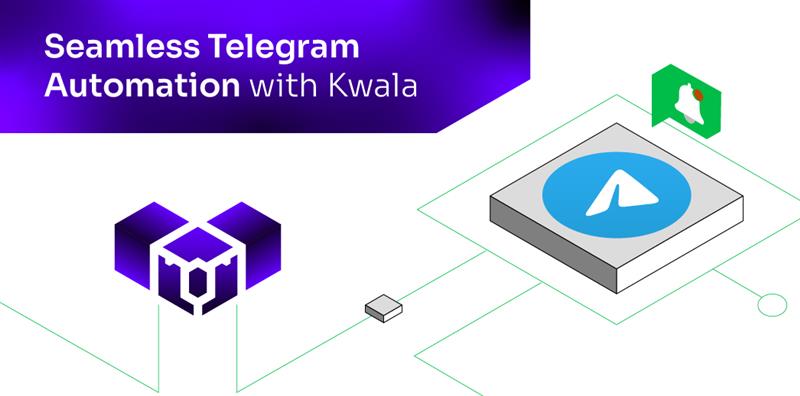
In this blog post, we discuss how a decentralized backend partner like Kwala acts as the bridge between slow, secure Web3 and fast, real-time Web2 Telegram communication. This makes your dApp faster, cheaper, and more reliable.
Bridge the real-time gap with no-code automation
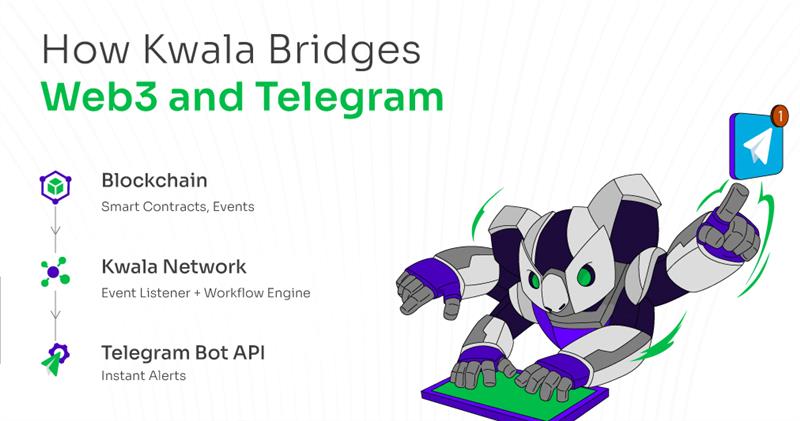
Developers often struggle with the complexity and limitations of integrating Web3 and Web2 APIs. Most existing solutions are overly centralized, making it hard to access blockchains freely and build with flexibility.
Kwala is the only workflow automation protocol for Web3 designed to simplify and decentralize Web2 API integrations. Kwala replaces complex, centralized infrastructure with simple, low-code automated workflows. This shift to decentralized automation offers huge benefits for integrating critical communication platforms, such as the Telegram app.
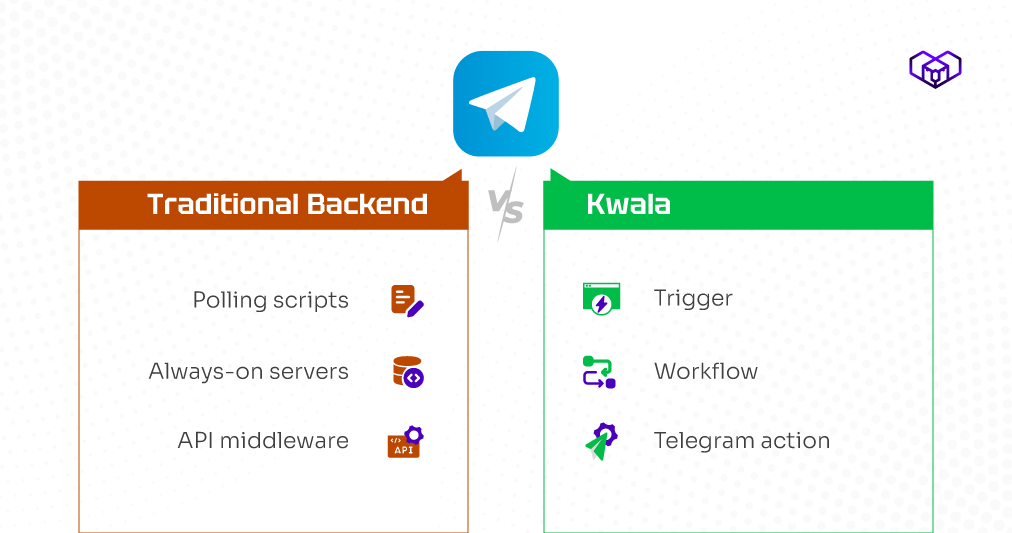
Here is a comparison of the drawbacks of traditional backends and how no-code automated, decentralized software like Kwala overcomes them:
| Feature | Traditional Backend | Kwala (No-code Automation) |
| Reaction speed | Slow, latent polling (seconds to minutes). | Instant, block-level listening (milliseconds). |
| Cost model | Expensive, fixed cost for always-on servers. | Pay-as-you-go model with Kwala credits. Pay only on execution. |
| Reliability | Centralized server, single point of failure. | Decentralized, credit-based system with no vendor lock-in. |
| Development | Weeks of custom API middleware and glue code. | No-code/low-code YAML that calls Web2 APIs directly. |
Integrate Telegram in your workflow in 4 simple steps
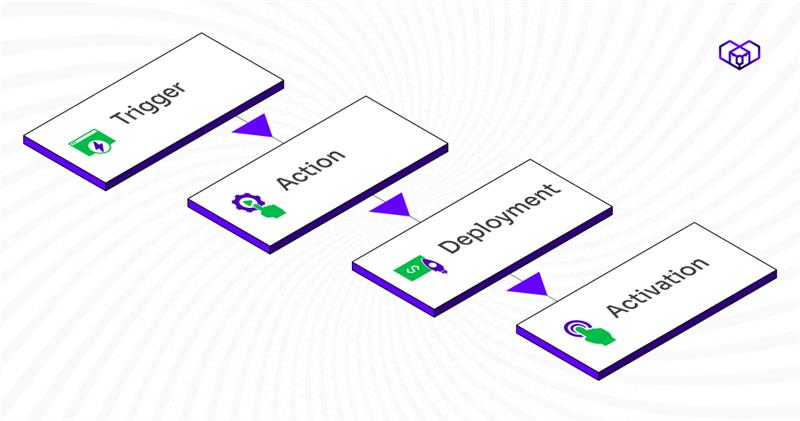
When you choose Kwala, you no longer have to manually track or worry about falling behind on critical on-chain events. Kwala keeps you instantly updated.
Here is a simple process by which you can connect the Telegram Bot API directly to Kwala’s Web3 workflow:
Step 1: Define the trigger
You start in the Kwala console by defining what on-chain event should kick off the process. It could be a Transfer event on a specific token contract, a new DAO proposal, or a time-based schedule. You could create instant alerts for low wallet balance to notify users before failures occur.
Step 2: Define the action
The core of the workflow is calling the Telegram Bot API.
Kwala natively supports Web2 API calls. You simply specify the HTTP call and securely reference the necessary data from the trigger event (e.g., the user address) and your pre-configured API key.
Step 3: Deploy the workflow
Once your YAML is written, you save and deploy it. This action registers your script in the Kwala system and pushes it onto our decentralized network. Crucially, the deployment and subsequent execution are paid for using your Kwala credits, a decentralized, credit-based system that replaces unpredictable gas and hosting fees.
Step 4: Activate and scale
Activate the workflow and walk away. Kwala instantly executes the Telegram API call whenever the on-chain condition is met. Since the platform is decentralized and horizontally scalable, your automation doesn’t buckle under load- whether you’re building on Avalanche, BNB etc with cross-chain Telegram triggers.
You can launch thousands of concurrent, complex workflows without managing any backend infrastructure, without ever touching a server again.
Never miss a notification with Kwala’s Telegram integration
Your dApp deserves a backend that is as resilient and dynamic as the decentralized world it lives in.
By moving your backend logic to the Kwala network, you cut the cord on centralized infrastructure, embrace true decentralization, and focus development energy purely on your core product.
Kwala is the only Web3 workflow automation protocol that lets you integrate on-chain events with critical Web2 actions, like Telegram alerts, using one simple script. It embraces the decentralized ethos with a pay-as-you-go model for affordable, high-frequency monitoring and ensures no vendor lock-in by executing logic across a decentralized network.
Set up on-chain notifications and flow at your own pace with Kwala’s no-code tools.
FAQs on Kwala Telegram integration
1. Are any API keys required to integrate Telegram with Kwala?
Yes, you’ll need a Telegram Bot API token, which you can generate through BotFather. Once created, you simply reference it securely inside your Kwala workflow to authenticate and deliver messages to your chosen chat or channel.
2. Can I integrate Telegram with other apps in my workflows?
Yes, Kwala supports multi-step automation, allowing Telegram actions to work alongside any Web2 API call. You can route on-chain triggers to platforms like Slack, Discord, email, CRM tools, or internal systems; creating end-to-end workflow automation without writing code.
3. What are some common use cases for Telegram integrations with Kwala?
Popular cases include instant DeFi liquidation alerts for users, governance updates like DAO proposal or voting notifications, and internal team signals for key smart contract events. Many teams also use it for real-time monitoring and operational on-chain updates.