servrless backend automation

What Is Serverless Web3 Development? Complete Guide

Introduction 

Every Web3 developer knows the moment the real problem starts. You deploy a smart contract. It works. Then you realize everything else is still unbuilt. 

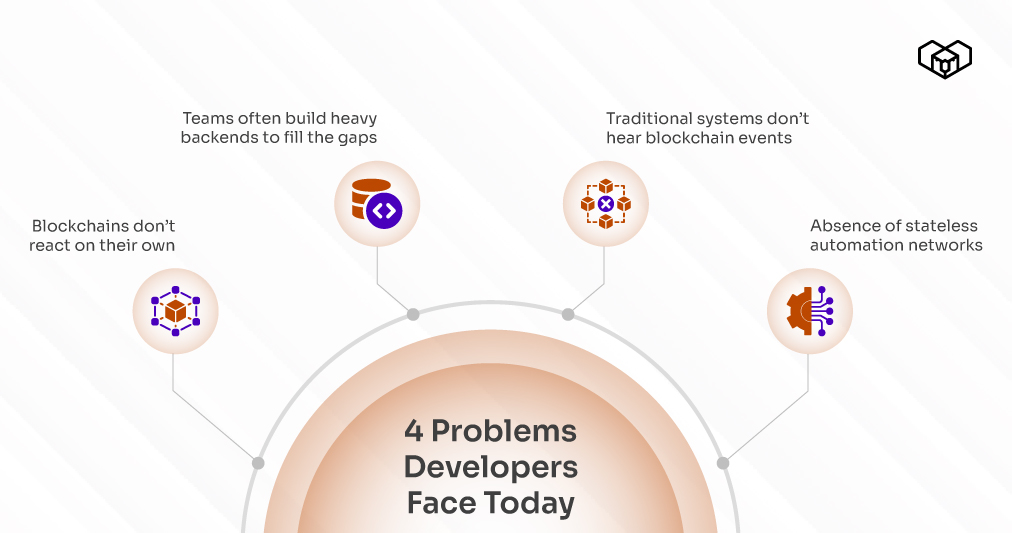
Someone needs to listen to the event logs. Something needs to trigger actions when conditions are met. Retry logic, gas management, multi-chain routing, and failure handling all need to exist somewhere. That somewhere is usually a sprawling backend you spend weeks building and months maintaining. 

In Web2, this is solved quickly. A Firebase function, a Zapier workflow, a Lambda. The tooling is mature. The overhead is low. In Web3, however, the same reactive behavior often means polling servers, RPC listeners, cron jobs, and chain-specific scripts that have nothing to do with your actual product. 

Serverless Web3 development is the answer. It removes the infrastructure layer entirely. In its place, an automated, event-driven execution model scales with your application without requiring an ops team, a backend engineer, or a cloud bill that grows every quarter. 

This guide explains what serverless Web3 development is, why it matters, how the underlying architecture works, and how to apply it correctly in production. 

What Is Serverless Web3 Development? 

Serverless Web3 development means building decentralized applications where backend logic runs through an automated workflow layer. Event monitoring, action execution, and cross-chain coordination all happen here. Consequently, you never provision, monitor, or maintain a backend server. 

In traditional Web2 serverless — AWS Lambda, Google Cloud Functions — serverless means compute abstraction. The server still exists, but the cloud provider manages it. Web3 serverless, however, goes further. 

Web3 serverless = compute abstraction + on-chain event monitoring + cross-chain orchestration 

A backend becomes genuinely serverless in Web3 when it can do five things: 

  • Monitor blockchain events continuously without a polling script 
  • Execute logic without custom servers or cron jobs 
  • Coordinate actions across multiple chains from a single workflow definition 
  • Handle retries, failures, and gas without developer intervention 
  • Scale automatically as event volume increases 

The practical result is significant. Developers describe what should happen in response to on-chain activity. The execution layer then handles how it happens, reliably, across chains, without infrastructure management. In other words, the developer owns the logic, not the infrastructure. 

Why Go Backend-Free in Web3? 

The case for eliminating backend infrastructure is not philosophical. It is operational. In fact, teams that maintain traditional Web3 backends consistently encounter the same problems, regardless of chain, stack, or scale. 

Backend Plumbing Consumes Disproportionate Time 

Wiring cron jobs, retries, queues, and custom event listeners for a single feature can take a full week. Moreover, multiply that effort across features and chains, and infrastructure becomes the primary bottleneck in your roadmap rather than a foundation for it. 

Scaling Is Fragile Under Traditional Models 

A traffic spike — an NFT drop, a DeFi liquidation cascade, a viral governance vote — can crash polling servers or overwhelm RPC queues. Scaling a traditionalWeb3 backend means provisioning more infrastructure. It does not mean shipping more product. 

Every New Feature Multiplies Backend Surface Area 

Adding a new event to track means a new listener. Adding a new chain means a new backend configuration. As a result, compounding complexity creates more failure points in production and slows iteration cycles significantly. 

Costs Rise Without Corresponding Product Value 

Hosting, monitoring, DevOps time, and engineering overhead for backend maintenance are costs attached to infrastructure, not to users or features. Furthermore, a backend-as-a-service approach carries maintenance costs even when activity is low. 

Security Risks Concentrate at Centralized Points 

A centralized backend that listens to on-chain events and triggers transactions is itself an attack target. Compromise the listener, compromise the automation. This single point of failure is structurally incompatible with what blockchain applications are designed to achieve. 

The zero-DevOps approach eliminates each of these constraints at the architectural level. Crucially, it is not a workaround. Instead, it restructures where responsibility lives — from your team to the serverless blockchain infrastructure layer itself. 

How Serverless Web3 Works 

At a high level, serverless Web3 replaces the traditional listener-backend-action pipeline with a three-component automated model. Each component has a distinct responsibility, and together they form a complete serverless blockchain infrastructure. 

1. Triggers 

Triggers define the conditions that start a workflow. These include on-chain events such as a smart contract emitting a Transfer event, block-based conditions, address activity, time-based intervals, price thresholds, and incoming webhooks from off-chain systems. 

2. Workflow Logic 

Workflow logic defines what happens when a trigger fires. It is expressed declaratively, not as imperative backend code. The logic specifies which contracts to call, what data to pass, which chains to act on, and which external APIs to notify. A minimal example looks like this: 

listen: 

  contract: <your-contract-address> 

  event: Transfer 

actions: 

  – type: call_contract 

    chain: base 

    method: settleOrder 

In other words, that YAML replaces what would otherwise be a backend service with custom polling logic, gas management, retry handling, and RPC endpoint configuration. It is declarative rather than imperative — you describe the outcome, not the steps to achieve it. 

3. Decentralized Execution 

Decentralized execution handles the actual running of the workflow. Rather than a single server running every action, a distributed network of nodes claims and executes workflows. This ensures actions fire exactly once. Failures are handled through automatic retries. The system stays live without any single point of failure. 

The entire model is event-driven by design. Nothing runs unless a defined condition is met. As a result, execution is efficient and cost-aligned with actual usage, not idle uptime. 

Decentralized Backend Architecture Explained 

Traditional Web3 backends, even when interacting with decentralized chains, execute their logic in centralized environments. Understanding where execution actually lives, therefore, clarifies why decentralized backend architecture is a meaningful structural shift rather than a marketing distinction. 

The Traditional Backend Stack 

Most Web3 applications today use one of five backend models. Each, however, comes with a significant limitation that ultimately limits scale, security, or both. 

  • Centralized server-based backends run Node.js or Python listeners on dedicated servers. They are reliable but represent a single point of failure and a permanent ops requirement. 
  • Cloud-managed backends reduce operational overhead but keep execution centralized under the cloud provider. 
  • Blockchain API-driven backends outsource the polling problem but introduce vendor dependency and rate-limit exposure. 
  • Serverless function backends are lighter than persistent servers, but still centralized and not natively aware of blockchain state. 
  • Hybrid Web2/Web3 backends are flexible but inherit the full complexity of both models simultaneously. 

The core limitation across all five is the same. Execution is centralized. Even when the blockchain itself is decentralized, the backend that reacts to it is controlled by a single provider or team. Consequently, failure points, scaling challenges, and trust assumptions all emerge from this single structural choice. 

The Decentralized Backend Alternative 

A decentralized backend model, in contrast, distributes both monitoring and execution across a network of nodes. No single server owns the process. Furthermore, no single point of compromise can halt execution. 

When an on-chain event matches a defined trigger, the execution network claims and runs the workflow exactly once. Coordination mechanisms prevent duplicate transaction and race conditions between nodes. As a result, execution is verifiable, deterministic, and comes with a clean audit trail. 

From an architecture standpoint, the flow looks like this: 

Because no single server owns execution, there is no single point of failure. Moreover, because execution is claimed rather than centrally assigned, the system scales horizontally. More demand means more nodes process in parallel, not more infrastructure for you to provision. In practice, this makes the decentralized backend more resilient than any server-based alternative. 

Serverless Blockchain Infrastructure: Best Practices 

A serverless architecture is only as strong as the workflows built on top of it. Consequently, these principles consistently separate reliable automation from fragile scripts in production environments. 

Use Specific, Narrow Triggers 

Broad triggers — fire on every block, watch all transfer events on a contract — generate far more executions than necessary. Each unnecessary execution wastes compute and increases the surface area for false positives. Therefore, define triggers as precisely as the use case allows: specific event signatures, specific address conditions, specific value thresholds. 

Keep Workflows Modular 

A workflow handling ten sequential steps is harder to debug, harder to update, and more expensive to re-run when a single step fails. Instead, split complex logic into composable units. A workflow for event detection can hand off to a second for execution and a third for notification. Modular workflows scale cleanly and fail gracefully. 

Validate Contracts and Inputs Early 

Mismatched ABIs — where your workflow definition does not match the actual deployed contract interface — are a common source of silent failures. The workflow appears to run but passes no data or calls the wrong method. Consequently, always validate contract addresses, event signatures, and parameter mappings on a testnet before activating production workflows. 

Manage Parallel Execution Carefully 

Parallel execution is powerful for independent operations: notifying multiple APIs, updating multiple contracts simultaneously. However, it becomes risky when later steps depend on earlier outputs. Therefore, map dependencies explicitly before enabling parallel workflow paths. 

Monitor Status Throughout the Lifecycle 

Every workflow should emit a status trail: claimed, active, triggered, executed, or failed with a specific reason. Reading these states eliminates the need for custom monitoring dashboards. In addition, it gives you actionable debugging information without digging through server logs. 

Test on Testnets Before Going Live 

Always activate new workflows on a testnet first. Testnets reproduce chain behavior without financial consequence for misconfigurations. Furthermore, the operational sequence — save, deploy, activate — should be fully validated at the testnet stage before any mainnet deployment. 

Real-World Use Cases 

DeFi: Automated Liquidations and Position Management 

A lending protocol needs to liquidate undercollateralized positions the moment collateral ratios fall below threshold. With a traditional backend, that requires a server constantly polling position data and submitting transactions at the right moment. This creates latency and a permanent ops requirement. 

With serverless Web3 architecture, however, the trigger fires natively when the on-chain condition is met. There is no server, no polling delay, and no gap between event and execution. Consequently, liquidation speed improves and operational risk drops significantly. Aave uses Chainlink Automation for liquidation management on exactly this principle. 

DAO Operations: Governance Execution Without Coordination Overhead 

A DAO passes a governance vote. In a traditional workflow, someone must notice the proposal passed, verify the result, and manually execute the treasury transfer. This creates a coordination bottleneck that is slow, error-prone, and dependent on human availability. 

With automated DAO operations, in contrast, the execution is conditional on the on-chain vote outcome. The moment quorum is confirmed and the proposal passes, the treasury action fires automatically. No multisig coordinator needs to be online. Furthermore, no manual verification is required at any step. 

NFT Platforms: Mint-to-Settlement in One Trigger 

An NFT mint completes. Immediately, metadata is updated, a Telegram notification reaches the holder, a royalty split executes to the artist address, and the mint is logged in the project CRM. What was previously a sequence of manual and semi-automated steps becomes a single on-chain trigger with branching off-chain consequences. Moreover, no backend server is in the loop at any point in the process. 

dApp Execution Without a Backend Team 

Cross-chain NFT settlement, game reward triggers, DeFi yield rebalancing, and real-time on-chain notifications can all run without dedicated backend infrastructure. For example, teams that previously needed 7 to 8 days of development and testing for a single automation workflow report completing the same result in 15 to 20 minutes using declarative configuration. 

How Kwala Eliminates Backend Management 

Kwala operates as a decentralized workflow automation layer. It is what the category of tools needed to become for Web3 to work without ops teams. Specifically, it sits between your smart contracts and your users, handling everything in between. 

The core abstraction is straightforward. Developers define workflows in YAML that describe what should happen when specific on-chain events occur. Kwala’s execution network then handles monitoring, execution, retries, gas management, cross-chain routing, and audit logging. As a result, there are no servers to provision and no chain-specific backend to write per network. 

Specifically, Kwala handles: 

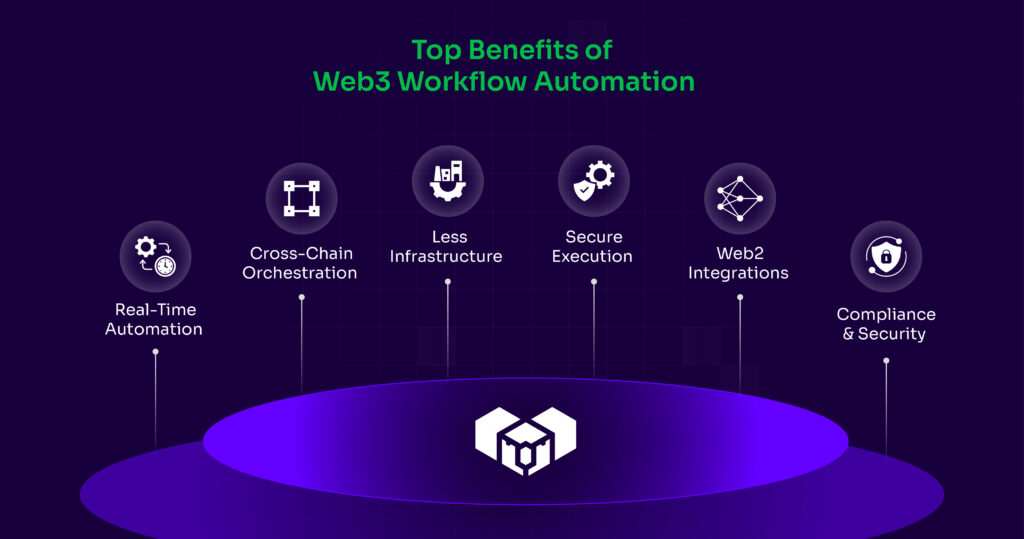
  • Real-time on-chain monitoring for contract events, wallet activity, block updates, and price conditions across supported EVM chains. 
  • Declarative YAML workflows that express backend logic without writing backend code. Trigger, action, chain, and parameters are all defined in a structured configuration file. 
  • Decentralized execution through a distributed node network that claims and runs workflows exactly once per trigger, preventing duplicate actions and race conditions. 
  • Cross-chain orchestration enabling a single workflow to listen on one chain, execute on another, and call a Web2 API in the same sequence. 
  • Native Web2 integration for REST API calls, database writes, CRM updates, Telegram notifications, and cloud function triggers without middleware. 
  • Verifiable execution logs providing a clean, auditable trail of every workflow run: what fired, what it did, and what the outcome was. 
  • Pay-as-you-go credits that scale costs with actual usage, eliminating fixed overhead of infrastructure that idles between events. 

Unlike backend-as-a-service tools that centralize execution under a single provider, Kwala uses a distributed execution model. As a result, there is no vendor lock-in and no single point of failure. The system stays live independently of any individual node, and you are never dependent on Kwala’s own uptime in the same way you would be with a centralized provider. 

Serverless vs Traditional Backend: A Direct Comparison 

The table below maps the key architectural differences between a traditional Web3 backend and a serverless Web3 approach. Notably, the trade-off is not simplicity for capability. Instead, it is a structural shift that removes an entire category of responsibility from your team while increasing reliability. 

Dimension Traditional Backend Serverless Web3 
Setup time Days to weeks (servers, RPC, listeners, scripts) Minutes (define workflow, activate) 
Maintenance Ongoing — patches, monitoring, incident response None — handled by execution layer 
Scaling Manual — provision more infra at traffic spikes Automatic — nodes scale with event volume 
Multi-chain Chain-specific backend per network required Single workflow definition covers all chains 
Failure handling Custom retry logic required per service Built into the execution layer 
Cost model Fixed infra cost regardless of usage Pay per execution — aligns with actual activity 
Security exposure Centralized listener is a single attack surface Distributed execution, no single control point 
Audit trail Custom logging required Verifiable execution logs built in 
DevOps requirement Ongoing ops team or dedicated developer time Zero 

Challenges and Limitations 

Serverless Web3 is not the right fit for every scenario. Understanding the limitations clearly, however, leads to better system design and more realistic production expectations. 

Trigger Reliability Depends on RPC Quality 

Serverless execution layers that detect on-chain events through RPC endpoints inherit the reliability profile of those endpoints. During high congestion, delayed or missed events are possible. Therefore, production deployments benefit from redundant RPC configurations or providers with guaranteed delivery. 

Complex Stateful Workflows Require Careful Design 

A workflow that must track and respond to state accumulating across many events over time is harder to express in a declarative model. Highly stateful logic — such as managing an auction where bids accumulate across many blocks — may require on-chain state storage alongside the automation layer. 

Gas Economics Introduce Execution Uncertainty 

A workflow triggered by an on-chain condition may execute under different gas price environments than expected. Consequently, serverless systems that do not account for gas volatility can behave inconsistently at high-demand moments. Gas limits and priority settings should be explicit in every workflow definition. 

Not All Automation Should Be Automated 

High-stakes, irreversible actions — large treasury movements, contract upgrades, major parameter changes — often benefit from a human review step. Serverless architecture enables speed. However, judgment about where speed is appropriate remains a product and governance decision, not a technical one. 

Debugging Distributed Execution Differs from Debugging a Local Server 

When a traditional backend fails, you read a log on your server. When a distributed execution layer fails, the diagnostic path runs through the workflow status trail and execution history. Teams new to this model need to develop fluency with status-based debugging rather than log-based debugging. 

The Future of Serverless Web3 

AI Agents Will Need Automation Infrastructure 

The next significant shift is autonomous AI agents that execute strategies on-chain. They will rebalance portfolios, execute governance votes, and manage liquidity positions based on real-time signals. Consequently, these agents need serverless Web3 infrastructure as their execution layer. Specifically, they need fast, reliable, event-driven systems that require no persistent servers and no human intervention to run. 

No-Code Web3 Will Become the Default 

As YAML and visual workflow builders mature, the threshold for building functional Web3 applications without backend engineering knowledge will continue to drop. Furthermore, non-technical founders, community managers, and operations teams will configure automations directly, just as they use Zapier or Make today, but for on-chain logic. 

Autonomous Infrastructure Will Self-Optimize 

Early serverless Web3 requires developers to define triggers and workflows explicitly. The next generation will involve execution layers that suggest optimizations: flagging over-broad triggers, recommending workflow splits, and identifying cost inefficiencies based on observed execution patterns. 

Multi-Chain Will Become as Invisible as Multi-Region 

Today, multi-chain coordination requires explicit configuration. In the near term, however, execution layers will abstract chain differences sufficiently that the question of which chain becomes an operational detail. The automation layer will handle it based on cost, speed, and liquidity conditions at execution time. 

Frequently Asked Questions 

What is serverless Web3 development? 

Serverless Web3 development is a model where decentralized applications run without developers managing backend servers, event listeners, or infrastructure. Workflow logic is defined declaratively and executed by a decentralized automation layer. That layer monitors on-chain events and fires actions automatically, across chains, without ops overhead. 

Can you build Web3 apps without a backend? 

Yes. Using a decentralized workflow automation layer, developers define what should happen in response to on-chain events without writing or hosting backend code. Smart contracts handle on-chain logic. The automation layer handles event detection, execution, cross-chain routing, and off-chain integration. As a result, a fully functional dApp can run with no backend infrastructure to maintain. 

What does zero DevOps mean in Web3? 

Zero DevOps in Web3 means running a production application without an operations team managing servers, monitoring logs, handling incidents, or maintaining backend infrastructure. Automation layers handle event listening, workflow execution, retries, and scaling automatically. Consequently, the entire operations layer is removed from the developer’s responsibility. 

How does a decentralized backend work? 

A decentralized backend distributes both event monitoring and workflow execution across a network of nodes rather than a single server. When an on-chain event matches a defined trigger, the execution network claims and runs the workflow exactly once, verifiably, without a central controller. Because no single node owns execution, the system has no single point of failure and scales horizontally with demand. 

Is serverless blockchain infrastructure secure? 

The security profile depends on implementation. A well-designed system provides no centralized listener that can be compromised, sandboxed execution environments, cryptographic verification of workflow outputs, and immutable execution logs. The distributed model eliminates the single-point-of-failure risk inherent in centralized backends. However, trigger definitions and contract interactions still require careful validation to prevent misuse. 

What are examples of no-backend dApps? 

Examples include DeFi lending protocols using automated liquidation triggers (Aave with Chainlink Automation), yield optimizers that automatically compound rewards (Beefy Finance with Gelato), NFT platforms where mint events trigger metadata updates and royalty splits, and DAO governance systems where approved proposals automatically execute treasury transfers. In each case, traditional backend services are replaced with event-driven automation workflows. 

How do you get started with serverless Web3 development? 

Start by defining your trigger: which contract event, price condition, or time interval should initiate your workflow. Then express your actions declaratively: which contract to call, which API to notify, which chain to act on. Finally, activate on a testnet before mainnet deployment. The checklist is straightforward: map triggers precisely, keep workflows modular, validate ABIs early, and test before activating. These steps cover the majority of first-deployment issues. 

What is the difference between serverless Web3 and traditional cloud serverless? 

Traditional cloud serverless — AWS Lambda, Google Cloud Functions — abstracts the server from the developer but keeps execution centralized under the cloud provider. Serverless Web3, in contrast, adds native on-chain event monitoring, cross-chain orchestration, and distributed execution across a decentralized node network. Therefore, it is not just compute abstraction. It is a full backend replacement designed specifically for the Web3 execution environment. 

Ready to Build Without the Backend? 

Serverless Web3 development removes an entire category of infrastructure work from your roadmap. The result is faster shipping, lower costs, and a cleaner architecture that scales without ops intervention. 

However, getting the architecture right matters. Use narrow triggers. Keep workflows modular. Validate on testnets first. And choose a platform whose security model does not reintroduce the centralized trust assumptions you are trying to eliminate. 

Kwala is purpose-built for exactly this: decentralized execution, stateless security, and a declarative workflow syntax that makes backend infrastructure optional. Explore Kwala’s workflow automation platform at kwala.network. 

Ready to explore a decentralized, no-code automation engine for your dApp?

Book a demo to explore the Kwala platform.