
 book a call with us
Your smart contract mints an NFT on Polygon. The transaction confirms. Now you need to update your database, send the user a confirmation email, notify your Discord community, and trigger a treasury rebalancing workflow on Ethereum. Most developers write custom backend code for this – Node.js scripts with event listeners, database connections, API calls, error […]
Read MoreAccording to a recent study, up to 90% of blockchain-technology initiatives within startups fail. That’s a striking number, and it underlines a harsh truth. Most Web3 ideas collapse not because the tech is bad, but because building and maintaining reliable infrastructure is harder than imagined.
Builders in DeFi, DAOs, NFTs, and enterprise Web3 work best when their systems respond instantly to on-chain activity. Tools like KWALA simplify the heavy lifting by turning blockchain events into smooth, automated actions that keep everything moving without extra effort.
As we break things down, you’ll see how DeFi automation tools, DAO workflow automation, and NFT platform automation create smoother, faster multi-chain operations. You’ll also get a clear view of how Kwala can automate all this.
4 core challenges developers face today
When teams fail to fully understand the hidden challenges in Web3 infrastructure, they often encounter bottlenecks that slow down launches and complicate growth. These issues shape how well Web3 workflow automation and blockchain automation protocols can support your project.
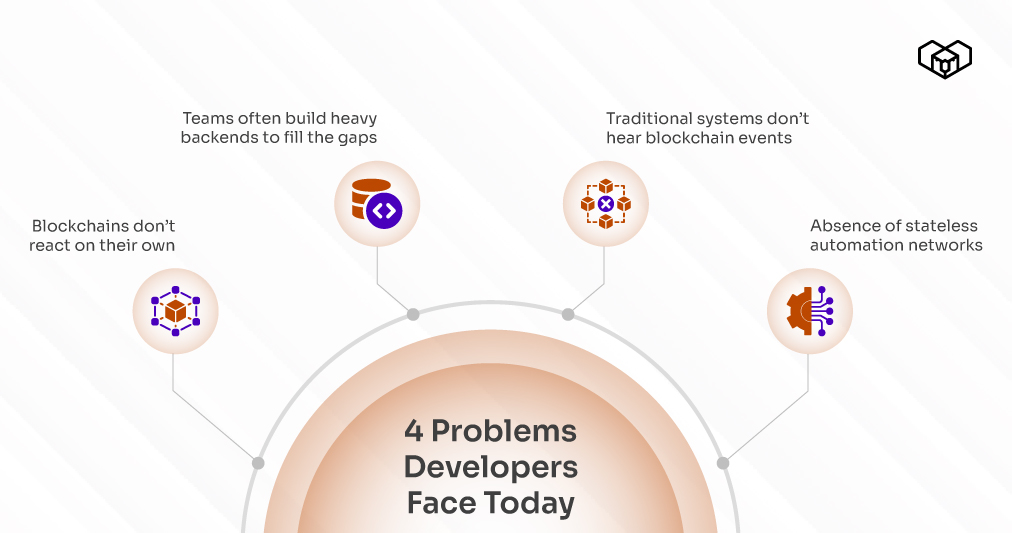
Here are some of the challenges teams face:
1. Blockchains don’t react on their own
Blockchains store and verify state, but they don’t naturally respond to events or trigger actions. This limits how quickly DeFi platforms, DAOs, and NFT apps can move. It also increases the need for external systems just to enable simple reactions, making smart contract automation for DeFi and DAO workflow automation even more valuable.
2. Teams often build heavy backends to fill the gaps
Most builders create polling servers, RPC listeners, queues, and ad-hoc scripts to make things feel reactive. This adds work, increases moving parts, and slows experimentation. With better DeFi automation tools and NFT platform automation, teams can focus more on product and far less on maintenance.
3. Traditional systems don’t hear blockchain events
Enterprise tools like CRMs, APIs, and databases don’t automatically listen to smart contract activity. This creates delays in updates, user actions, and compliance workflows. A modern automation layer bridges this gap, letting multi-chain automation for Web3 apps deliver real-time connections with off-chain systems.
4. Absence of stateless automation networks
Here are the friction points teams experience without a stateless automation fabric:
- Extra engineering to capture every event
- More complexity as chains and use cases expand
- Slow or fragmented cross-chain coordination
- Limited ability to automate DAO governance or NFT lifecycle tasks
This is why the strong benefits of Web3 automation matter – automation removes the strain and keeps everything moving smoothly.
What Web3 workflow automation protocols are
Web3 workflow automation is the layer that enables your app to react to on-chain activity without requiring servers, queues, or endless RPC listeners. These blockchain automation protocols turn smart contract events, wallet actions, and time-based triggers into predictable workflows that run across chains and external apps.
They support everything from smart contract automation for DeFi to automated DAO governance workflows and NFT marketplace automation tools. In fact, the momentum is clear – as of 2024, 66% of businesses have automated at least one business process, and this number is expected to rise to 85% by 2029
With this kind of structure, multi-chain Web3 apps operate with more consistency, less friction, and a smoother development rhythm overall.
Top 6 benefits of web3 workflow automation for DeFi, DAOs, NFT platforms, and enterprises
Automation gives Web3 apps a smoother, more scalable rhythm across chains. Here are the benefits that matter most for teams looking to strengthen Web3 workflow automation and build smarter systems with blockchain automation protocols:
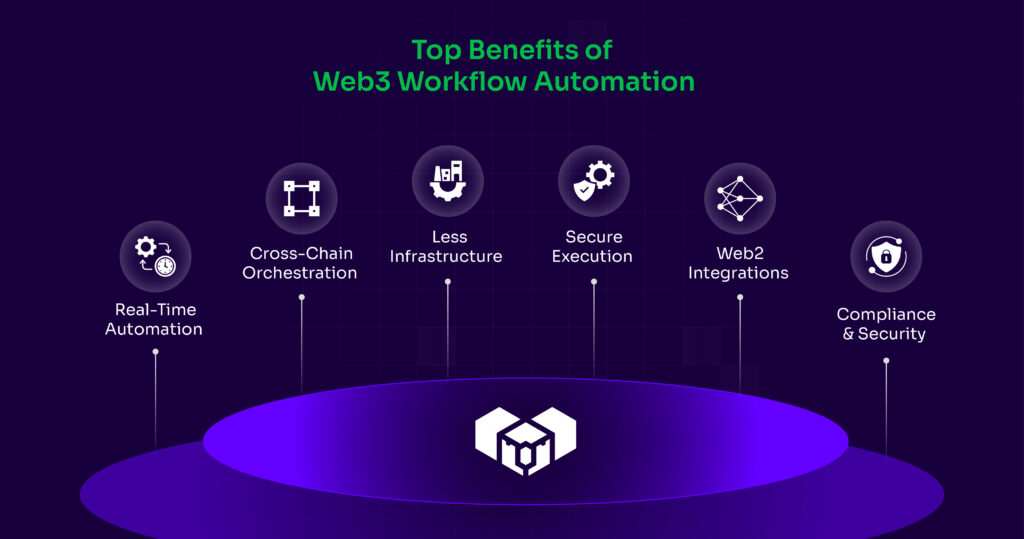
1. Real-time event-driven automation
Event-driven logic keeps DeFi, DAOs, and NFT platforms responsive at every step. This powers smart contract automation for DeFi, instant NFT mint actions, and better DAO execution. As workflows react to smart contract events, wallet activity, price shifts, and off-chain signals, multi-chain apps operate with far more consistency.
2. Cross-chain orchestration
Unified automation streamlines the complexity of coordinating logic across different networks, facilitating liquidity actions, DAO treasury movements, and NFT sync flows. With cross-chain orchestration, apps can manage contract calls, token transfers, approvals, and multi-step pipelines in one predictable sequence.
3. Less infrastructure to maintain
Automation lightens the technical load for teams using DeFi automation tools, DAO workflow automation, and NFT platform automation by reducing the need for:
- Polling servers
- Worker queues
- Custom schedulers
- Manual bridges or alert systems
This frees teams from heavy backend upkeep and keeps the focus on product velocity.
4. Secure and deterministic execution
An automation layer also improves reliability across DeFi, NFT, and DAO logic. Deterministic execution, sandboxed environments, and verifiable actions ensure that workflows execute consistently every time.
The core benefits of Web3 automation become stronger as multi-chain operations gain more predictability and security.
5. Enterprise-ready web2 integrations
These systems connect Web3 events to existing enterprise tools by enabling:
- REST API calls
- Database updates
- CRM syncing
- Cloud function triggers
Businesses gain more flexibility when Web3 workflows connect seamlessly to their existing tools, making it especially valuable for teams scaling multi-chain automation for Web3 apps across departments.
6. Compliance, auditability, and security
Automation strengthens governance, identity workflows, and audit trails. Immutable histories, programmable controls, and clean enforcement paths support automated DAO governance workflows and secure financial operations. This gives DAOs, DeFi teams, NFT platforms, and enterprises clearer visibility across every action.
Introducing Kwala: A new class of automation protocol
Kwala is a decentralized backend designed to simplify Web3 workflow automation for multi-chain apps. It replaces servers with a stateless, pay-as-you-go workflow layer that turns blockchain events into predictable actions.
Here’s how it works:
- Stateless off-chain execution with cryptographic trust
- Deterministic YAML workflows powered by the KVM
- Event triggers for contracts, wallets, prices, webhooks, and intervals
- Cross-chain actions for calls, approvals, transfers, and pipelines
- Web2 integrations for APIs, databases, CRMs, and cloud functions
- Zero-trust security with signing, sandboxing, and immutable history
Together, these features position Kwala as the automation layer that Web3 has been missing.
The automation layer Web3 was waiting for
Web3 keeps expanding across chains, and teams gain a huge advantage when their systems run on smooth, scalable automation. Strong Web3 workflow automation simplifies complex logic, supports real-time reactions, and gives every project a cleaner path to grow.
Additionally, with the rise of blockchain automation protocols, DeFi, DAO, and NFT platforms have finally gained a way to coordinate logic, triggers, and cross-chain actions through one unified layer. Everything feels more connected, more predictable, and far easier to maintain as ecosystems grow.
Kwala pushes this shift forward by making automation feel native, letting developers build in a more reactive and intuitive environment.
Try Kwala and automate your Web3 workflows effortlessly
FAQs on Web3 workflow automation
What is workflow automation?
Workflow automation is the process of turning manual tasks into automatic, trigger-based actions. In Web3, it often uses blockchain automation protocols or Web3 workflow automation to react to smart contract events, wallet activity, and cross-chain signals instantly.
What are the three automated workflows?
The three automated workflows commonly used in Web3 are event-driven actions, rule-based logic, and multi-step cross-chain sequences. These help power smart contract automation for DeFi, DAO workflow automation, and NFT platform automation.
What are the three types of workflows?
1. Sequential workflows that move step by step
2. State-machine workflows that change based on conditions
3. Event-based workflows that respond to triggers.
All three forms support multi-chain automation for Web3 apps and help teams design predictable systems.