
 book a call with us
Your liquidation protection logic executes on-chain. The collateral ratio drops, the contract triggers, and the position closes within the same block. But your monitoring dashboard still shows the old state because your polling script runs every 30 seconds, and you just missed the window. DeFi developers face this gap constantly. The blockchain operates in real-time, […]
Read MoreBackend work in Web3 rarely starts with complexity; it grows into it. A developer sets out to track a contract event or run a simple on-chain action. Soon they’re piecing together RPC endpoints, maintaining indexers, writing monitoring scripts, and managing infrastructure that was never meant to be part of the original roadmap.
Multiply this across multiple chains, each with its own architecture and performance profile, and the burden becomes a bottleneck. The more ambitious the application, the more backend scaffolding it demands.
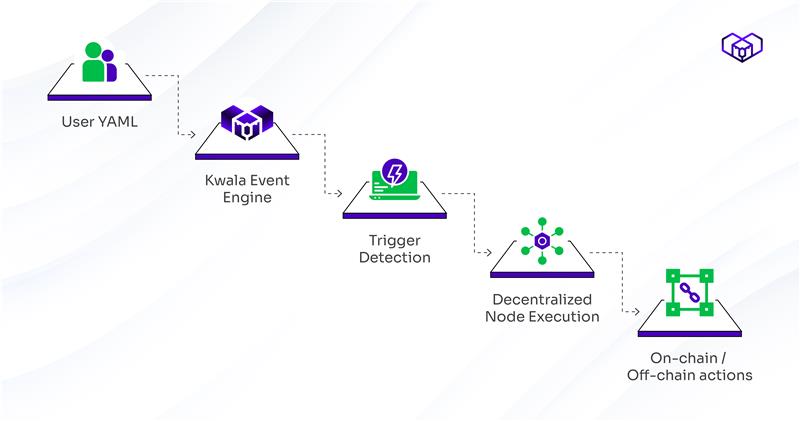
Serverless blockchain development emerged to solve this exact friction point. By moving execution, monitoring, and orchestration into an automated layer, developers regain the freedom to focus on product logic rather than running infrastructure.
Kwala builds on this principle: delivering a backend model where workflows respond to on-chain events in real time, scale across chains, and execute reliably through a decentralized network.
Here’s a closer look at how serverless blockchain backends work, and how you can design, deploy, and optimize them using Kwala.
Why serverless blockchain infrastructure matters
Serverless design in Web3 means you don’t maintain listeners, schedulers, or execution pipelines. Instead, your backend becomes a set of automated workflows triggered by on-chain or off-chain signals.
This is crucial in a space where chains produce continuous event streams and applications rely on instant reaction times.
- No servers to provision
- No chain-specific indexing logic to write
- No separate infra per chain
As your use cases grow, a system built on serverless blockchain infrastructure ensures you scale without rewriting pipelines every few months.
What makes Web3 serverless (and different from Web2)
Web2 serverless = compute abstraction
Web3 serverless = compute + event monitoring + chain orchestration
A backend becomes truly serverless in Web3 when it can:
- Monitor chain events continuously
- Execute logic without custom servers
- Support multi-chain actions
- Maintain reliability at scale
Kwala aligns with this model through a decentralized event engine that listens to contract activity, block updates, address changes, and scheduled events.
Understanding Kwala’s decentralized backend model
At its core, Kwala acts as a decentralized backend platform.
Instead of writing infra to listen to the blockchain, developers describe intent using YAML. Kwala’s network handles:
- Event monitoring
- Execution sequencing
- Error-handling and retries
- Distributed claim-and-run execution
This frees teams from operating node clusters or maintaining listeners manually.
Step-by-step: setting up a serverless Web3 backend with Kwala
Kwala abstracts the infrastructure layer by providing a workflow engine that listens to events and executes logic automatically. With only a few initial steps, you can configure a fully serverless backend ready to react to on-chain activity.
Step 1: Start in the workflow console
Connect MetaMask, enter the console, and access your workspace. This is where automation scripts live, update, and run.
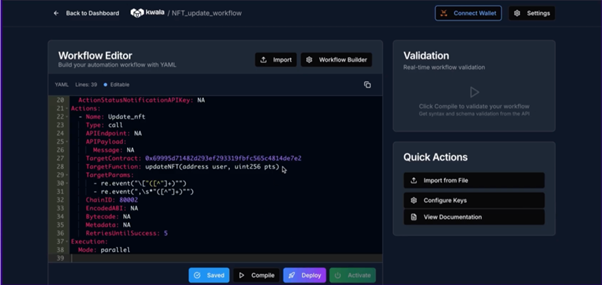
Step 2: Use YAML to build logic
The editor gives you a structured starting point: name, trigger, actions, execution mode. You only define intent; Kwala executes.
This workflow-first approach often replaces the need for a traditional backend, functioning like a full-stack Web3 backend platform without requiring teams to manage compute or infra.
Step 3: Save, deploy, activate
- Save registers your workflow
- Deploy puts it into standby
- Activate turns on monitoring and execution
Once active, your backend runs continuously, even when you’re offline.
Designing good trigger logic
Triggers define when your backend springs into action. Kwala supports:
- Contract events
- Block-based triggers
- Address activity
- Webhooks
- Price-based triggers
When your triggers are clearly defined, your workflows stay clean, accurate, and cost-efficient. Strong backend foundations often start with precise event definitions, especially when building on serverless blockchain infrastructure.
Crafting clean, composable actions
Actions are what your workflow does once triggered. These may include:
- Smart contract calls
- Cross-chain operations
- Data fetching from Web2 APIs
- Notifications
- State updates
Kwala abstracts execution environments so developers don’t write infrastructure for each chain.
This makes it functionally similar to a decentralized backend platform, but without the vendor lock-in of centralized tools.
Multi-chain automation made simple
Web3 applications rarely stay on one chain. Liquidity lives somewhere else, execution costs live elsewhere, and user bases differ.
Kwala’s orchestration layer helps teams run logic across chains without:
- Learning new chain architectures
- Handling different signing mechanisms
- Building custom RPC pipelines
This ability to scale workflows cross-chain is one of the strongest arguments for using a full-stack Web3 backend platform early in your project lifecycle.
Five best practices for serverless Web3 backends
A serverless backend is only as strong as the workflows behind it. Keeping these principles in mind will help your automations run smoothly, scale cleanly, and remain easy to iterate on as your project grows.
- Use specific triggers: Broader triggers = more executions = higher cost.
- Keep workflows modular: Multiple small workflows scale better than one massive one.
- Validate contracts and inputs early: Mismatched ABIs are a common source of silent failures.
- Use parallel execution carefully: Ideal when steps aren’t dependent on previous outputs.
- Monitor workflow statuses: Claimed → Active → Triggered → Executed. Reading these correctly saves debugging time.
These practices help teams build confidence on a decentralized backend platform as automation increases.
When to choose a serverless architecture
A serverless Web3 backend benefits teams when:
- You need fast iteration without infra setup
- Your product depends on real-time reactions
- You plan multi-chain expansion
- You don’t want DevOps overhead
- You want to reduce indexing and node-related maintenance
Startups, solo developers, and enterprises all gain from infrastructure that reacts instantly and scales automatically.
If your project requires predictable, high-volume, event-driven logic, adopting serverless blockchain infrastructure early prevents refactoring later.
Smart start checklist for developers
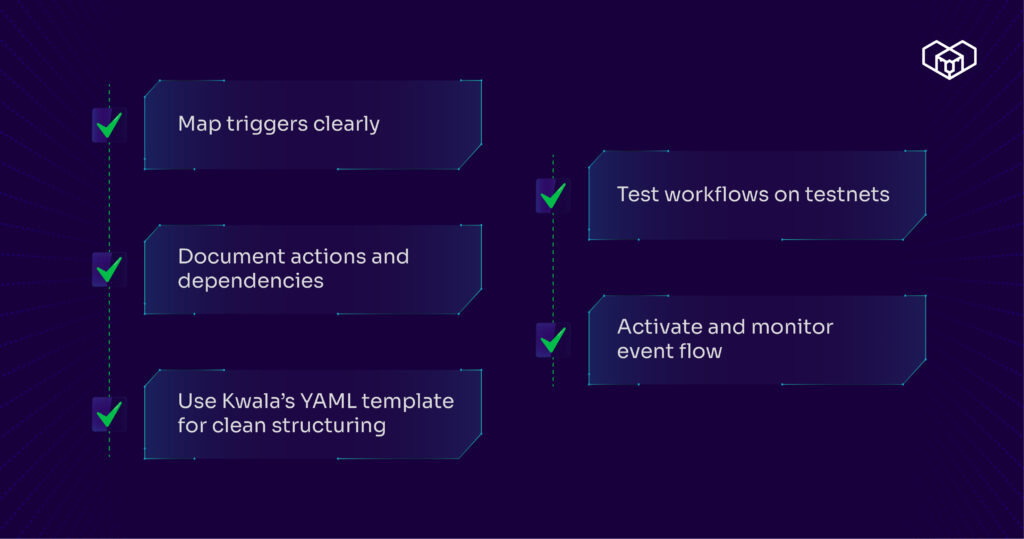
Before going live, ensure these fundamentals are in place for a smooth automation experience:
- Map triggers clearly
- Document actions and dependencies
- Use Kwala’s YAML template for clean structuring
- Test workflows on testnets
- Activate and monitor event flow
With these foundations, your backend becomes predictable, maintainable, and fully automated. Kwala simply helps you get there faster by handling the event monitoring and execution for you.
FAQs on serverless blockchain infrastructure
How does Kwala handle workflow failures or unexpected chain behavior?
Kwala includes built-in validation, retries, and status indicators. If a workflow fails, it shows an error state, helping developers diagnose issues quickly without digging through low-level logs or custom monitoring.
Can Kwala support backends for high-frequency applications like gaming or arbitrage?
Yes, Kwala’s decentralized execution layer is designed for high-volume triggers and distributed processing. This enables fast reaction times required for gaming logic, real-time events, or rapid on-chain changes.
Does Kwala lock me into a specific chain or ecosystem?
No, Kwala is chain-agnostic and supports major L1s and L2s. You can start on one chain and extend to others without learning new languages or redesigning backend pipelines.