
 book a call with us
Web3 development has reached a point where teams aren’t slowed down by ideas; they’re slowed down by the backend. Every dApp needs event listeners, retries, smart contract connections, multi-network logic, indexing, cron jobs, notifications, and API bridges. However, the time spent building these backend pieces keeps multiplying, stretching development cycles even before the actual product is ready. For years, Web3 teams have had only […]
Read MoreWhat if your Web3 app could react to on-chain events the moment they happened: without a single server, listener, or custom backend?
From NFT mints to DeFi movements and cross-chain updates, real-time reactions are now essential to how dApps operate. Yet achieving this responsiveness is anything but simple. Developers still manage their own decentralized event listener backend, track confirmations, maintain servers, and stitch together event logic just to keep applications reactive.
Kwala changes that equation entirely.
It introduces a decentralized, stateless automation layer that monitors blockchain events in real time and triggers actions the instant they occur. What once required an entire backend now becomes a lightweight YAML workflow designed to execute the moment an event fires.
Up next, we’ll see how Kwala turns on-chain events into instant actions, and how that unlocks a new level of responsiveness for Web3 builders.
What makes Web3 event monitoring so difficult?
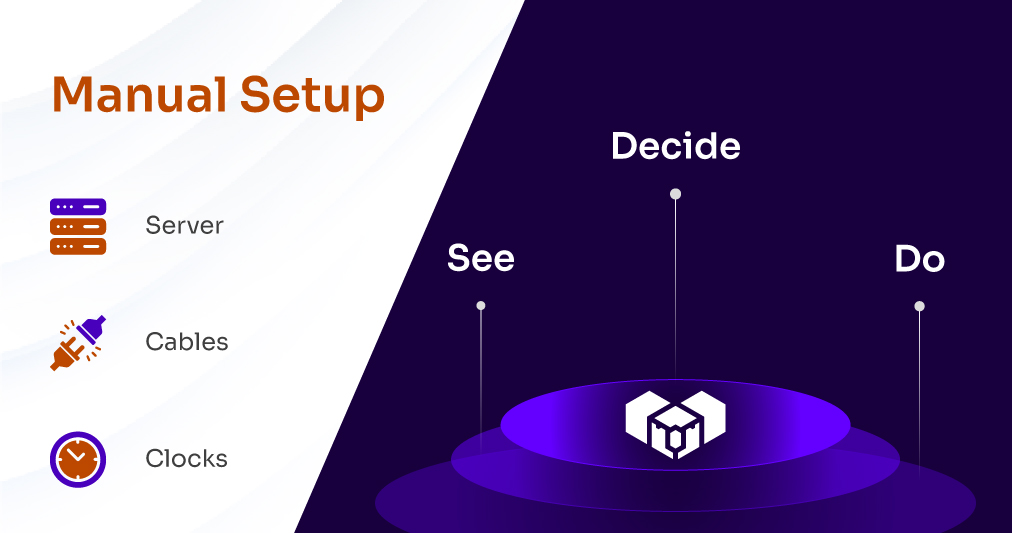
Event logs were originally designed as a foundation for automation. Every smart contract emits events (transfers, updates, executions) that developers could theoretically program against.
However, in practice, accessing and reacting to these events is challenging. Extracting block data from blockchains involves dealing with API limits, costly infrastructure, and unreliable centralized providers. Developers often spend days just setting up listeners, queues, and retry logic.
This complexity results in:
- Custom servers constantly polling blockchain nodes
- Manual parsing of event logs
- High resource consumption
- Delays in reacting to critical triggers
- Inconsistent execution across multi-chain systems
To build even a basic reactive dApp, teams end up architecting their own event-driven backend for blockchain apps, even though this backend work isn’t their core product value.
Kwala removes this entire layer.
Kwala’s core advantage: real-time event monitoring at protocol level
Kwala continuously streams blocks from major blockchain networks directly into its decentralized infrastructure. This means every on-chain event – transfers, contract executions, price movements, block updates, or address activity is instantly visible at the protocol level.
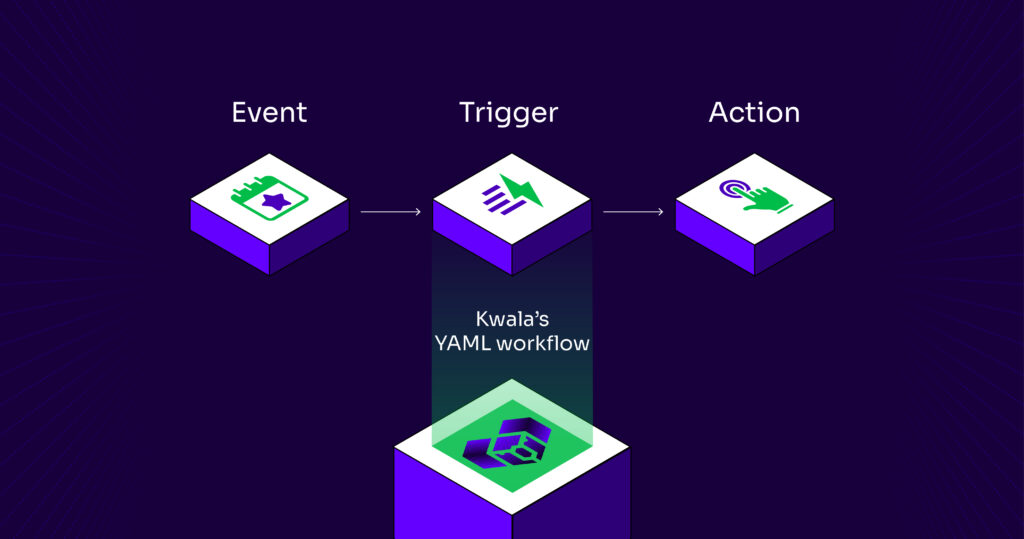
As the team describes it, every blockchain’s block is streamed into the Kwala network, allowing developers to work with these events as easily as writing a simple instruction.
This architecture turns Kwala into a true Web3 event trigger service, powered by a decentralized resource pool that reacts the moment an event appears on-chain.
Kwala can detect:
- Smart contract events
- Block confirmations
- Price or market-based triggers
- Time-based schedules
- Address-level activity
- Webhook inputs for Web2 ↔ Web3 flows
Once a workflow is activated, Kwala continuously monitors the defined events in real time.
YAML workflows: turning complex backend logic into simple automation
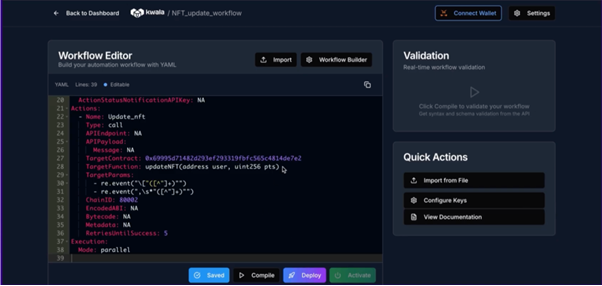
At the heart of Kwala’s real-time architecture is its YAML-driven workflow model. Each workflow contains 6 characters:
- A trigger: which event should initiate the workflow
- Actions: what should happen when the event fires
- Execution settings: parallel or sequential
- Expiry or TTL
- Cross-chain dependencies
Developers simply define the event they want to monitor and specify the actions Kwala should take. The rest is handled automatically by the decentralized network.
Programming event logs with Kwala is as simple as writing a WhatsApp text. The interface eliminates the need for specialized languages, backend logic, or infrastructure expertise: letting teams build responsive applications in minutes rather than weeks.
This dramatically accelerates the development lifecycle for event-driven dApps.
How Kwala executes real-time actions the moment events occur
When a trigger event fires, Kwala executes the defined logic instantly.
Developers can:
- Call smart contracts
- Send transactions
- Initiate cross-chain updates
- Trigger Web2 APIs
- Notify applications
- Perform multi-step workflows
Since Kwala is decentralized, no single node can interfere with workflow execution. Once deployed, each workflow is claimed by a specific node, ensuring conflict-free processing. This exclusive claim prevents duplicate actions and guarantees consistent, reliable execution across the network.
Real-time responsiveness becomes a built-in protocol guarantee.
Solving the real limitations of centralized event services
Centralized API providers offer partial solutions but often introduce new constraints: rate limits, unpredictable performance, or vendor lock-in. They may simplify reading events, but they don’t solve real-time orchestration across blockchains.
Kwala’s decentralized approach addresses these limitations directly:
- No rate limits (since the network streams blocks independently)
- No reliance on centralized gateways
- No need to maintain separate servers for event listeners
- No friction when scaling across multiple blockchains
- No specialized language or framework required
This creates the foundation for a truly autonomous decentralized event listener backend powered by the community, not a single provider.
Why real-Time event-driven architecture matters for Web3 builders
Applications today must react to events the moment they happen: especially in environments where timing affects user experience, asset values, or state changes.
With Kwala, developers can instantly automate:
- DAO notifications when proposals go live
- NFT reveal workflows
- Cross-chain liquidity updates
- On-chain → Web2 automation (emails, CRM updates, alerts)
- DeFi liquidation protection
- Gaming achievements and reward unlocking
Instead of building these systems manually, teams express logic through YAML, deploy once, and let Kwala’s decentralized network handle continuous monitoring.
Developers no longer need to master multiple ecosystems or maintain costly infrastructure. Kwala eliminates the need to create an entire backend just to save costs, helping teams stay focused on their core business logic.
Kwala as the real-time engine for a multi-chain future
As blockchains become more specialized – settlement layers, high-throughput chains, low-fee L2s – applications increasingly depend on integrating events across ecosystems.
However, bridging and multi-chain orchestration is prohibitively complex without automated, event-driven layers.
Kwala delivers this by:
- Listening to events across chains
- Triggering actions across chains
- Abstracting infrastructure complexity
- Providing uniform, predictable execution
This positions Kwala as both the Web3 event trigger service and the real-time engine that brings multi-chain automation within reach of every builder.
The automation layer Web3 has been missing
Event-driven Web3 applications demand constant monitoring, instant reactions, and seamless cross-chain logic. Traditionally, this required building an entire infrastructure stack before shipping even a basic feature.
Kwala replaces all of that with a decentralized automation layer that listens, reacts, and orchestrates in real time: allowing developers to build intelligent, event-driven systems without managing any backend complexity.
By turning blockchain events into accessible triggers and workflows, Kwala unlocks the speed, scalability, and automation Web3 applications were always meant to have.
FAQs on event-driven backend for blockchain apps
What types of events can Kwala monitor across chains?
Kwala detects smart contract events, block-based triggers, price movements, time schedules, address activity, and webhook inputs, enabling fully reactive automation across diverse use cases.
Can Kwala trigger actions outside blockchain systems?
Yes, workflows can call REST APIs, webhooks, or external services, allowing seamless integration with Web2 applications, databases, notification tools, or existing enterprise systems.
How reliable is Kwala’s execution when multiple events fire simultaneously?
Kwala assigns each workflow to a single node for conflict-free execution. It ensures deterministic, reliable processing even during high-frequency event bursts across complex multi-chain environments.