
 book a call with us
Decentralised finance (DeFi) is moving faster than any of us can keep up with manually. And with 83.2 million active DeFi users, on-chain activity has become denser. Your creditworthiness can change in seconds, yet most scoring systems update hours (or days) later. But tracking that manually is almost impossible. You’d need to monitor events nonstop, parse contract logs, and run […]
Read MoreEver had an event fire on Ethereum and your workflow on another chain just… didn’t?
A listener breaks, an RPC lags, a backend script stops silently; suddenly your entire workflow is out of sync. Cross-chain automation is powerful, but it’s fragile when built on custom servers, indexers, and polling engines.
Kwala removes that fragility. As a decentralized automation fabric designed to react to blockchain state changes, Kwala lets developers orchestrate smart contract workflows across chains without maintaining infrastructure. You monitor an event, define what should happen next, and Kwala executes that logic deterministically across networks.
This shifts Web3 development away from backend-heavy plumbing and toward a clean, declarative model: where blockchain activity becomes programmable triggers and multi-step workflows that run seamlessly across ecosystems.
This blog explains how that shift works in practice, and how Kwala makes cross-chain smart contract orchestration straightforward for developers.
Why cross-chain orchestration breaks down in traditional stacks
Most teams eventually run into the same set of problems, like:
- Backend listeners fail silently during RPC congestion
- Orchestration logic grows unmanageable across networks
- Multiple chains require separate monitoring pipelines
- Business logic must be duplicated across servers, scripts, and queues
Blockchains were designed as state machines, not reactive automation systems. They do not push events or natively trigger external actions. Yet real-world applications like NFT drops, asset mints, on-chain transfers, marketplace updates, and DeFi movements need exactly that.
kwala eliminates this overhead by becoming what blockchains have been missing: an accessibility layer that observes state changes across chains and turns them into reliable, programmable automation.
Instead of building and maintaining automation infrastructure, you simply define what should happen when a chain emits a specific event.
kwala’s event-driven foundation
Every workflow in Kwala begins with a precise event trigger. This is where you define:
- The chain you want to monitor
- The contract address
- The ABI
- The event name
- Event parameters you want to extract
Kwala’s event engine continuously streams block data into its decentralized network. Once your workflow is activated, Kwala monitors the selected event for you without servers, indexers, or polling.
You simply choose the smart contract your logic needs to listen to, select the event being fired on-chain, and use Kwala’s form-based builder to define what should happen next. Once you fill in these details and activate the workflow, Kwala handles the entire sequence seamlessly.
This is where smart contract workflow automation becomes intuitive instead of infrastructure-heavy.
A unified fabric for cross-chain workflow execution
Once an event is captured, Kwala can orchestrate actions across almost any major layer-1 or layer-2 network. Build on Ethereum for settlement, Base for faster and cheaper operations, Polygon for scaling: developers can combine the strengths of different chains in a single workflow.
This positions Kwala as a chain-agnostic dApp backend, where developers express logic declaratively and the network handles execution.
Since wallet interactions can create friction for users, Kwala simplifies that too. When a user connects to MetaMask, the wallet is automatically configured to Kwala’s own network, meaning no manual chain switching is required inside the wallet for workflows to run.
How a cross-chain workflow runs on Kwala
Monitor an Event → Send Telegram Alert → Trigger a Cross-Chain Contract Call
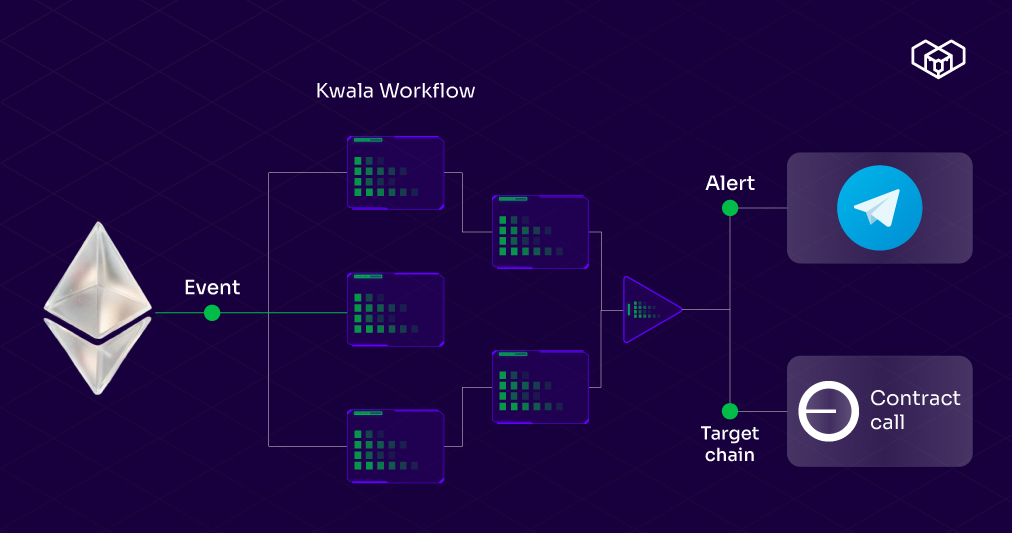
Here is a clean example of how Kwala orchestrates multi-chain logic without backend infrastructure. The workflow listens for a mint event on Ethereum, notifies the team on Telegram, and then synchronizes state by executing a smart contract function on Base.
Step 1: Create a new workflow
Name it something like Mint Sync Across Chains.
Step 2: Select the correct trigger – event
Choose Event trigger, then specify:
- Chain: Ethereum
- Contract Address: Your NFT or custom contract
- ABI: Paste or upload the ABI
- Event: The mint event (e.g., Transfer or any custom event)
- Event Parameters: Map fields like tokenId, from, or to as needed
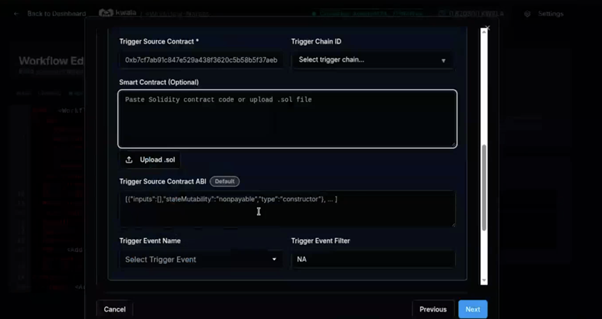
This tells Kwala to react whenever the contract emits this event.
Step 3: Add action #1 – send a Telegram alert
Configure:
- Telegram bot token
- Chat ID
- Message template (e.g., “New token minted: {{tokenId}} to {{to}}”)
Kwala automatically references event parameters, ensuring your operations team receives a real-time notification.
Step 4: Add action #2 – execute a cross-chain contract call
Now define the orchestration step:
- Chain: Base
- Contract Address: The target contract for synchronization
- Function: Choose it from your ABI
- Inputs: Pass event values (e.g., tokenId, recipient address) into the function
This is where Kwala’s workflow engine shines: executing deterministic logic across chains without you managing RPC providers, retries, or backend code.
Step 5: Review and publish
Once live, the workflow executes automatically:
- Ethereum contract emits the mint event
- Kwala detects it instantly through the event trigger
- A Telegram notification is sent to your team
- A contract function on Base is executed using the event payload
This is true cross-chain smart contract orchestration, powered entirely by a declarative workflow.
Why teams choose Kwala for cross-chain automation
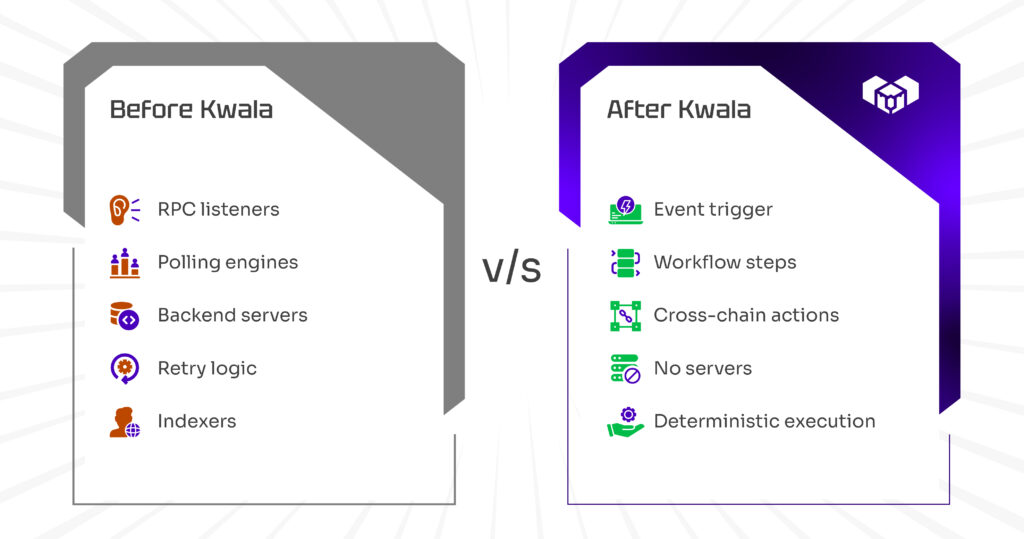
Kwala gives developers a programmable yet serverless layer for orchestrating smart contract workflows across chains.
With its stateless automation model and event-driven architecture, teams gain:
- Event-driven model: reacts instantly to blockchain state changes
- Form-based workflow builder: no learning curve or scripting required
- Cross-chain orchestration: execute logic across multiple L1s and L2s
- Gas abstraction via Kwala credits: no need to maintain native tokens across wallets
- Serverless execution: no backend listeners or servers to maintain
- Web2 compatibility: call REST APIs or trigger external services
- Decentralized resource pool: an open network anyone can build on
Whether you’re synchronizing assets across chains, sending off-chain alerts, or coordinating multi-network contract calls, Kwala makes it intuitive through its automation engine for cross-chain smart contract orchestration, smart contract workflow automation, and building a chain-agnostic dApp backend.
Kwala turns the blockchain from a passive state machine into an active automation layer – one where every event becomes a programmable opportunity to drive your application forward.
FAQs on cross-chain smart contract orchestration
Can Kwala listen to events on any smart contract I’ve already deployed?
Yes, as long as you provide the contract address and ABI, Kwala can listen to events emitted by existing contracts. This includes custom events you’ve defined yourself.
Can I expand my workflow to new chains without rewriting my logic?
Yes, you can add new actions on additional chains by simply adding steps and selecting the chain. The workflow remains the same; Kwala manages orchestration across L1s and L2s.
Do the chains in my workflow need to be compatible (e.g., all EVM chains)?
No, as long as Kwala supports the chains, they can be mixed freely. You can monitor a contract event on Ethereum, then run a contract function on Base or Polygon, and even trigger a Web2 API off-chain in the same sequence.