
 book a call with us
You can track on-chain events all day, yet the one update that matters still slips by unnoticed. Logs get messy, updates lag, and custom scripts break at the worst times. Developers may also struggle with unreliable RPC endpoints, rate limits, inconsistent indexing, and maintaining cron jobs or listeners that silently fail. And the more chains or contracts […]
Read MoreEvery Web3 team hits the same wall. Your smart contracts are ready. Your front end looks great. Then you try to connect everything and realize the hardest part is not the blockchain. It is the messy glue code holding your app together.
This is when a real Web3 API provider stops being optional. Kwala steps in here. It works as a backend logic engine blockchain teams plug into when they want instant reactions to on-chain events without building a giant backend.
This piece breaks down why backends fail in Web3, what secure and scalable APIs actually need, and how Kwala replaces fragile custom code with a reliable, event-driven foundation.
What is a web3 API?
A Web3 API is the layer that lets your app talk to the blockchain the same way a food delivery app talks to a restaurant. It reads on-chain data, reacts to events, and triggers smart contract actions without you building every connector yourself.
For example, if an NFT is minted, a Web3 API can detect it instantly and update your app, send a message, or launch a workflow.
Here’s exactly how a Web3 API helps your app:
- Detects on-chain events in real time
- Triggers smart contract calls and workflows automatically
- Cuts backend complexity and reduces maintenance
- Supports multi-chain logic without extra code
- Improves debugging with transparent analytics
- Keeps execution consistent during traffic spikes
- Makes your app faster, safer, and easier to scale
In short, a Web3 API gives your app a faster and more reliable way to react to blockchain events. It becomes the backbone of a secure, scalable Web3 build.
4 reasons why web3 APIs break at scale
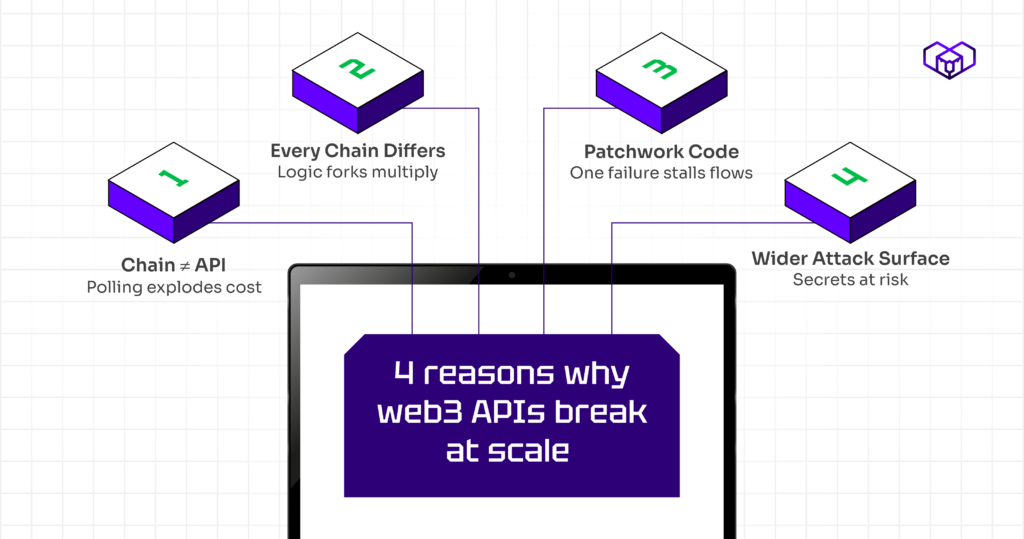
Scaling matters in Web3 because growth brings heavier traffic, faster event flow, and higher expectations from users who want instant reactions to everything happening on-chain. But most teams discover that their Web3 APIs start failing long before the product grows.
Let’s look at some reasons why this happens:
1. Blockchains are not built for API style interactions
Blockchains answer only when queried, so they behave more like passive databases than real-time systems. Apps that need immediate reactions start polling aggressively, which raises cost and puts pressure on infrastructure.
Delays build up fast during activity spikes. A real-time engine with Web3 backend analytics and workflow monitoring helps teams see bottlenecks, reduce polling, and catch missed events before they break the system.
2. Every chain behaves differently
RPC limits, event formats, block times, and congestion patterns vary wildly across chains. Developers end up rewriting the same logic for each network, which slows down builds and breaks consistency.
Cross-chain automation becomes unreliable without orchestration. Using a unified Web3 API provider smooths these differences by offering one consistent event layer across all networks.
3. Custom backend code grows into a patchwork
Teams often build listeners, queues, cron jobs, and indexing logic on their own. This works at first, but quickly turns into a fragile web of microservices. One failure in the chain interrupts the entire workflow.
A centralized, event-driven backend logic engine blockchain removes this complexity by replacing scattered backend glue code with a single, reliable execution layer.
4. Security risks increase with complexity
More endpoints and more scripts create a bigger attack surface. Poorly monitored listeners generate blind spots where issues hide. Keys and secrets get stored in unsafe environments just to keep workflows running.
With a secure API layer, including Web3 backend analytics and workflow monitoring, however, it reduces this risk by giving complete transparency into execution and enforcing safer secret management.
How Kwala solves these problems
Scaling Web3 APIs does not have to be difficult. With the right tooling, backend strain, event handling, and cross-chain logic become easier to manage.
Kwala delivers this by acting as a Web3 API provider, while offering powerful Web3 backend analytics and workflow monitoring. Below is how Kwala does this and builds a truly scalable Web3 API layer:
Real-time on-chain event monitoring
Kwala listens to mints, transfers, approvals, and other on-chain events without relying on heavy polling. This removes the need for custom listeners that often break at scale. As a Web3 API provider, it delivers fast, accurate triggers your app can depend on.
Built-in Web3 backend analytics and workflow monitoring also give teams full visibility into event flow and performance.
Built-in triggers for Web2 and Web3 actions
Kwala connects on-chain events to both Web3 and Web2 systems, so apps can react instantly without custom glue code.
What it enables:
- Smart contract calls triggered by blockchain events
- Web2 actions such as Slack alerts, Notion updates, emails, or CRM updates
- Smooth workflows for hybrid apps that mix Web2 and Web3 logic
This creates a unified automation layer where both ecosystems work together, powered by consistent monitoring and clean analytics from Kwala’s Web3 backend analytics and workflow monitoring.
High reliability through a decentralized backend
Instead of relying on a single server, Kwala uses a decentralized execution layer that remains stable under pressure. Workflows scale automatically during sudden surges, reducing downtime and eliminating bottlenecks.
The architecture performs well for NFT launches, DeFi operations, and DAO automations where reliability is crucial. The result is a backend that grows with your traffic instead of collapsing under it.
Multi-chain workflow automation baked in
Kwala removes the complexity of handling multi-chains by abstracting their quirks into one streamlined logic layer. Developers write workflows once and execute them anywhere, without needing to rewrite code for each network, significantly reducing engineering overhead and preventing cross-chain failures.
It also provides a clean environment for orchestrating smart contract calls across multiple ecosystems.
Strong security with full visibility
Security is not an add-on but a core layer of the platform’s architecture. Here’s how:
- Secrets remain fully encrypted
- Access controls prevent unauthorized execution
- Execution logs capture every workflow action for audit clarity
- Stateless design minimizes exposure and reduces attack surfaces
Thus, protecting sensitive data and ensuring workflows run safely in production environments.
Zero vendor lock-in
Kwala keeps teams in control of their setup instead of locking them into one system. Workflows run on a decentralized network, so you are free to add chains, shift your architecture, or scale without reworking the backend.
You also pay only when workflows run. It’s a flexible foundation built to support how real teams grow.
Kwala as the backend logic engine blockchain teams rely on
Scaling a Web3 product gets easier when your backend stops fighting you. That is what Kwala brings to the table. Instead of wrestling with listeners, queues, and chain quirks, you get one steady logic engine that handles the messy parts and lets you focus on your actual product.
The bonus is the visibility you gain through real web3 backend analytics and workflow monitoring, which helps you catch issues early and ship with more confidence. A simple tip: invest in backend clarity before chasing scale. It saves far more time than it costs.
Start building with Kwala and streamline your entire Web3 backend
FAQs on web3 API provider
What is an API service provider?
An API service provider gives apps a way to talk to external systems without heavy backend work. In Web3, a Web3 API provider handles on-chain data, triggers, and workflows so developers can build faster.
Is Google using web3?
Google supports parts of the Web3 ecosystem through cloud tools and blockchain datasets. Teams still pair these tools with a backend logic engine blockchain for automation and workflow execution.
How to connect to a Web3 provider?
You connect by using an RPC endpoint or SDK from a web3 API provider. Tools like Kwala also give web3 backend analytics and workflow monitoring, so you can track every action clearly.