
 book a call with us
When your app depends on fast user actions, manual bounty payouts can feel painfully slow. Teams often find themselves tracking every event, checking every wallet, and approving every reward – work that becomes chaotic the moment users interact frequently. These delays don’t just add operational load; they interrupt the real-time experience that players and community members expect. One […]
Read MoreThe moment a dApp needs to react to on-chain activity, teams face a familiar bottleneck: every workflow demands its own patchwork of monitors, scripts, queues, and retry logic. What starts as a single event subscription quickly grows into a fragile backend that must stay online around the clock.
This is why developers increasingly rely on a dApp orchestration tool rather than building backend plumbing themselves.
However, the landscape of Web3 backend solutions is broad – API providers, automation networks, low-code builders – each solving a piece of the problem. The challenge is identifying which approach supports real-scale, multi-chain applications without burdening teams with more operational overhead.
Kwala enters here with a different foundation. Instead of providing data endpoints or simplified SDKs, it offers a decentralized orchestration layer that watches blockchain activity in real time and carries out workflows end-to-end.
Why orchestration matters in modern dApp design
As dApps expand across L1s and L2s, backend work becomes less about writing code and more about managing complexity:
- Every chain emits events differently.
- Liquidity sits across ecosystems, forcing cross-chain interactions.
- Web2 systems still need to be integrated into on-chain workflows.
A blockchain workflow orchestration platform addresses these growing points of friction. Instead of adding new tooling to maintain, it centralizes triggers, actions, and execution logic. The value lies in freeing developers from the constant setup, testing, and maintenance cycle that consumes most engineering time.
For multi-chain teams, this shift is even more important. Cross-chain workflows often require stitching together separate services, each with its own limits and assumptions. Kwala avoids that by allowing workflows to span chains directly through YAML logic executed by a decentralized resource pool.
How Kwala structures automation
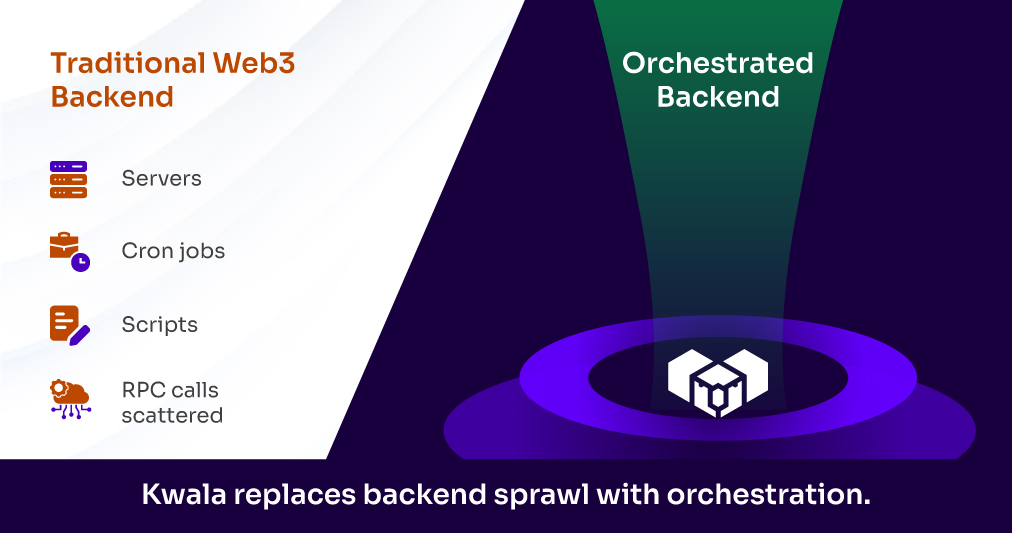
Kwala treats automation as a first-class architectural layer rather than an add-on to backend code. Instead of relying on developer-hosted servers to watch for on-chain activity, Kwala’s decentralized network continuously processes blocks from major L1s and L2s and reacts the moment a defined condition is met.
This multi-chain foundation is built into the protocol itself. A single workflow can listen to an event on one chain, execute a contract call on a different chain, and pass results to an off-chain system: all without separate indexers, cron jobs, or monitoring scripts.
Workflows are expressed declaratively in YAML, allowing teams to capture intent without managing any backend logic:
- Triggers: contract events, block milestones, address activity, or API responses
- Actions: contract executions, Web2 API calls, notifications, or chained operations
- Execution: parallel or sequential steps depending on workflow design
By separating logic from infrastructure, Kwala eliminates the operational burden that usually comes with multi-chain automation. This is also what differentiates it from a typical Web3 automation platform: execution happens within a decentralized network rather than through centralized servers, API layers, or tool-specific backends.
Where Kwala differs from leading Web3 backend competitors
Below is a streamlined comparison with the four competitors most commonly chosen for event-driven or backend-heavy Web3 development.
1. Alchemy: API and node infrastructure
What it offers: Reliable RPC, WebSockets, and enhanced APIs for reading blockchain data.
Where it stops:
- Event listeners depend on centralized uptime
- Automation requires developers to run their own logic
- Cross-chain workflows become a multi-tool effort
Kwala’s shift: Logic executes inside the decentralized network itself, removing the backend layer entirely and making cross-chain orchestration native rather than assembled.
2. Moralis indexing and data APIs
What it offers: Fast data access and simple endpoints for tracking events or tokens.
Where it stops:
- Credit-based limits can restrict event-heavy workflows
- Requires external infrastructure for executing follow-up logic
- Multi-chain workflows must be designed manually
Kwala’s shift: Kwala doesn’t rely on API endpoints for event detection; it monitors block data directly through its decentralized network and can act on events without developer-managed servers.
3. QuickNode Streams: hosted event triggers
What it offers: Real-time updates and tracking contract activity.
Where it stops:
- Triggers are only the starting point; execution is left to the developer
- Additional services are required for queuing, retries, and workflow logic
- Cross-chain interactions depend on stitching multiple integrations together
Kwala’s shift: Triggers and actions exist in one system. A workflow can express intent end-to-end – listening, executing, coordinating across chains – without additional tooling around it.
4. Gelato: smart contract automation protocol
What it offers: On-chain scheduling, conditional checks, and decentralized execution.
Where it stops:
- Not designed for multi-chain workflow orchestration
- Less suited for mixed Web3-Web2 automations
- Requires developers to structure logic through predefined on-chain conditions
Kwala’s shift: Kwala supports on-chain, cross-chain, and off-chain automation under one model, using YAML to define workflows with far more flexibility.
Why teams choose orchestration-first development
A modern dApp orchestration tool should reduce operational drag, not add new layers of complexity.
Kwala aligns with this shift by offering:
- Native event monitoring across major L1s and L2s
- Decentralized execution that scales without dedicated servers
- Hybrid automation for Web3 and Web2 systems
- Workflow clarity through declarative YAML instead of custom backend code
For many teams, this structure shortens development cycles because the orchestration logic becomes the product logic; infrastructure no longer dictates what is feasible.
Web3 is moving toward automation-first backends
As applications become more interconnected and liquidity spreads across chains, infrastructure-heavy approaches make less sense. A blockchain workflow orchestration platform gives teams a stable foundation for reacting to on-chain activity without rebuilding backend machinery for every feature.
Kwala extends this model further by combining event monitoring, decentralized compute, and multi-chain automation inside a single system. The result is a Web3 automation platform that supports production-scale applications without requiring developers to build or manage backend infrastructure.
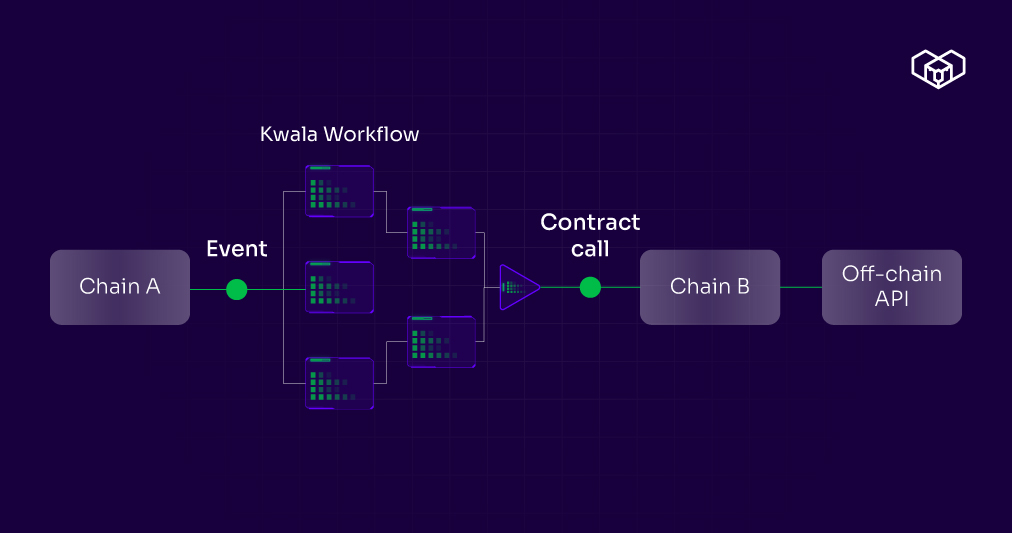
Instead of maintaining systems just to keep workflows alive, teams focus on design and logic, and Kwala handles the orchestration.
FAQs on dApp orchestration tool
1. Does Kwala require developers to learn a new language or framework?
No, workflows are written in simple YAML. Developers only specify triggers, contract addresses, and actions. No new programming language, SDK, or framework is required to operate multi-chain automations.
2. How does Kwala fit into enterprise compliance requirements?
Kwala never holds private keys or user data and only processes signed transactions. Its decentralized execution and audit-friendly workflow structure help enterprises meet requirements like GDPR, MAS, and SEC guidelines.
3. How does Kwala handle failures or retries in multi-chain workflows?
Kwala’s network validates each step and reruns failed actions automatically based on workflow rules. This ensures cross-chain logic continues reliably without developers manually managing retries or fallback infrastructure.