
 book a call with us
Building in Web3 still feels heavier than it should. Developers spend more time fixing infra, writing listeners, and stitching chains together than actually shipping features. A Web3 backend platform for developers is no longer a nice-to-have. It’s essential. Kwala steps in as a developer backend platform that Web3 teams can trust. It provides multi-chain workflow automation for developers, a serverless blockchain infrastructure for developers, and a no-DevOps […]
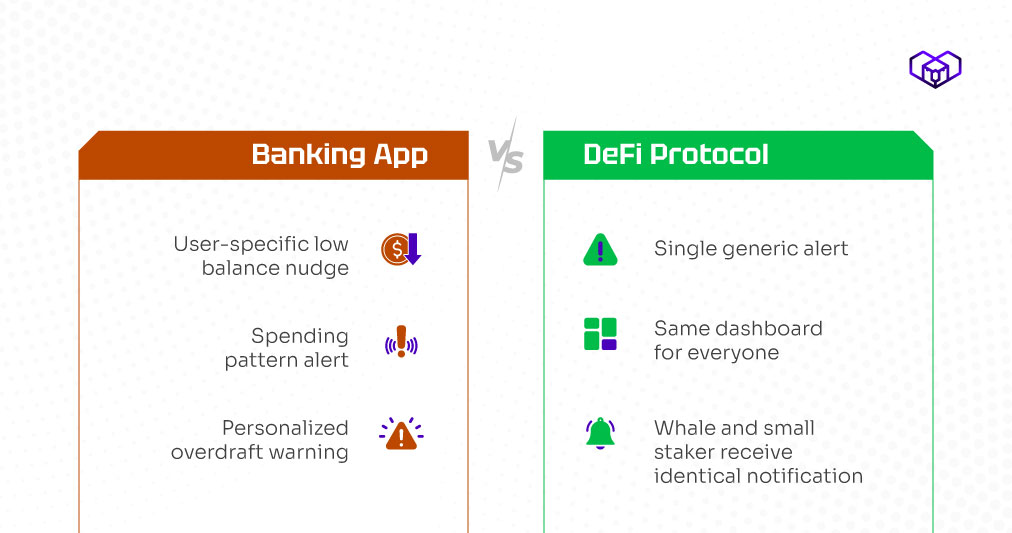
Read MoreYour banking app knows when your balance drops low. It sends a nudge before you overdraft. It learns your spending patterns and adjusts alerts accordingly.
Now open any DeFi protocol. Everyone sees the same dashboard, the same alerts. A whale moving millions gets the same experience as someone staking fifty dollars.
This is the personalized DeFi gap that costs protocols their users.
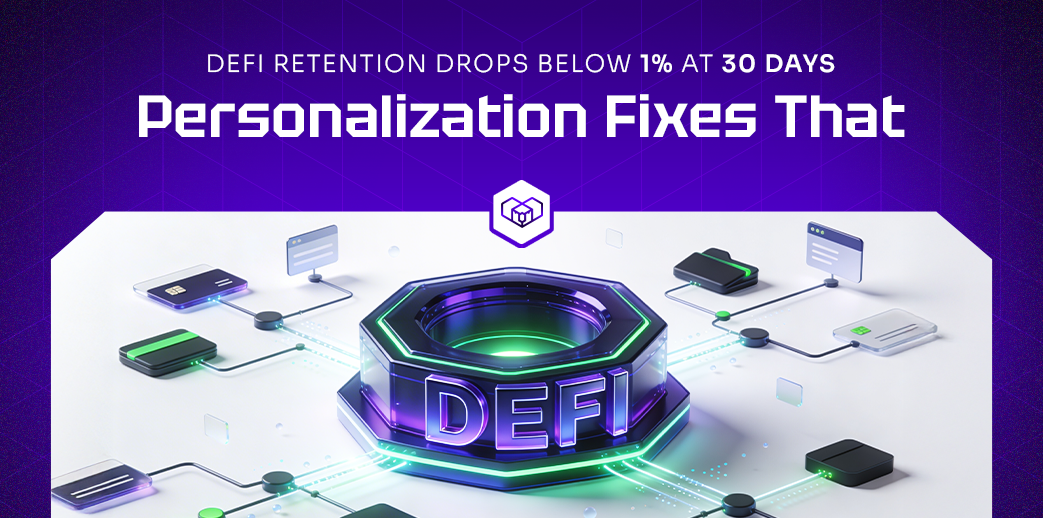
According to Deloitte’s Global Banking Consumer Study, 78% of customers expect financial advice tailored to their personal situation — a standard DeFi has yet to meet. Meanwhile, DeFi retention drops below 1% after thirty days. These numbers connect directly. Generic experiences push users away. Personalized ones keep them engaged.
The infrastructure to close this gap already exists and it doesn’t require rebuilding your protocol from scratch. Here’s how event-driven automation makes DeFi personalization deployable in days, not months.
Why one-size-fits-all fails in DeFi
Think about liquidation warnings. Most protocols set one threshold for everyone, maybe 120% collateral ratio. But risk tolerance varies wildly between users.
For the conservative user, alert fatigue sets in within days. They disable notifications entirely and miss the one that matters. For the active trader, the 120% alert arrives too late. By the time they act, slippage and gas costs have already eroded their position. These aren’t edge cases. They are the predictable outcome of designing one experience for a user base with fundamentally different risk profiles, portfolio sizes, and engagement patterns. Generic alerts don’t just fail to help they actively damage user trust in the protocol.
AI-driven DeFi workflows offer a great solution by adapting to individual preferences. Instead of broadcasting one signal to everyone, automation layers route different messages to different users based on their settings.
The same trigger logic applies across any lending protocol, DEX, or governance contract wherever on-chain state changes carry meaning for your users.
In practice, a personalized liquidation alert workflow on Kwala might look like this: you define a trigger on the HealthFactor event of your lending contract. You map wallet addresses to user preference tiers pulled from your backend API conservative, standard, aggressive. Kwala evaluates each event against the matching preference tier and fires the appropriate action: an urgent Telegram message for the aggressive trader at 110%, a standard email for the conservative holder at 150%, and nothing for the user who opted out entirely. One workflow definition. Thousands of personalized executions. Zero custom backend routing logic on your end.
How Kwala enables custom automation
Kwala lets you create custom DeFi automation that responds to individual context. The process works in three parts.
Step 1 — Define the Trigger
Monitor the on-chain event that matters: a collateral ratio change, a token transfer, a governance proposal. Kwala watches your specified contract continuously.
Step 2 — Set User Conditions
Map conditions to wallet addresses or user segments. User A’s threshold is 150% collateral. User B’s is 110%. The same on-chain event fires different logic for each.
Step 3 — Configure Personalized Actions
Route outputs to the right channel with the right message. Push notifications, Telegram alerts, email digests — each user receives what they configured, nothing they didn’t.
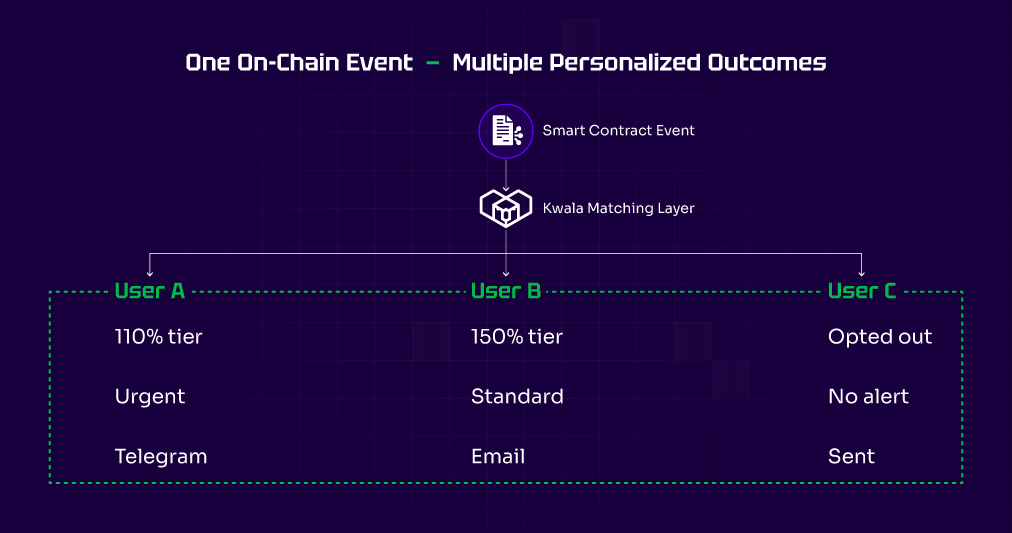
The same protocol event triggers different responses for different users. User A gets an urgent alert. User B gets a gentle reminder. User C gets nothing because they opted out of that notification type.
This is smart DeFi automation in practice. One workflow handles thousands of users, each receiving a tailored experience.
3 DeFi Personalization Patterns That Measurably Improve User Retention
Building adaptive DeFi strategies comes down to three proven patterns.
1. Threshold-based personalization
Let users define their own trigger points. When staking rewards hit a user-defined minimum, send the claim reminder. When governance proposals match user-defined categories, send the voting alert.
Teams already exploring token price-based notifications can extend this logic to any user preference.
2. Behavior-responsive alerts
Track how users interact and adapt over time. If someone ignores yield alerts under 5%, stop sending them. If someone always claims rewards on Fridays, batch their notifications accordingly.
Behavioral adaptation is where DeFi personalization moves beyond simple threshold configuration. Instead of asking users to manually fine-tune every preference, the system observes interaction patterns and adjusts autonomously. A user who consistently dismisses low-yield alerts is signaling a preference more reliably than any settings form. A user who always acts on governance alerts within the first hour reveals a high-engagement profile that warrants priority delivery.
Kwala workflows can incorporate this behavioral context by reading interaction logs from your backend no on-chain data storage required. The result is a notification system that gets smarter with every interaction, without your team touching the workflow configuration.
3. Portfolio-aware messages
Context shapes meaning. An ETH price drop matters differently to someone with 90% ETH exposure versus 5%.
Pull wallet composition before sending alerts. Deliver risk warnings to concentrated holders and opportunity alerts to diversified ones.
Why personalized DeFi is crucial for business
Protocols spend heavily on user acquisition through airdrops, incentives, and marketing campaigns. But then users leave within weeks because the experience feels generic and overwhelming.
Smart DeFi automation reverses this pattern. When alerts actually matter to users, engagement increases. When engagement increases, retention follows.
According to McKinsey’s personalization research, apps with adaptive personalization see 25–30% higher retention than those delivering generic experiences — a gap that compounds significantly at scale.
The same principles apply during onboarding. Teams that automate user onboarding flows see reduced early drop-off. Personalization works at every stage of the user journey, from first interaction to long-term engagement.
Building without heavy infrastructure
Traditional personalization requires significant infrastructure investment:
- User preference databases to store individual settings
- Notification routing systems to direct messages appropriately
- Backend logic to match events with user segments
- Ongoing maintenance to keep everything synchronized
For a mid-size protocol team, building this stack typically represents four to eight weeks of senior engineering time before accounting for ongoing maintenance, incident response, and scaling work as user counts grow. Kwala replaces this entire layer with a declarative workflow configuration. Your frontend captures user preferences via standard API calls. Kwala handles the matching, execution, and delivery. The credit-based model means you pay for successful executions, not idle infrastructure. For most teams, the economics resolve quickly: the cost of not personalizing measured in churn far exceeds the cost of deploying Kwala workflows.
Personalized automation builds on the same event-driven foundation as general workflow automation once your triggers are configured, adding user-specific routing is incremental, not a rebuild.
The combination delivers Adaptive DeFi workflows without requiring your team to become infrastructure specialists.
Ready to Personalize Your Protocol?
The gap between generic DeFi experiences and personalized ones isn’t a design problem it’s an infrastructure problem. Kwala gives protocol teams the event-driven automation layer to close that gap without rebuilding their backend. Start with threshold-based alerts. Add behavioral routing as your user data grows. Scale to full portfolio-aware personalization as your protocol matures. The workflow structure supports every stage. Explore Kwala’s personalization workflows
Frequently Asked Questions: Personalized DeFi Automation with Kwala
Does personalization require storing user data on-chain?
No, Kwala workflows reference off-chain preference data through your backend APIs. On-chain events serve as triggers while personalization logic incorporates any data source you control.
Can I start with basic DeFi personalization and scale automation over time?
Yes. Begin with basic threshold personalization. Add behavior-based adjustments as you gather usage data. The workflow structure supports iterative improvement.
How does Kwala handle default alerts for users who haven’t set preferences?
Default to sensible baseline settings. Users who have not customized still receive standard alerts. Those who configure preferences get the enhanced experience.