
 book a call with us
Decentralised finance (DeFi) is moving faster than any of us can keep up with manually. And with 83.2 million active DeFi users, on-chain activity has become denser. Your creditworthiness can change in seconds, yet most scoring systems update hours (or days) later. But tracking that manually is almost impossible. You’d need to monitor events nonstop, parse contract logs, and run […]
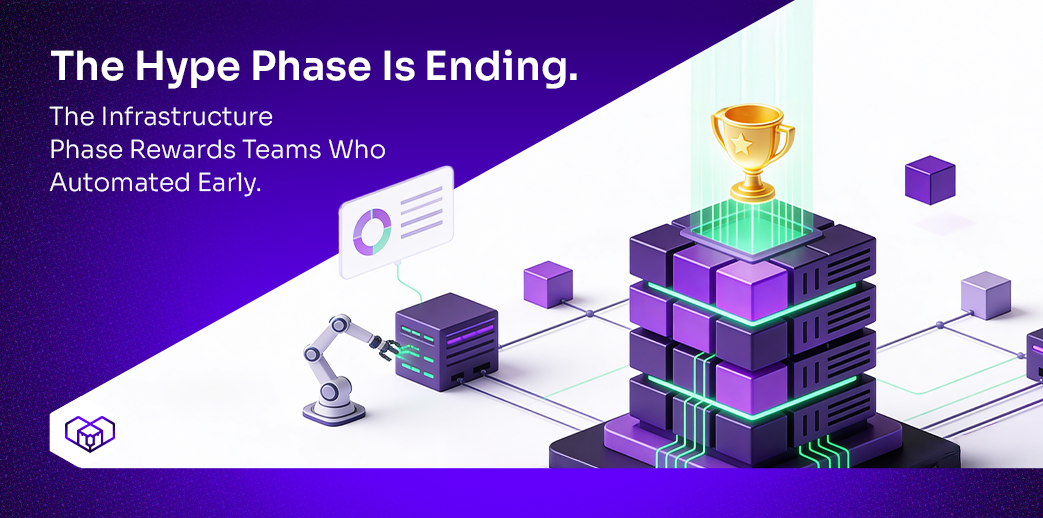
Read MoreIn 2026, the Web3 hype cycle is ending and the infrastructure phase is beginning. The protocols that survive the transition will be the ones that automated early.
What does that actually mean for builders? It means the hype phase is ending. The infrastructure phase is beginning. And the teams that win will be the ones who automated early, while others were still doing things manually.
The Web3 automation roadmap for 2026 looks different from previous years. AI agents are moving from experimental to mission-critical. Event-driven architectures are becoming standard. Manual orchestration is becoming a competitive liability.
Automation trends 2026 are about positioning your protocol for a landscape where automation is the baseline, not the differentiator.
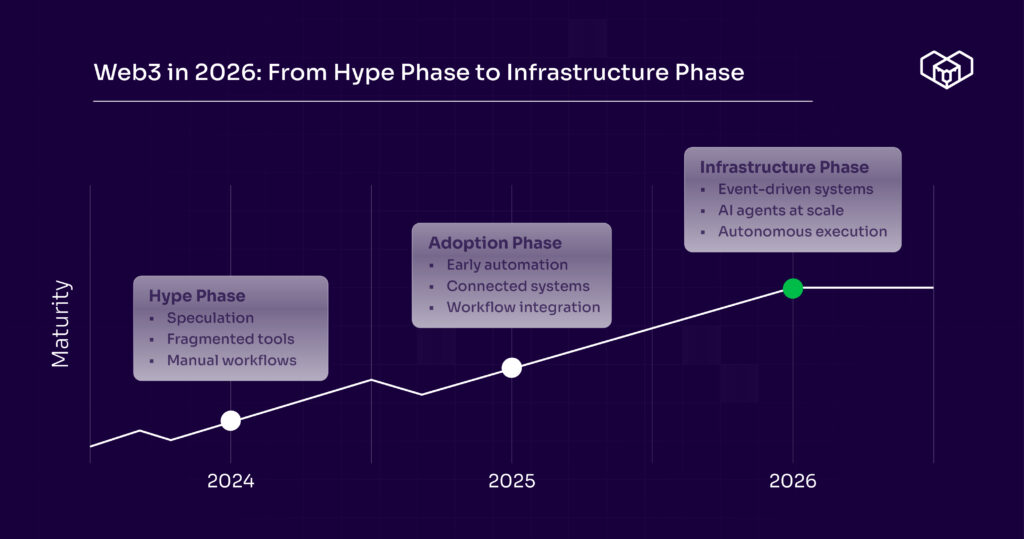
Where Web3 Automation Actually Stands in Early 2026
Here is where the market stands heading into 2026.
Studies show AI agents could generate $450 billion in economic value by 2028. Yet in 2026, only 2% of organizations have deployed AI agents at full scale. Another 12% have them running at partial levels. That gap represents the opportunity.
The convergence of blockchain, AI, and Web3 is moving from buzz to infrastructure. Production deployments in supply chain, tokenized real-world assets, and automated governance are scaling first.
Automation trends 2026 point clearly toward event-driven systems that connect on-chain activity to off-chain responses.
For teams building now, the question is not whether to automate, but where to start. Understanding how blockchain events trigger automated actions provides the foundation for everything that follows.
Three Shifts Defining the Future Blockchain Automation Landscape
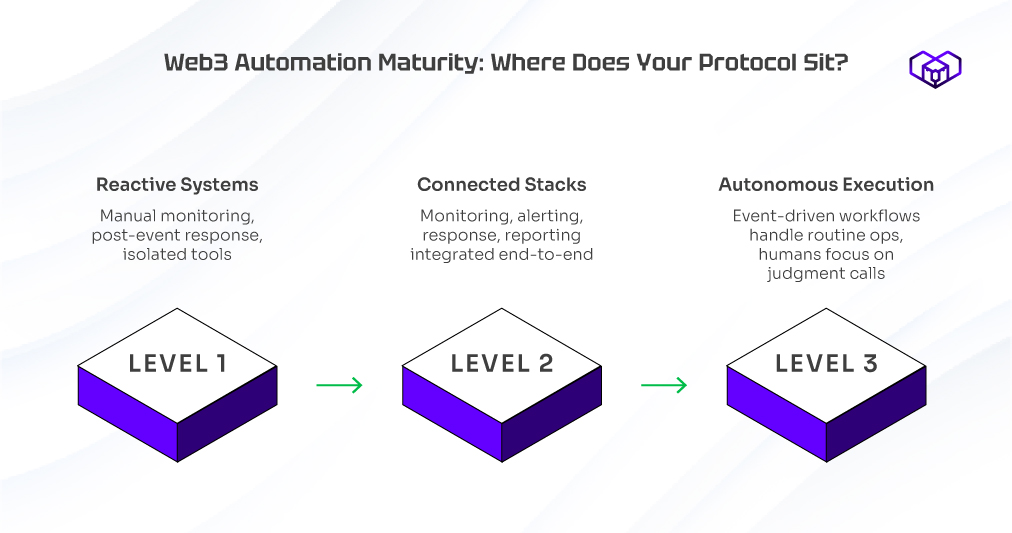
Future blockchain automation is being shaped by three major shifts that separate teams building durable infrastructure from those still reacting to events manually.
1. From reactive to proactive systems
Early automation responded to events after they happened. Next-generation systems anticipate conditions and prepare responses in advance.
Workflows that monitor approaching thresholds and trigger preparations before critical moments arrive are becoming standard.
A reactive system alerts you when a wallet’s collateral ratio hits the liquidation threshold. A proactive system monitors the trajectory collateral value declining over several blocks and alerts the user at 130% so they can act before the 120% trigger. The difference between these two systems isn’t intelligence. It’s the window between detection and action. Proactive automation creates that window. Reactive automation eliminates it.
2. From isolated tools to connected stacks
Standalone automation tools are giving way to integrated systems. Your monitoring connects to your alerting connects to your response workflows connects to your reporting.
The teams winning in 2026 built these connections early.
A connected stack in practice: an on-chain governance proposal reaches quorum, triggering a Kwala workflow that simultaneously posts to your protocol’s Discord, updates your governance dashboard API, and sends email notifications to registered voters. Three systems updated by one event, without a developer manually copying data between them. The value isn’t in any single notification it’s in the elimination of the lag between on-chain state and off-chain awareness.
3. From manual oversight to autonomous execution
Human-in-the-loop requirements are shrinking for routine operations.
Event-driven workflows handle the predictable stuff automatically, freeing teams to focus on decisions that actually require human judgment. Teams exploring workflow automation for reducing manual actions are already moving in this direction.
Human oversight remains essential for novel situations, edge cases, and high-stakes decisions. But for routine operations threshold alerts, deployment notifications, compliance data routing, balance warnings requiring human initiation creates unnecessary delay and introduces failure points. Event-driven workflows handle the predictable 80% automatically. Your team focuses cognitive resources on the 20% that genuinely requires judgment.
Building Your AI Automation Strategy for 2026
Event-driven automation does not require building AI models. You define triggers, conditions, and actions using Kwala’s configuration approach. The intelligence comes from how you connect systems, not from complex algorithms.
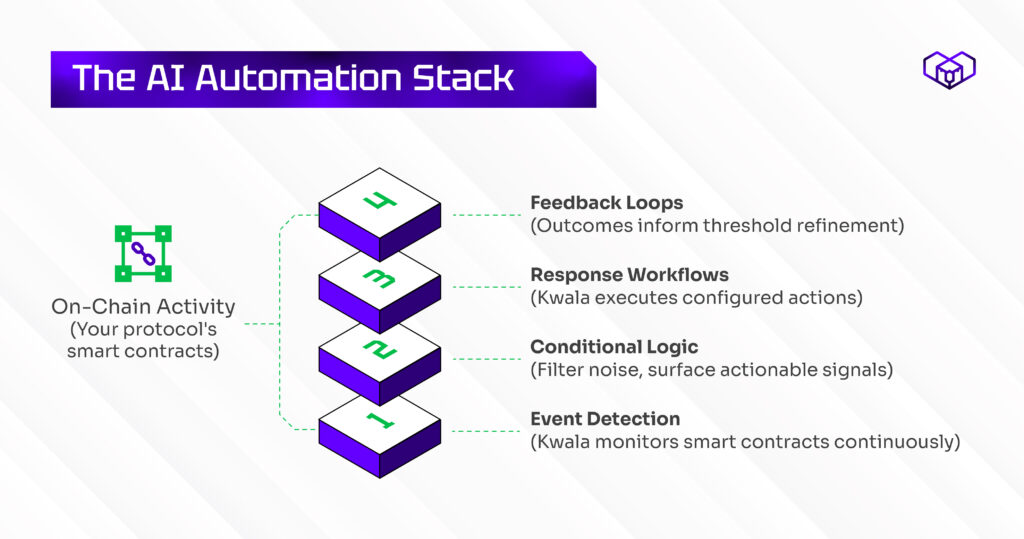
Here is how to think about it:
- Step 1 — Event Detection: Monitor What Matters
- Step 2 — Conditional Logic: Filter Noise, Surface Signals
- Step 3 — Response Workflows: Automate Appropriate Action
- Step 4 — Feedback Loops: Build Systems That Improve Over Time
This is precisely the infrastructure layer Kwala is built to provide. Rather than requiring teams to build custom indexing, webhook servers, or event parsers, Kwala operationalizes this stack through declarative workflow configuration — you define the logic, the platform handles the execution. Kwala fits into this stack as the event-driven layer that connects on-chain activity to your automation responses. You define what to watch for. You configure what happens when conditions are met. The platform handles monitoring and execution.
The key insight for AI Web3 strategy is that intelligence comes from connection. Simple rules applied consistently beat sophisticated models applied inconsistently.
Your Web3 Automation Roadmap: Quarter-by-Quarter for 2026
Here is what a complete blockchain innovation roadmap covers for the year ahead.
Q1: Foundation: Event Monitoring and Core Notifications
Establish event monitoring for your core smart contracts. Build notification workflows that keep your team informed of critical activity.
This is table stakes, and teams without it are already behind. Start with automated alerts for blockchain activities as your foundation.
Concretely, Q1 means: identify your three to five most critical smart contracts, configure Kwala event triggers for each, and establish notification routing to your primary team communication channel. By end of Q1, your team should receive automatic alerts for every deployment, every significant transfer, and every state change that currently requires manual monitoring. The goal is not sophistication it’s eliminating blind spots. Teams that complete Q1 properly find that the act of defining “what matters” in their contracts clarifies their entire operational picture.
Q2: Integration: Connecting On-Chain Events to Off-Chain Systems
Connect your event detection to your existing operational tools. When on-chain conditions are met, trigger responses in your off-chain systems. This is where automation starts delivering real efficiency gains.
Q2 is where automation starts generating measurable efficiency gains. Connect your event detection layer to your existing operational tools: your KYT platform, your case management system, your CI/CD pipeline, your reporting dashboard. A qualifying transfer on-chain should automatically update your compliance queue. A contract deployment should automatically trigger your integration test suite. A governance proposal reaching threshold should automatically notify relevant stakeholders. Each connection eliminates a manual handoff that currently costs engineer time.
Q3: Expansion: Multi-Chain Coverage and Complex Workflows
Extend monitoring to additional contracts, chains, and conditions. Build more sophisticated workflows that handle multi-step responses. Add cross-chain visibility using multi-chain automation patterns.
By Q3, your foundation is proven and your integrations are stable. Now extend coverage: additional contracts, additional chains, additional condition types. Build multi-step workflows that handle sequential responses event detected, condition evaluated, action taken, outcome logged without human intervention at each stage. Cross-chain visibility means deploying parallel workflows across your supported networks with outputs unified into single dashboards. Your automation surface area grows without a corresponding growth in monitoring overhead.
Q4: Optimization: Feedback Loops and Autonomous Refinement
Refine your workflows based on what you learned. Eliminate noise. Improve response accuracy. Build the feedback loops that make your automation smarter over time.
Q4 is about learning from the system you’ve built. Which workflows fired most frequently? Which alerts drove action and which generated noise? Refine threshold conditions, adjust notification routing, and eliminate redundant triggers. The feedback loops built in Q4 compound into Q1 of the following year your 2027 automation foundation is smarter because your 2026 system generated real operational data. This is the compounding advantage that teams starting in 2026 will have over teams starting in 2027.
Positioning for what comes next with Kwala
The future automation trends point toward increasingly autonomous systems. But autonomy builds on reliability. You cannot trust a system to act independently if it does not perform consistently when supervised.
That is why the 2026 roadmap focuses on foundation before sophistication:
- Reliable event detection proves the system sees what matters
- Consistent notification delivery proves the system communicates accurately
- Predictable workflow execution proves the system responds appropriately
- Documented outcomes prove the system creates value
Each layer establishes trust for the next level of autonomy. Teams that skip steps end up rebuilding foundations later when their sophisticated systems prove unreliable.
Web3 efficiency in 2026 comes from doing the basics exceptionally well. Get event detection right. Get notification routing right. Get workflow execution right. Then build upward from that solid base.
The Web3 automation roadmap for 2026 is about laying foundations that support whatever comes next, and Kwala helps you with just that.
Frequently Asked Questions: Web3 Automation Roadmap 2026
Do I need AI expertise to implement these automation patterns?
No. Event-driven automation does not require building AI models. You define triggers, conditions, and actions using Kwala’s configuration approach. The intelligence comes from how you connect systems, not from complex algorithms.
Can Early-Stage Web3 Protocols Benefit From Automation in 2026?
Start with basic monitoring and notification workflows. Even early-stage protocols benefit from visibility into on-chain activity. Build sophistication as your protocol matures and your automation needs grow.
How Do I Measure the ROI of Web3 Automation Workflows?
Track time saved on manual monitoring, response time to critical events, and coordination overhead reduction. Most teams see measurable improvements within the first month of implementation.