
 book a call with us
You can track on-chain events all day, yet the one update that matters still slips by unnoticed. Logs get messy, updates lag, and custom scripts break at the worst times. Developers may also struggle with unreliable RPC endpoints, rate limits, inconsistent indexing, and maintaining cron jobs or listeners that silently fail. And the more chains or contracts […]
Read MoreYour startup just closed a seed round. You hired two more developers. Suddenly, everyone is stepping on each other’s toes, and the Slack channel is full of “did anyone deploy that?” messages. This is the Web3 dev automation problem and it compounds quickly as your team grows.
According to Electric Capital’s 2024 Developer Report, the number of active Web3 developers grew 18% year-over-year meaning more teams competing for the same engineering talent, with every hour of developer time carrying higher opportunity cost.
Web3 dev automation is how lean teams punch above their weight. The right workflows eliminate the coordination tax that kills velocity. Instead of hiring for every new task, you automate the repetitive stuff and let your developers focus on what actually matters.
This is the Web3 dev automation problem and it compounds quickly as your team grows.
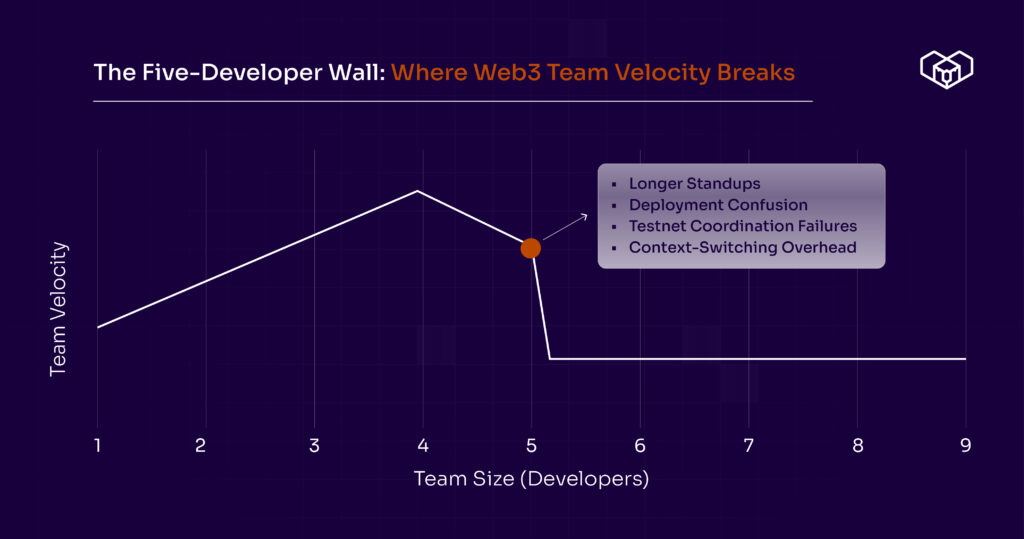
Why Web3 Startups Hit a Scaling Wall at Five Developers
Something strange happens around the five-developer mark in most companies. Communication overhead starts eating your week. Standups get longer. Context-switching increases. Deployment coordination becomes a full-time job.
Traditional developer workflows blockchain teams inherit from Web2 do not translate well. Smart contract deployments are irreversible. Testnet coordination requires timing. On-chain events need monitoring across multiple environments. In Web2, a bad deployment is rolled back in minutes. In Web3, a bad deployment is permanent. That irreversibility changes everything about how teams must coordinate before and after every contract push. A developer who deploys a contract update without notifying the frontend team creates integration failures that aren’t immediately obvious the contract is live, the frontend is calling old function signatures, and users are hitting silent errors. Testnet coordination has similar failure modes. Developer A is testing against a contract state that Developer B changed an hour ago. Without automated state-change notifications, Developer A burns hours debugging a problem that doesn’t exist on the current contract.
Most teams solve this by hiring a DevOps person. But that is expensive, and it does not fix the underlying problem.
What you actually need is automation that handles the coordination layer so developers can stay in flow. Understanding how on-chain event triggers work is the first step toward building this automation layer and with Kwala, it’s also where the heavy infrastructure work ends.
What Web3 Dev Automation Looks Like in Practice
Here is what that automation layer looks like when implemented across a lean Web3 team’s actual development workflow.
Deployment Notifications
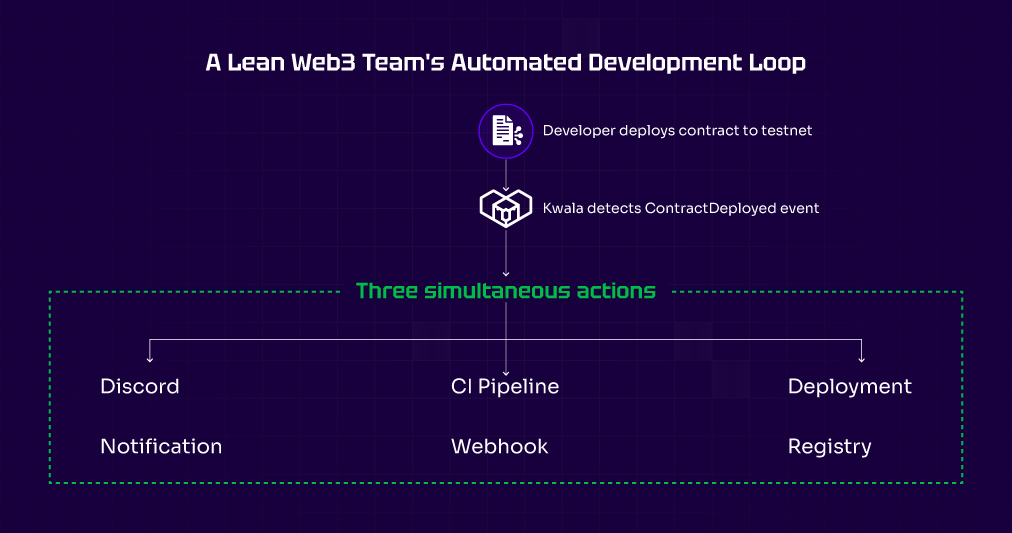
When a contract deploys to testnet, the team needs to know. In Kwala, a deployment notification workflow triggers on the Contract Deployed event emitted by your factory contract, or on any custom event you define in your deployment script. The workflow action posts a structured message to your Discord or Slack webhook including the contract address, deploying wallet, network, block number, and timestamp. Your team gets a notification that contains everything they need to start working with the new deployment, without asking anyone for details.
Set up an event trigger that detects deployment events and pushes alerts to your Discord or Slack channel. No more “hey, did you deploy?” messages. The system tells everyone automatically.
Environment Sync Alerts
Your frontend developer is testing against a contract that just changed. Configure workflows that notify relevant team members when contract state changes affect their work.
Everyone stays synchronized without constant check-ins.
Automated Testing Triggers
When specific on-chain events fire during testing, trigger your CI pipeline or alert your QA channel.
The same event trigger pattern that powers deployment notifications extends directly to testing swap the notification action for a CI webhook call, and your test suite becomes reactive to actual on-chain behavior.
Building a Dev Productivity Stack That Scales With Your Team
Here is what a dev productivity Web3 stack looks like when you build it right:
- Event monitoring is the foundation. Kwala watches your specified contracts continuously across environments, so your team stops relying on individual developers to announce their own changes the system announces them automatically.
- Deployment tracking goes beyond “contract deployed.” Kwala workflows capture the full deployment context address, network, deploying wallet, block and route that structured data to whoever needs it, whether that’s your Slack channel, your deployment dashboard, or your project management tool.
- Testing automation closes the loop between on-chain activity and your QA process. When a specific function is called or a specific event fires during a testnet session, Kwala triggers your CI pipeline or posts to your QA channel. Testing becomes reactive to actual on-chain behavior rather than scheduled runs.
- Cross-environment coordination is where teams typically fall apart. Staging, testnet, and mainnet each have separate contract addresses and deployment states. Kwala maintains separate workflows per environment with outputs routing to the same team channels — one team view across all three environments.
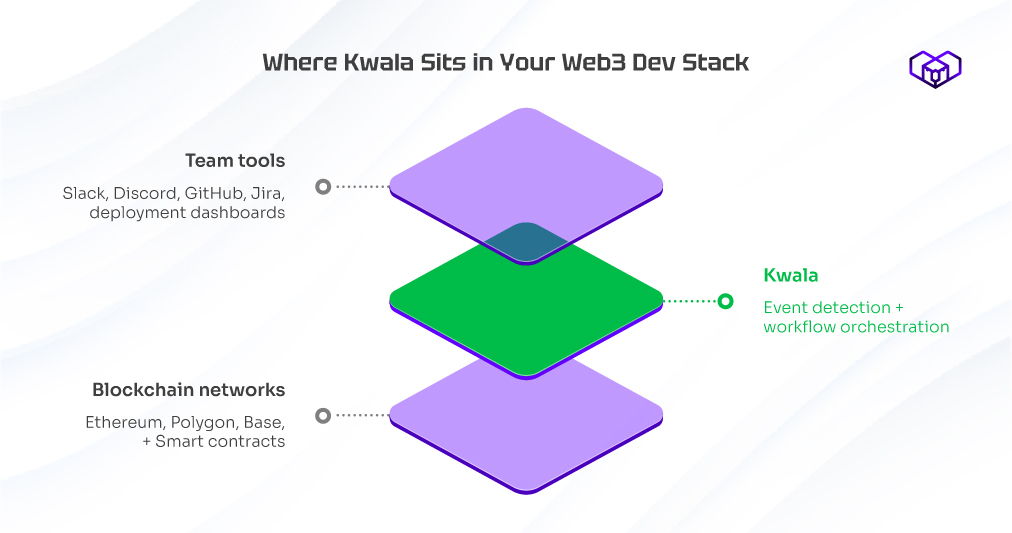
Kwala fits into this stack as the event-driven automation layer. You define triggers based on smart contract events. You configure actions that call your existing tools, whether that is Slack webhooks, Discord bots, or custom API endpoints.
The key insight is that automation for dev teams should not replace your existing tooling. It should connect everything together so information flows automatically instead of manually.
Blockchain CI/CD: Extending Your Pipeline Into On-Chain Activity
Traditional CI/CD Web3 pipelines stop at deployment, but blockchain development does not end when the contract hits the chain. You need visibility into what happens after deployment.
Event-driven workflows extend your pipeline into the on-chain world. When your contract emits a specific event, trigger a webhook that updates your deployment dashboard. When a testnet transaction fails, alert the developer who initiated it.
Here is where blockchain CI/CD gets interesting, as you can build feedback loops that were impossible before. Contract deployed successfully? Trigger your integration test suite. Specific function called? Notify the product team. A concrete example: your deployment script emits a ContractUpgraded event. Kwala detects the event and fires three sequential actions first, a POST request to your GitHub Actions webhook that triggers your integration test suite against the new contract address; second, a Slack notification to your product channel with the new contract address and upgrade summary; third, an update to your deployment registry API marking the new version as active. Three actions. One event. Zero manual coordination.
This is the kind of pipeline extension that previously required a custom indexer, a webhook server, and glue scripts to maintain. Kwala collapses that infrastructure into a single workflow configuration.
Kwala’s workflow configuration follows the same declarative structure across all pipeline stages define the contract event, define the downstream action, deploy. The CI/CD extension requires no additional infrastructure beyond what you already configured for notifications.
How Automation Lets a Five-Person Team Outship a Ten-Person Team
The math is simple. Every hour your developers spend on coordination is an hour they are not building.
Team automation tools give you leverage. A five-person team with solid automation can outship a ten-person team drowning in Slack threads and deployment coordination. The coordination tax is measurable. Research from LinearB’s 2024 Engineering Benchmarks report found that developers spend an average of 13.5 hours per week on non-coding activities meetings, status updates, context-switching, and manual coordination. Automation that eliminates even four of those hours per developer per week compounds significantly across a five-person team: twenty developer-hours recovered weekly, every week.
Here is what changes when you get this right:
- Deployment coordination happens automatically through event triggers
- Environment changes propagate to the right people without manual updates
- Testing workflows fire based on on-chain activity rather than scheduled checks
- Cross-functional visibility improves because information flows without asking
For teams building multi-chain workflows, Kwala’s per-chain workflow deployment keeps each network’s events isolated while routing outputs to unified team channels. Ethereum testnet deployments, Polygon mainnet events, and Base contract interactions all flow into the same Slack channel one team view, regardless of chain count.
Explore Web3 dev automation with Kwala and build scalable team workflows for your startup.
Why Not Just Use GitHub Actions or Tenderly?
It’s a fair question. GitHub Actions can trigger on deployment events. Tenderly sends alerts on contract activity. Discord webhooks are trivial to set up manually. So why add Kwala to the stack?
The answer is the gap between what those tools were designed to do and what blockchain development actually requires. GitHub Actions operates in your CI environment it doesn’t have native visibility into on-chain state. Tenderly is excellent for debugging and monitoring, but it’s not designed to orchestrate multi-step workflow actions across your team’s tooling. Custom webhooks work until they don’t they require maintenance, they go down, and they don’t scale across multiple chains without duplicating infrastructure.
Kwala operates at the on-chain event layer specifically. It monitors contract events continuously across networks, evaluates conditions against any data source you connect, and executes multi-step action chains all without your team running or maintaining the underlying infrastructure. The monitoring is decentralized. The execution is reliable. And the configuration takes hours, not a sprint.
Ready to Stop Losing Dev Hours to Coordination Overhead?
The teams shipping fastest in Web3 aren’t the biggest they’re the most automated. Kwala gives lean startup teams the event-driven workflow layer that keeps deployments visible, environments synchronized, and CI pipelines connected to on-chain activity. Start with one workflow. Add more as your team grows. Start building with Kwala
Frequently Asked Questions: Web3 Dev Automation for Startup Teams
Does this replace our existing CI/CD tools?
No. Kwala extends your existing pipeline by connecting on-chain events to your current tooling. Your build and test infrastructure stays the same, but now it responds to blockchain activity automatically.
How quickly can a small team set this up?
Most teams configure their first workflows within a day. Start with deployment notifications, then expand to testing triggers and cross-environment coordination as you learn what your team needs.
What if we work across multiple chains?
Each workflow monitors events from a single contract, but you can deploy separate workflows per chain. Outputs route to unified channels so your team gets a single view across all environments.