
 book a call with us
Most DeFi protocols operate across multiple blockchains by the time they reach maturity. Assets move between Ethereum and Arbitrum. Governance happens on one chain while execution occurs on another. Treasury operations span five networks simultaneously. The technical challenge isn’t moving assets between chains. Bridges exist for that. The problem is coordinating workflows across those chains without deploying separate monitoring infrastructure […]
Read MoreEvery Web3 developer reaches a point where the backend starts feeling heavier than the actual product. You’re juggling listeners, syncing data across chains, patching RPC issues, and trying to keep scripts alive during traffic spikes.
That’s when the realization dawns that you don’t need any more scattered tools; what you need is a Web3 infrastructure for developers that doesn’t fall apart under load.
Kwala steps in exactly here. It acts as one of the simplest Web3 developer tools backend, removing the usual server work and giving you a clean backend platform for NFT workflows and other on-chain automation.
This blog talks about the best practices developers can follow to build stronger, more reliable Web3 systems with far less effort, and how Kwala supports that.
What is Kwala?
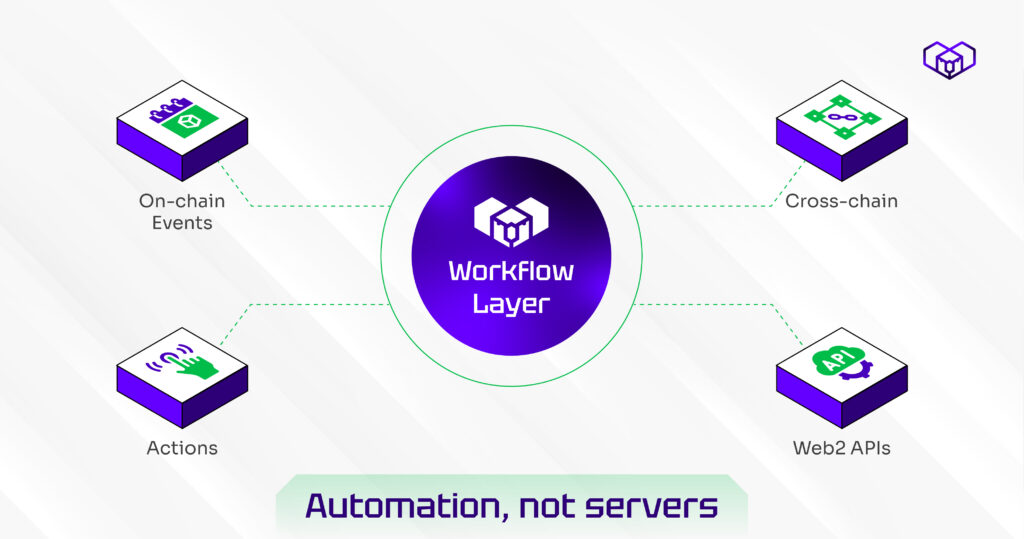
Kwala sits at the center of modern Web3 infrastructure for developers, giving teams a simpler way to automate blockchain logic without maintaining servers or complex integrations. It works as a Web3 developer tools backend that handles triggers, actions, cross-chain logic, and Web2 connections through one unified layer.
For NFT teams, it also doubles as a backend platform for NFT workflows, removing the usual engineering overhead.
Here’s what Kwala offers out of the box:
- Decentralized, credit-based system
- No vendor lock-in
- Pay-as-you-go model
- Supports Web2 API calls and popular blockchain networks
Kwala provides developers with a cleaner starting point and a significantly lighter backend to maintain. It keeps automation simple so you can focus on building, not patching infrastructure.
8 developer best practices with Kwala
Developers need a strong foundation to build scalable systems. Good Web3 practices keep your automation stable, your backend lighter, and your workflow predictable. Kwala helps you follow these patterns without carrying the burden yourself.
Below are 8 best practices you should follow, along with how Kwala implements them:
1. Choose stateless architecture for cleaner scaling
Stateless design removes hidden state, reduces drift, and avoids backend failures. It keeps logic portable across environments and makes scaling far easier for anyone building Web3 systems.
How Kwala applies it:
- Stateless automation fabric
- “Stateless logic, stateful execution” model
- Blockchain remains the single source of truth
2. Move from polling to event-driven automation
Polling wastes compute, introduces delays, and collapses under high traffic. Real-time triggers deliver accuracy and speed, which is critical for reliable Web3 infrastructure for developers.
How Kwala applies it:
Kwala listens directly to smart contract events across supported blockchains, automatically extracts the relevant event payloads, and relays them to downstream actions without manual parsing or custom listeners. Developers define what data matters, and Kwala handles the rest, consistently and deterministically.
- Native smart contract event listeners
- Wallet- and transaction-based triggers
- Webhook and price-based triggers
- Deterministic event payload extraction using re.event (index) for precise, repeatable execution
3. Minimize custom infrastructure to reduce failures
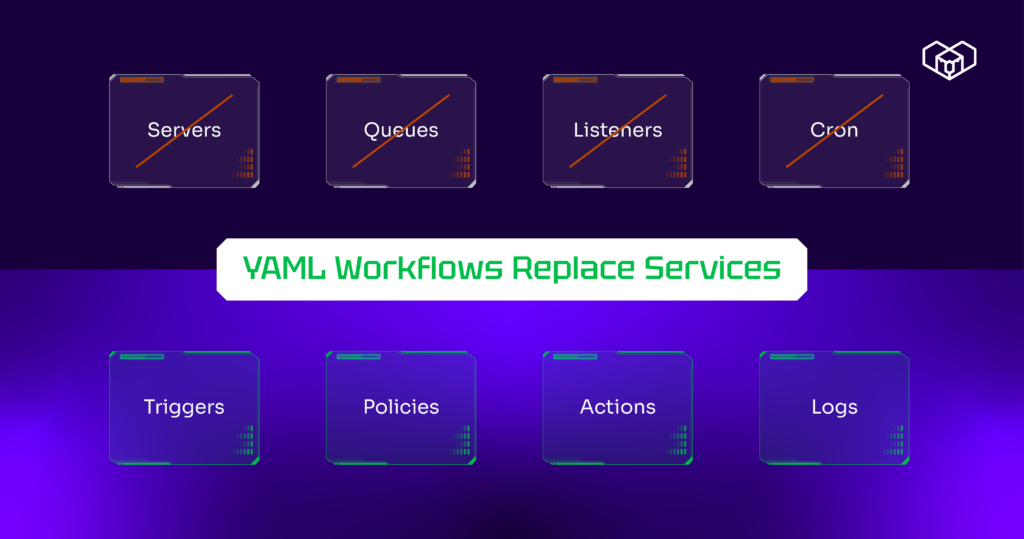
The more backend you maintain, the more things can break. Servers, queues, and RPC listeners add cost, security risk, and engineering drag. Simplifying this improves reliability.
How Kwala applies it:
- No servers or custom backend code
- No cloud dependencies for developers
- YAML workflows replace internal services
- Acts as a Web3 developer tools backend so you don’t maintain your own
4. Use one abstraction for all multi-chain logic
Every chain behaves differently. Repeating logic across networks leads to bugs, inconsistent behavior, and wasted development time. A unified layer keeps things maintainable.
How Kwala applies it:
- Listen on one chain, act on another
- Cross-chain orchestration (Ethereum, Polygon, Kalp)
- No custom bridges or RPC layers
- Simplifies multi-chain automation in your backend platform for NFT workflows
5. Use deterministic execution for predictable results
When workflows run differently across environments, debugging becomes impossible. Deterministic execution ensures the same output every time, regardless of load or machine.
How Kwala applies it:
- Deterministic workflow VM
- Consistent parsing + scheduling
- Built-in validation
- Identical behavior across decentralized runners
6. Treat web2 integration as core infrastructure
Most real-world actions still live off-chain: emails, CRMs, user systems, and databases. Ignoring Web2 limits what your dApp can do and holds back real utility.
How Kwala applies it:
- REST API support
- Webhook calls
- Cloud function triggers
- Database connections
7. Build with zero-trust principles for safer automation
Backend servers and bridges create unnecessary attack vectors. A zero-trust approach minimizes exposure and keeps workflows tamper-resistant.
How Kwala applies it:
- Sandboxed workflow execution
- Cryptographically signed actions
- Immutable history
- Optional trust-minimized multi-runner execution
8. Use predictable economics to scale sustainably
Web3 workloads spike without warning. Without clear cost controls, scaling becomes unpredictable and expensive. A stable model helps teams plan and grow confidently.
How Kwala applies it:
- Credit-based execution
- Pay only for triggers, actions, and API calls
- Predictable enterprise cost structure
- No server scaling fees
Why Kwala sets the standard for web3 infrastructure for developers
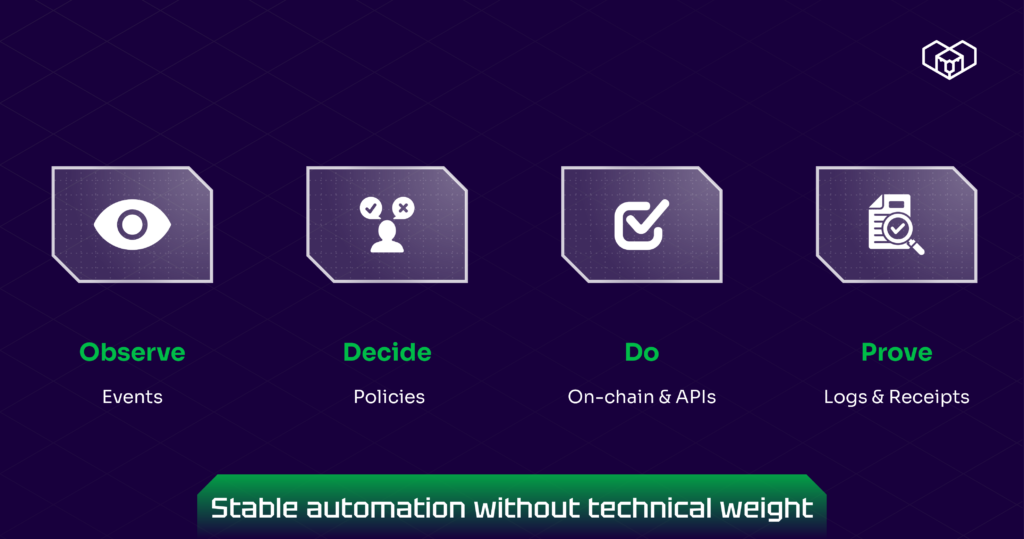
A strong Web3 stack doesn’t need layers of servers, scripts, and backend fixes. Kwala proves that developers can work faster when the foundation is simpler.
As Web3 infrastructure for developers, it keeps automation stable without adding technical weight. It behaves like a clean, reliable Web3 developer tools backend, so teams can build without worrying about infrastructure breaking underneath them.
Plus, for NFT projects, it serves as a flexible backend platform for NFT workflows, making it easier to ship features that stay consistent across chains.
Build and automate Web3 apps without the friction- start with Kwala today.
FAQs on web3 infrastructure for developers
What is web3 infrastructure?
It refers to the tools, nodes, networks, and automation layers that power decentralized apps. A Web3 infrastructure for developers also includes everything developers use behind the scenes, from smart contract triggers to workflow engines.
What do web3 developers do?
They build dApps, smart contracts, and backend automation that interact with blockchains. They work with wallets, nodes, APIs, and on-chain logic.
What is L1 vs L2 vs L3 blockchain?
L1 blockchains are base networks like Ethereum or Solana. L2s sit on top to increase speed and reduce cost, while L3s focus on app-specific scaling. A backend platform for NFT workflows can interact with all three layers depending on the workflow design.
What are the 4 types of blockchain?
The four main types are public, private, consortium, and hybrid blockchains. Each differs in access, governance, and use cases.