
 book a call with us
Ever had a user wait hours to get locked out because their NFT subscription wasn’t verified in time? In Web3, even a few-second delay can make a big difference. Hence, manual checks won’t keep up. Though there are existing tools that promise to help, most of them add layers of technical complexity. As a result, you end up juggling scripts, backend […]
Read MoreYour lending protocol executes liquidations through a custom Node.js script on a single AWS instance. The script polls the chain every 20 seconds, checks collateral ratios, and triggers liquidations when thresholds breach. This works until the instance crashes during a volatile market swing, and your protocol accumulates $200k in bad debt before anyone notices.
DeFi protocols face a scaling paradox. Growth demands more automation, but traditional automation introduces attack surfaces, single points of failure, and operational overhead that grows faster than the protocol itself.
Kwala provides a DeFi automation platform that inverts this model. Protocols define workflows once and deploy them to a decentralized execution layer that handles security, reliability, and scale automatically.
This piece walks through how DeFi protocols eliminate operational bottlenecks while maintaining security guarantees.
The security cost of custom automation infrastructure
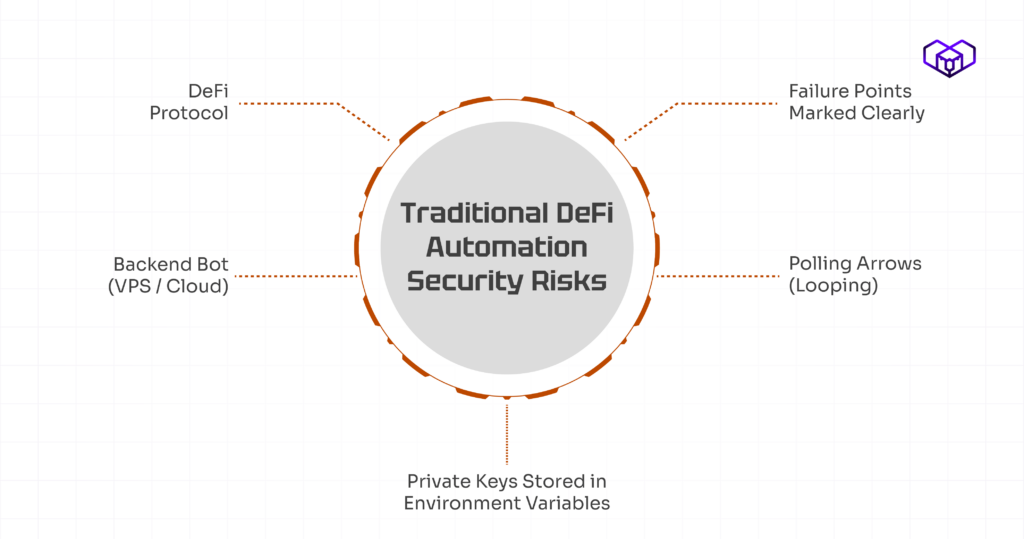
Most DeFi protocols automate DeFi protocols using custom backend scripts. A team writes a liquidation bot, deploys it to a VPS, and monitors collateral ratios continuously.
This introduces compounding security risks:
- Centralized control points: Private keys or execution credentials live in your stack. A compromised server or leaked variable can drain protocol funds.
- Silent failures: Scripts fail without alerts. During high-volatility periods when liquidations matter most, these failures create the exposure your automation was meant to prevent.
- Poor scaling: Ten workflows across five chains, each requiring monitoring and failover systems, becomes a full-time infrastructure job.
Learn how to automate blockchain alerts with ease.
How decentralized automation removes security friction
A DeFi automation platform built on decentralized infrastructure changes the security model fundamentally. Kwala operates as a blockchain automation service where workflows run on a decentralized execution layer.
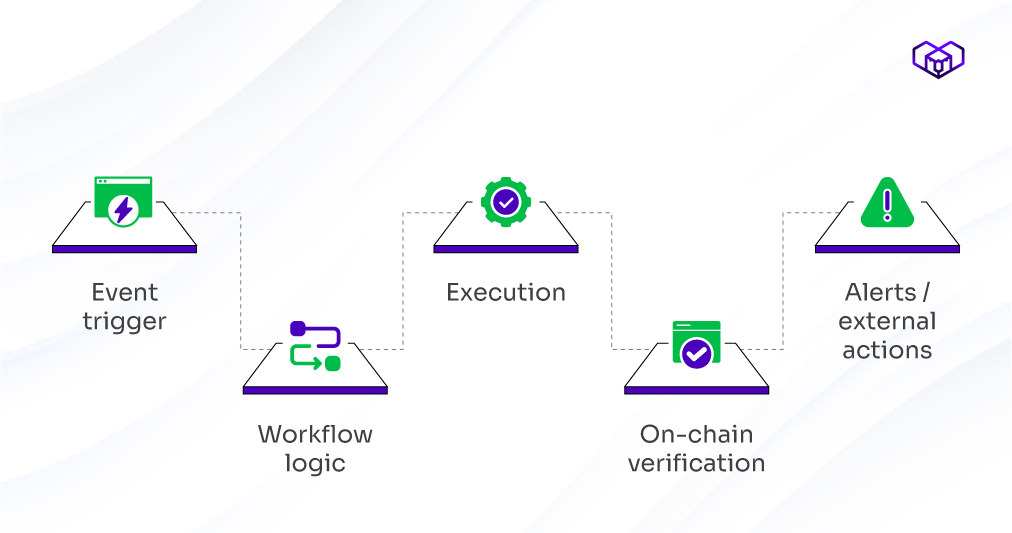
The architecture delivers three core advantages:
Automation patterns that demand both security and scale
Different DeFi workflows share the same requirement: instant execution without introducing new attack vectors.
Protocol liquidations require zero downtime tolerance. When collateral ratios breach thresholds, liquidations must execute immediately. A DeFi automation platform monitoring collateral events in real-time triggers liquidations through decentralized execution without exposing credentials.
Oracle-dependent strategies follow the same pattern:
- Rebalancing based on Chainlink price updates
- Executing conditional swaps when volatility spikes
- Adjusting lending rates based on utilization metrics
Cross-chain treasury operations compound the challenge. Protocols on Ethereum, Arbitrum, and Polygon need coordinated workflows moving funds across networks. Managing separate infrastructure for each chain multiplies burden and risk. Web3 automation for DeFi lets you define cross-chain workflows once.
Governance automation executes proposals when voting closes, alerts stakeholders at quorum thresholds, and coordinates multi-sig actions across chains.
Building automation without infrastructure overhead
Kwala removes operational burden while preserving security guarantees. You define event triggers and workflow logic in YAML, deploy to the decentralized execution layer, and the system handles monitoring to verification.
The workflow model supports secure DeFi workflows like monitoring liquidations across multiple markets, tracking oracle feeds to trigger rebalancing, coordinating treasury operations, and executing governance actions automatically.
Example: Your protocol monitors collateral ratios across Aave, Compound, and your native market. When positions approach liquidation threshold, the workflow calculates optimal size, executes the transaction, logs results on-chain, sends Discord alerts, and updates dashboards. All without managing servers.
The pay-as-you-go model aligns costs with usage. You pay execution credits only when workflows run, making automation economically viable at any scale.
Cross-chain support eliminates managing separate infrastructure per network. One workflow monitors Ethereum events and triggers Arbitrum actions without additional configuration, which is critical for scalable DeFi infrastructure operating across chains.
Learn how Kwala enables automated DeFi workflows requiring instant execution.
Automation as foundational infrastructure with Kwala
DeFi protocols relying on manual operations or fragile custom scripts face a scaling ceiling. The operational burden grows faster than the protocol, and security risks compound with each new workflow.
Kwala provides the DeFi automation platform that removes this ceiling. Protocols gain instant event detection, decentralized execution, and security guarantees without managing infrastructure.
The teams building next-generation DeFi understand that automation determines whether protocols can operate reliably at scale. Explore Kwala’s decentralized backend for DeFi automation.
FAQs
How does Kwala’s decentralized execution improve security compared to running liquidation bots?
Kwala eliminates exposing private keys to centralized servers. Workflows execute through a credit-based system on the decentralized network, removing custody risk that traditional bots introduce.
Can I automate workflows across multiple DeFi protocols simultaneously?
Yes. Kwala supports monitoring and executing across multiple protocols and chains within a single workflow. Track Aave liquidations, Chainlink updates, and DAO governance simultaneously.
What happens if a workflow fails during execution?
Failed executions are logged transparently on-chain with failure details. You can configure retry logic or alerts as part of your workflow definition.