
 book a call with us
You’ve just won a hackathon, your dApp works fine, the wallet connects, transactions go through, maybe there’s even a slick NFT minting flow. The demo is flawless too. Fast forward a few weeks: you’re up late, debugging why events are being missed at 3 AM, your RPC node has gone down again, and you’re drowning in server maintenance tickets instead of shipping features. Sound familiar? The gap between a production […]
Read MoreWeb3 applications may run on decentralized networks, but the backend often tells a different story. Behind many dApps, there are still servers watching the blockchain, scripts polling for events, and infrastructure that feels very much like Web2.
This gap shows up quickly as products scale. Developers want their apps to react the moment something happens on-chain, work seamlessly across multiple networks, and stay cost-efficient: all without spending weeks setting up and maintaining backend infrastructure.
That’s where backend models start to matter. Understanding the difference between traditional and decentralized backend models explains why platforms like Kwala are gaining traction among Web3 builders. Let’s dive in.
Five traditional backend models in Web3
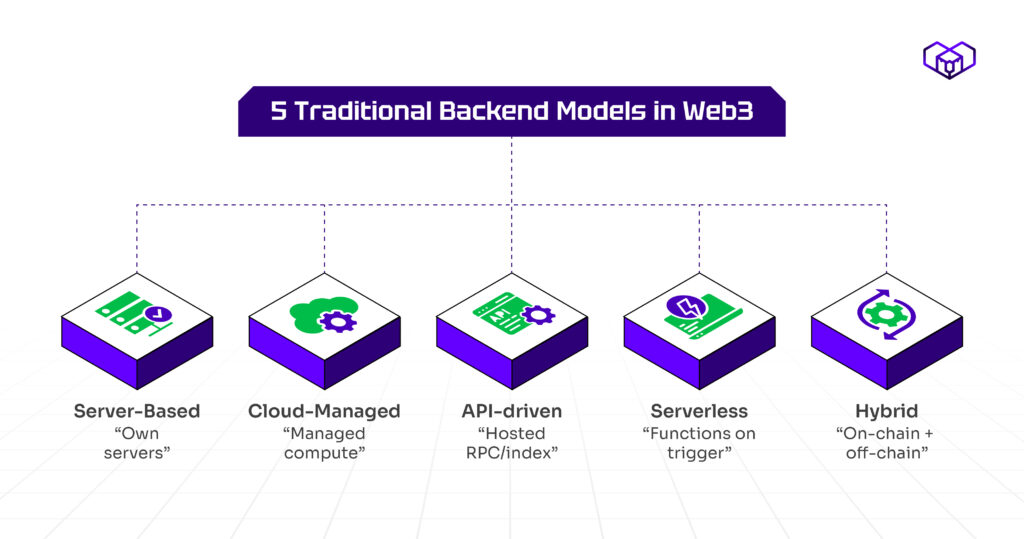
Traditional backend models are extensions of Web2 architecture, adapted to interact with blockchains. They remain widely used because they are familiar and flexible, but they introduce trade-offs in decentralization and reliability.
Traditional backend models form the foundation of many Web3 applications today. They enable event monitoring, automation, and integrations, but execute backend logic through centralized systems.
1. Centralized server-based backends
In this model, backend logic runs on dedicated servers controlled by a single team. These servers listen to blockchain events through RPC calls and execute logic when conditions are met.
Common platforms/tools:
- Custom Node.js or Python servers: Run event listeners, business logic, and background jobs.
- Hosted databases: Store off-chain state, user data, and processed event results.
- Private RPC endpoints: Provide direct access to blockchain data with controlled throughput.
2. Cloud-managed backends
Cloud-managed backends move server logic to managed cloud infrastructure, reducing operational overhead while keeping execution centralized.
Common platforms/tools:
- AWS: Used for compute instances, queues, and managed databases.
- Google Cloud: Supports event processing, scaling services, and data storage.
- Microsoft Azure: Offers cloud compute and integration services for backend logic.
3. Blockchain API–driven backends
These backends rely on third-party providers to supply blockchain data instead of running custom listeners or nodes.
Common platforms/tools:
- RPC providers: Expose blockchain nodes through hosted endpoints.
- Indexing services: Pre-process and structure blockchain data for faster queries.
- Webhook-based blockchain APIs: Push event notifications to backend systems.
4. Serverless function backends
Serverless backends execute small functions in response to triggers, making them suitable for lightweight automation.
Common platforms/tools:
- AWS Lambda: Runs short-lived functions triggered by webhooks or schedules.
- Google Cloud Functions: Handles event-based logic without persistent servers.
- Azure Functions: Executes backend tasks on demand within Azure’s ecosystem.
5. Hybrid Web2-Web3 backends
This model combines on-chain smart contracts with off-chain backend systems to support real-time user experiences.
Where this model is common:
- NFT platforms: Manage minting flows, metadata updates, and notifications.
- Marketplaces: Track listings, bids, and sales off-chain.
- DeFi dashboards: Aggregate protocol data for analytics and monitoring.
- DAO tooling: Handle governance notifications and proposal tracking.
Core limitation of traditional models:
All these approaches centralize execution and monitoring. Even when smart contracts are decentralized, backend logic depends on infrastructure controlled by a single provider or team: creating points of failure, scaling challenges, and trust assumptions.
Three Decentralized backend models
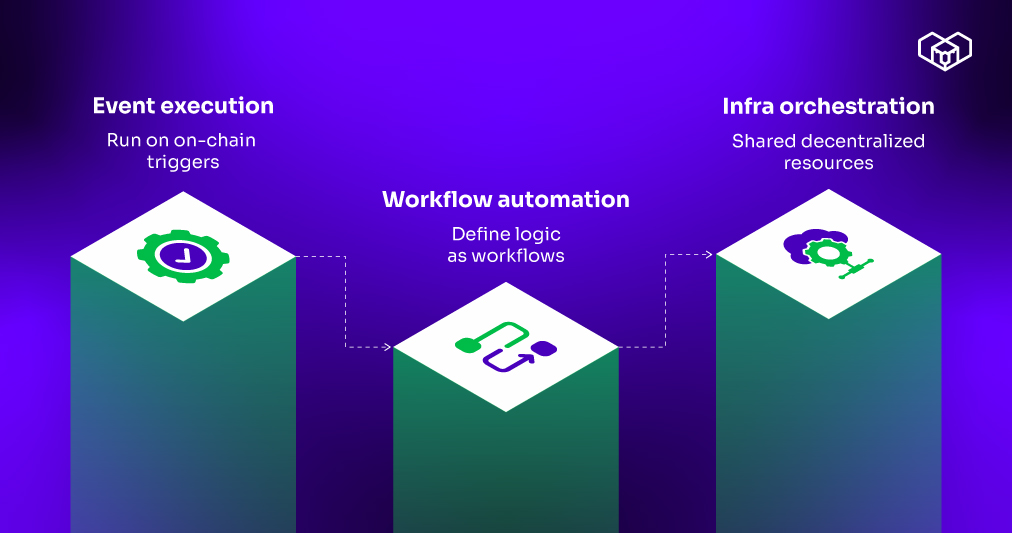
Decentralized backend models rethink where and how backend logic runs. Instead of executing automation on private servers, logic is executed by distributed networks that monitor blockchain activity natively.
1. Event-driven decentralized execution networks
These networks execute backend logic only when specific on-chain events occur. Rather than running continuously on a single server, execution is claimed and performed by nodes in a distributed network.
What they focus on:
- Native on-chain event monitoring
- Deterministic, verifiable execution
- Preventing duplicate or conflicting runs
This model suits use cases where accuracy and reliability of execution matter more than persistent infrastructure.
2. Decentralized workflow automation platforms
Workflow automation platforms allow developers to define backend logic as workflows instead of writing custom services. These workflows react to blockchain events and coordinate actions across chains or systems.
What they abstract:
- Event streaming across multiple blockchains
- Execution coordination between actions
- Cross-chain and off-chain orchestration
By abstracting backend complexity, this model helps teams move faster without maintaining listeners, queues, or schedulers.
3. Decentralized infrastructure orchestration layers
These platforms function as shared backend infrastructure for Web3. They expose a decentralized resource pool that developers can program, enabling multiple applications to build automation on top of the same execution network.
Rather than offering a single use-case tool, orchestration layers support broader backend patterns – monitoring, execution, and integration – without central ownership of infrastructure.
Platforms offering decentralized backend approaches
Different platforms implement decentralized backend models at different layers of the stack:
- Kwala: A decentralized backend platform built around real-time on-chain monitoring and workflow execution across chains.
- Chainlink: Focuses on oracle-driven automation and decentralized triggers tied to smart contracts.
- Gelato: Specializes in task automation and execution for smart contract operations.
Each platform addresses backend automation from a different angle, varying in how they handle execution, monitoring depth, and developer experience.
Where Kwala fits in, and why it stands apart
Kwala combines multiple decentralized backend concepts into a single platform focused on monitoring-first backend execution.
Unlike traditional models that poll APIs or rely on centralized listeners, Kwala continuously monitors blockchain activity across supported chains. When an event matches defined conditions, the network claims and executes the workflow – ensuring reliable, single-run execution.
How Kwala differs from both models
Rather than fitting into existing backend categories, Kwala takes a fundamentally different approach to how backend logic runs in Web3.
Compared to traditional backends:
- No servers, queues, or cron jobs to manage
- No dependency on centralized RPC listeners
- Backend logic responds to events in real time
Compared to other decentralized approaches:
- Workflows are defined declaratively, not embedded in contracts
- Execution coordination prevents duplicate or conflicting runs
- Cross-chain actions can be handled within a single workflow
Kwala also functions as a backend logic engine blockchain, where workflows act as the backend itself rather than a layer bolted onto existing infrastructure. This makes it especially suited as a backend platform for NFT workflows, DeFi automation, DAO notifications, and multi-chain orchestration.
Why Kwala is better for modern Web3 backends
Kwala’s advantage is not in replacing smart contracts or competing with infrastructure providers, but in removing the need to rebuild backend plumbing altogether.
By decentralizing:
- Monitoring (listening to on-chain events)
- Execution (running logic when conditions are met)
- Coordination (ensuring workflows execute once and correctly)
Kwala aligns backend behavior with how blockchains actually operate.
For teams comparing backend models, the shift is clear: instead of maintaining centralized systems to react to decentralized data, Kwala lets backend logic live closer to the chain – without sacrificing flexibility or developer control.
FAQs on decentralized backend platform
1. Can decentralized backend platforms work alongside existing Web2 infrastructure?
Yes, decentralized backend platforms can complement existing Web2 systems by triggering APIs, notifications, or data pipelines when on-chain events occur. This allows teams to decentralize execution without rewriting their entire stack at once.
2. How do decentralized backends handle reliability when multiple nodes are involved?
Most decentralized backend platforms use execution-claim or coordination mechanisms to ensure a workflow runs only once per event. This prevents duplicate actions while maintaining fault tolerance if individual nodes go offline.
3. Is a decentralized backend suitable for production-scale applications, or only early-stage projects?
Decentralized backends are increasingly designed for production workloads. By distributing monitoring and execution across nodes, they can handle high event volume while reducing single points of failure that often affect centralized backends.